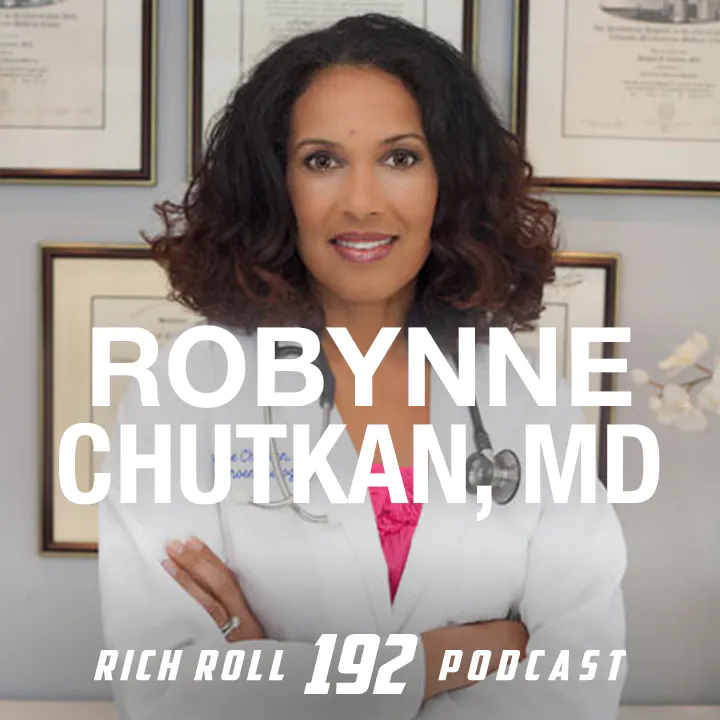
Live Dirty, Eat Clean: Robynne Chutkan, MD on Everything Microbiome
Our bodies are comprised of about ten trillion cells. But our microbiome — all the bacteria, viruses, and fungi that live in or on our bodies – outnumber human cells by a factor of 10. Therefore, it can be said that we are far more microorganism than human.
We choose to believe that we are sentient beings, responsible for our health, moods and decisions. But the crazy truth is that to a large extent, our emotional state, propensity for disease and even our specific food cravings can all be traced back to the nature of our gut ecology.
Most of these microorganisms are symbiotic. Maintaining a healthy culture of the right microorganisms is fundamental to good health. But should the quality of your microbiome go awry, health havoc ensues.
This week on the show we delve deep into the nuts and bolts of this fascinating and quickly evolving field of medicine with respected gastroenterologist, microbiome expert and avid marathoner Robynne Chutkan, MD ( @DrChutkan ).
A graduate of Yale, Dr. Chutkan received her medical degree from Columbia College of Physicians and Surgeons in New York, where she also did her internship and residency and served as Chief Resident. She completed her fellowship in gastroenterology at Mount Sinai Hospital in New York and has been on the faculty at Georgetown University Hospital since 1997.
In 2004, Dr, Chutkan founded the Digestive Center for Women, an integrative gastroenterology practice that incorporates nutritional optimization, exercise physiology, biofeedback, and stress reduction as part of the therapeutic approach to digestive disorders.
Lecturing throughout the United States and Europe, Dr. Chutkan has authored dozens of journal articles; serves as medical consultant and on air talent for the Discover Health Channel; is a member of the medical advisory board for the Dr. Oz Show (where she has appeared as a regular guest); and has also made national appearances on The Today Show, The Morning Show, and The Doctors.
Consistently named one of the area's best doctors by Washingtonian magazine, Dr. Chutkan is also the author of two bestselling books, Gutbliss* and most recently, The Microbiome Solution*.
Specific topics covered today include:
* what is the microbiome?
* The regulatory functions of the microbiome
* the perils of over-sanitization
* why you should avoid a c-section birth
* the problem with prophylactic antibiotic prescription
* the hygiene hypothesis & modern plagues
* the affluence effect & overmedication
* the nexus between antibiotics & autoimmune disorders
* behavior/cravings influenced by the microbiome
* eating disorder impact on microbial makeup
* why you should rethink the flu shot
* rewilding your microbiome
* the efficacy of probiotics & fermented foods
* products and environments that disrupt our body’s ecosystems
* fecal bacteriotherapy
Enjoy!
Rich
Learn more about your ad choices. Visit podcastchoices.com/adchoices
Available Results
Generated results are saved to your library for reuse and search.
Choose Template
Pick the result you want. You can review provider and model before generating.
A concise first-pass summary for understanding the episode quickly.
A comprehensive, source-grounded extraction of the reusable knowledge in an episode.
A comprehensive extraction focused on health practices, protocols, claims, and safety caveats.
A dedicated analysis of warnings, limitations, trade-offs, weak evidence, and uncertainty.
Repeatable methods, frameworks, mental models, processes, and systems.
Technologies, AI models, technical methods, capabilities, limitations, and adoption implications.
A concise first-pass summary for understanding the episode quickly.
A detailed readable summary organized by chapter or topic.
A navigable map of subjects, topic flow, and suggested chapters.
A comprehensive, source-grounded extraction of the reusable knowledge in an episode.
Reusable atomic knowledge units extracted from the episode.
A comprehensive extraction focused on health practices, protocols, claims, and safety caveats.
A comprehensive extraction focused on opportunities, strategy, markets, and company building.
Explicit actions, next steps, habits, recommendations, and things to avoid.
A dedicated inventory of concrete resources named in the episode.
A dedicated analysis of warnings, limitations, trade-offs, weak evidence, and uncertainty.
A concise first-pass summary for understanding the episode quickly.
A detailed readable summary organized by chapter or topic.
A navigable map of subjects, topic flow, and suggested chapters.
A comprehensive, source-grounded extraction of the reusable knowledge in an episode.
Reusable atomic knowledge units extracted from the episode.
A comprehensive extraction focused on health practices, protocols, claims, and safety caveats.
A comprehensive extraction focused on opportunities, strategy, markets, and company building.
Scientific findings, mechanisms, studies, hypotheses, and the limits of the evidence discussed.
Technologies, AI models, technical methods, capabilities, limitations, and adoption implications.
Investment theses, assets, catalysts, valuation reasoning, time horizons, and risks.
Chronologies, actors, causes, consequences, turning points, and competing historical interpretations.
Policies, proposals, stakeholders, arguments, implementation constraints, and predicted effects.
Career paths, skills, hiring signals, workplace decisions, transitions, and limitations of the advice.
Behavioral mechanisms, biases, motivation, habits, emotions, interventions, and evidence limitations.
Economic mechanisms, incentives, indicators, market structure, forecasts, and uncertainty.
Leadership principles, team systems, organizational design, culture, feedback, and failure modes.
Audience, positioning, messaging, acquisition, retention, experiments, metrics, and failed approaches.
Teaching methods, learning strategies, practice, feedback, assessment, and effectiveness evidence.
Theses, premises, arguments, objections, values, thought experiments, and unresolved questions.
Communication patterns, conflict, boundaries, expectations, repair methods, and contextual limitations.
Books, papers, authors, courses, and other learning resources mentioned in the episode.
Repeatable methods, frameworks, mental models, processes, and systems.
Explicit actions, next steps, habits, recommendations, and things to avoid.
Memorable statements and important claims with attribution and source context.
A dedicated inventory of concrete resources named in the episode.
A dedicated analysis of warnings, limitations, trade-offs, weak evidence, and uncertainty.