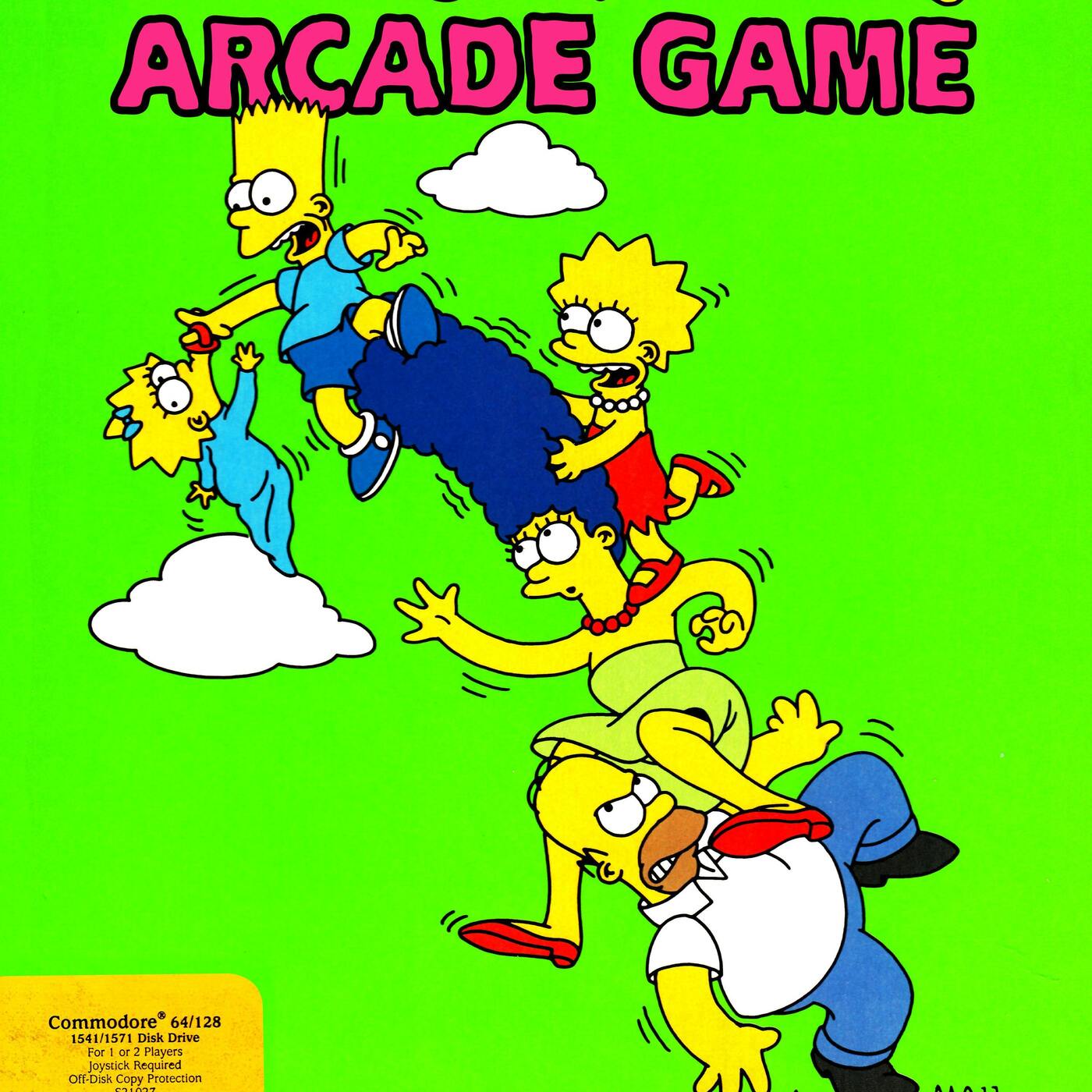
Remember The Game? #123 - The Simpsons Arcade Game
A lot of people would argue that The Simpsons should have stopped churning out episodes years ago, because the quality isn't what it used to be. I can't believe that you can say the same thing about their video games, but maybe you can. The Simpsons Arcade Game was the first video game made for the franchise. It's a pretty primitive beat 'em up, and while it may not be as complex or ambitious as some of their future games, I think most Simpsons fans would agree that it's still more fun. And seeing as it came out in 1991, around the same time 'Simpson-Mania' took off, it's understandable that so many old-school fans of the series have fond memories of playing it. Fellow Simpson nerd and frequent guest Chris Heber is back on the show this week, and we went over our memories of pumping quarter after quarter (or Chuck-E-Cheese token after Chuck-E-Cheese token) into this game back in the day, and while it's still so well regarded almost 30 years later. And before we talk about Marge's vacuum swinging antics, it's the fabled 'Remember The Game?' intro! I talk about gaming franchises I'd like to see squished together, whether or not people should sell their PS4s and Xbox Ones, and more! We also have another ripping edition of 'Play One, Remake One, Erase One'. This week it's the 'Beat 'em Up' edition, starring Double Dragon, Spider-Man & Venom: Maximum Carnage, and Streets of Rage 2. Enjoy the podcast!
Learn more about your ad choices. Visit megaphone.fm/adchoices
See Privacy Policy at https://art19.com/privacy and California Privacy Notice at https://art19.com/privacy#do-not-sell-my-info.
Available Results
Generated results are saved to your library for reuse and search.
Choose Template
Pick the result you want. You can review provider and model before generating.
A concise first-pass summary for understanding the episode quickly.
A comprehensive, source-grounded extraction of the reusable knowledge in an episode.
Policies, proposals, stakeholders, arguments, implementation constraints, and predicted effects.
A dedicated analysis of warnings, limitations, trade-offs, weak evidence, and uncertainty.
Memorable statements and important claims with attribution and source context.
Teaching methods, learning strategies, practice, feedback, assessment, and effectiveness evidence.
A concise first-pass summary for understanding the episode quickly.
A detailed readable summary organized by chapter or topic.
A navigable map of subjects, topic flow, and suggested chapters.
A comprehensive, source-grounded extraction of the reusable knowledge in an episode.
Reusable atomic knowledge units extracted from the episode.
A comprehensive extraction focused on health practices, protocols, claims, and safety caveats.
A comprehensive extraction focused on opportunities, strategy, markets, and company building.
Explicit actions, next steps, habits, recommendations, and things to avoid.
A dedicated inventory of concrete resources named in the episode.
A dedicated analysis of warnings, limitations, trade-offs, weak evidence, and uncertainty.
A concise first-pass summary for understanding the episode quickly.
A detailed readable summary organized by chapter or topic.
A navigable map of subjects, topic flow, and suggested chapters.
A comprehensive, source-grounded extraction of the reusable knowledge in an episode.
Reusable atomic knowledge units extracted from the episode.
A comprehensive extraction focused on health practices, protocols, claims, and safety caveats.
A comprehensive extraction focused on opportunities, strategy, markets, and company building.
Scientific findings, mechanisms, studies, hypotheses, and the limits of the evidence discussed.
Technologies, AI models, technical methods, capabilities, limitations, and adoption implications.
Investment theses, assets, catalysts, valuation reasoning, time horizons, and risks.
Chronologies, actors, causes, consequences, turning points, and competing historical interpretations.
Policies, proposals, stakeholders, arguments, implementation constraints, and predicted effects.
Career paths, skills, hiring signals, workplace decisions, transitions, and limitations of the advice.
Behavioral mechanisms, biases, motivation, habits, emotions, interventions, and evidence limitations.
Economic mechanisms, incentives, indicators, market structure, forecasts, and uncertainty.
Leadership principles, team systems, organizational design, culture, feedback, and failure modes.
Audience, positioning, messaging, acquisition, retention, experiments, metrics, and failed approaches.
Teaching methods, learning strategies, practice, feedback, assessment, and effectiveness evidence.
Theses, premises, arguments, objections, values, thought experiments, and unresolved questions.
Communication patterns, conflict, boundaries, expectations, repair methods, and contextual limitations.
Books, papers, authors, courses, and other learning resources mentioned in the episode.
Repeatable methods, frameworks, mental models, processes, and systems.
Explicit actions, next steps, habits, recommendations, and things to avoid.
Memorable statements and important claims with attribution and source context.
A dedicated inventory of concrete resources named in the episode.
A dedicated analysis of warnings, limitations, trade-offs, weak evidence, and uncertainty.