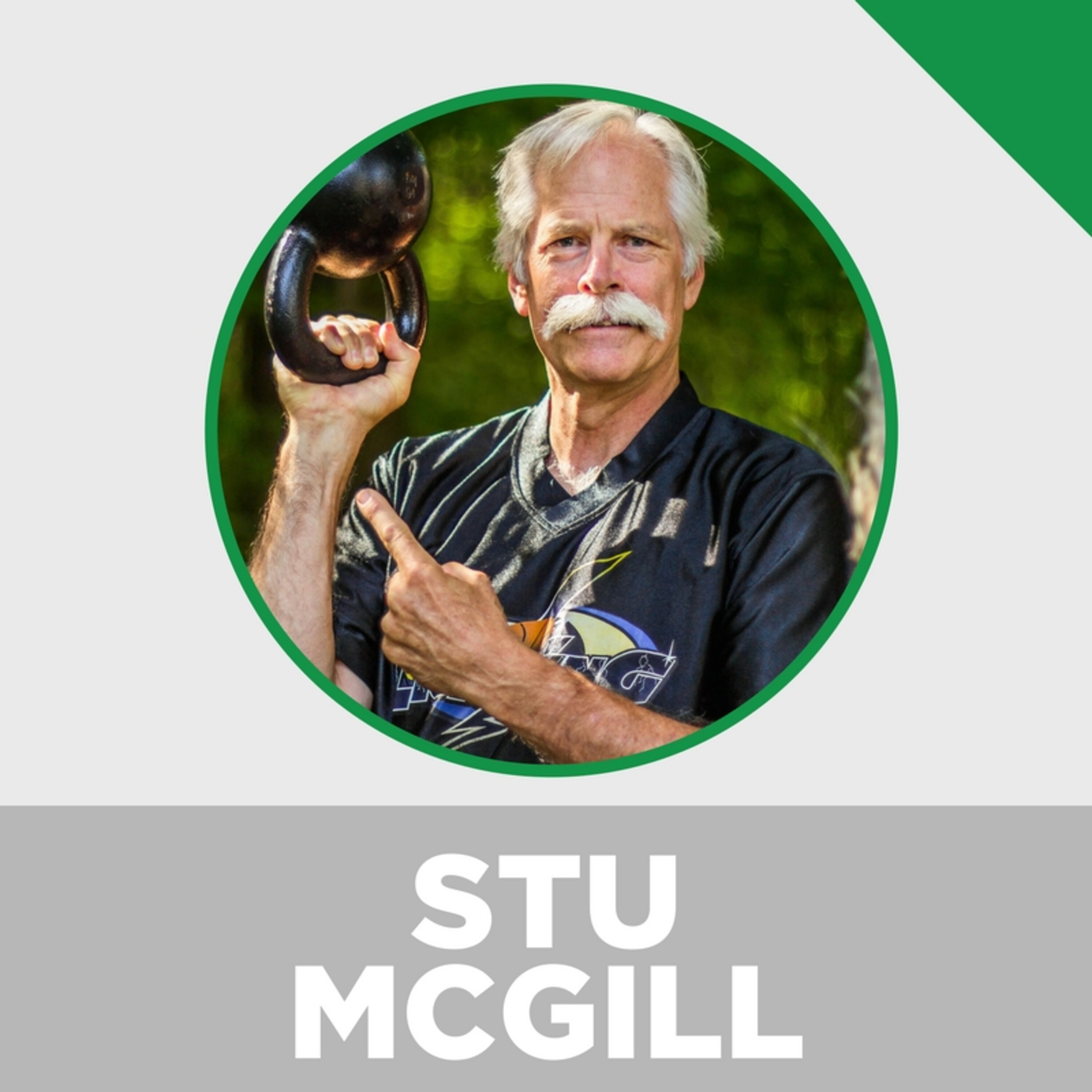
How To Get Extreme "Okinawan" Strength, 3 Ways To Fix Low Back Pain & The Best Core Exercises With Stu McGill
https://bengreenfieldfitness.com/mcgill
Are crunches really all that bad? How can you get the torso strength of a steel bar? How can you keep your glutes "turned on"? Is there a way to fix your back without seeing a chiropractic doc over and over again?
These questions and many more are things I constantly think about when it comes to the health of the low back, so I decided to get one of the world's leading low back experts on the podcast to clear up the confusion and clutter about your back and spine. Stuart McGill has been a Professor of Spine Biomechanics at the University of Waterloo for over 32 years, authored of over 240 scientific journal papers and has mentored over 40 graduate students during this scientific journey. As a consultant, he has provided expertise on low back injury to various government agencies, many corporations and legal firms and professional/international athletes and teams worldwide. He is regularly referred special patient cases from the international medical community for opinion.
During our discussion, you'll discover:
-How Stu quantifies whether or not something actually works to strengthen your low back or fix your back pain...[8:30]
-The three major elements that influence spine stability...[14:00]
-The Stuart McGill "big three" exercises for low back pain...[24:20]
-What Stu thinks about credit card analogy out there that you can't "bend" the spine a whole bunch of times without causing damage...[31:10]
-How you can develop extreme "Okinawan" strength...[40:05]
-How Stu treats and fixes low back pain related to sex...[45:45]
-How to make your core stability a "subconscious motion"...[58:25]
-Whether it is true that an SI joint can "lock up" and if so, how that can be fixed...[62:30]
-Stu's opinion on inversion tables or yoga trapezes for self traction and low back pain...[68:30]
-And much more!
Resources from this episode: -Stu McGill's books on Amazon -Stu's new book "The Gift Of Injury" -The Stu McGill big three exercises -The Stir The Pot exercise -My interview about Core Foundation exercises -Hard style plank
Show Sponsors:
-Daily Burn - Visit DailyBurn.com/Ben today to start your FREE sixty-day trial!
-GAINSWave - Go to GAINSWave.com/Ben and find a provider near you. Don’t forget to mention you heard about GAINSWave through Ben Greenfield and you can save 30% off your FIRST treatment.
-Blue Apron - Blue Apron is treating listeners to $30 off your first order. Go to blueapron.com/ben
-Kion Lean - Go to GetKion.com and use code BEN10 for 10% off your purchase of Kion Lean - the best supplement for longevity and fat loss!
Do you have questions, thoughts or feedback for Stu or me? Leave your comments below and one of us will reply!
See omnystudio.com/listener for privacy information.
Available Results
Generated results are saved to your library for reuse and search.
Choose Template
Pick the result you want. You can review provider and model before generating.
A concise first-pass summary for understanding the episode quickly.
A comprehensive, source-grounded extraction of the reusable knowledge in an episode.
A comprehensive extraction focused on health practices, protocols, claims, and safety caveats.
A dedicated analysis of warnings, limitations, trade-offs, weak evidence, and uncertainty.
Repeatable methods, frameworks, mental models, processes, and systems.
Technologies, AI models, technical methods, capabilities, limitations, and adoption implications.
A concise first-pass summary for understanding the episode quickly.
A detailed readable summary organized by chapter or topic.
A navigable map of subjects, topic flow, and suggested chapters.
A comprehensive, source-grounded extraction of the reusable knowledge in an episode.
Reusable atomic knowledge units extracted from the episode.
A comprehensive extraction focused on health practices, protocols, claims, and safety caveats.
A comprehensive extraction focused on opportunities, strategy, markets, and company building.
Explicit actions, next steps, habits, recommendations, and things to avoid.
A dedicated inventory of concrete resources named in the episode.
A dedicated analysis of warnings, limitations, trade-offs, weak evidence, and uncertainty.
A concise first-pass summary for understanding the episode quickly.
A detailed readable summary organized by chapter or topic.
A navigable map of subjects, topic flow, and suggested chapters.
A comprehensive, source-grounded extraction of the reusable knowledge in an episode.
Reusable atomic knowledge units extracted from the episode.
A comprehensive extraction focused on health practices, protocols, claims, and safety caveats.
A comprehensive extraction focused on opportunities, strategy, markets, and company building.
Scientific findings, mechanisms, studies, hypotheses, and the limits of the evidence discussed.
Technologies, AI models, technical methods, capabilities, limitations, and adoption implications.
Investment theses, assets, catalysts, valuation reasoning, time horizons, and risks.
Chronologies, actors, causes, consequences, turning points, and competing historical interpretations.
Policies, proposals, stakeholders, arguments, implementation constraints, and predicted effects.
Career paths, skills, hiring signals, workplace decisions, transitions, and limitations of the advice.
Behavioral mechanisms, biases, motivation, habits, emotions, interventions, and evidence limitations.
Economic mechanisms, incentives, indicators, market structure, forecasts, and uncertainty.
Leadership principles, team systems, organizational design, culture, feedback, and failure modes.
Audience, positioning, messaging, acquisition, retention, experiments, metrics, and failed approaches.
Teaching methods, learning strategies, practice, feedback, assessment, and effectiveness evidence.
Theses, premises, arguments, objections, values, thought experiments, and unresolved questions.
Communication patterns, conflict, boundaries, expectations, repair methods, and contextual limitations.
Books, papers, authors, courses, and other learning resources mentioned in the episode.
Repeatable methods, frameworks, mental models, processes, and systems.
Explicit actions, next steps, habits, recommendations, and things to avoid.
Memorable statements and important claims with attribution and source context.
A dedicated inventory of concrete resources named in the episode.
A dedicated analysis of warnings, limitations, trade-offs, weak evidence, and uncertainty.