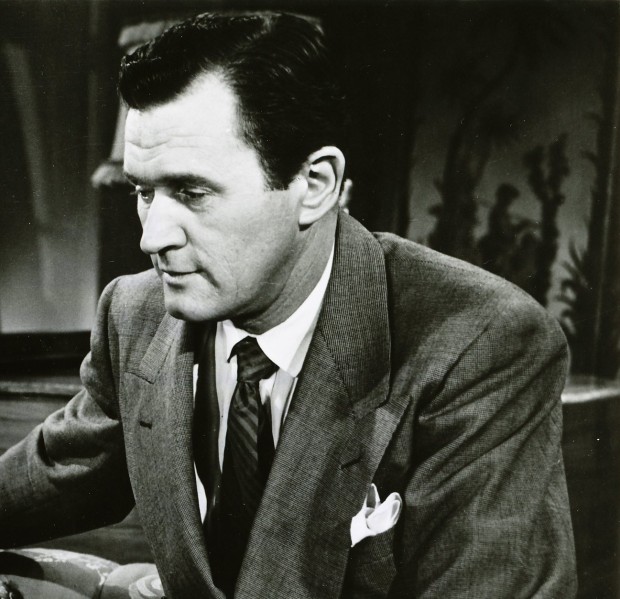
Happy Birthday, Wally Maher
There are several old time radio actors who can best be described, in my opinion, as "the glue." Rarely featured in the lead, they're versatile, talented performers who can make a character come to life in only a few lines, and their dynamic presence holds many a show together all these years later. The actor who springs to mind first whenever I think of this class of performer is Wally Maher. Born August 4, 1908, Maher was one of those actors who, when compiling a list of their credits, it may be easier to list the shows on which he didn't appear. Maher's many credits include turns on Suspense, Sam Spade, Richard Diamond, The Lux Radio Theatre, Johnny Dollar, Nero Wolfe...the list goes on and on. He'd no doubt have had an equally impressive run in television through the 1950s and 1960s were it not for a tragic and premature end to his career.
After coming to Hollywood in the 1930s, Maher found his talents as a mimic made him a natural for radio. He practically became a piece of the furniture on The Lux Radio Theatre and he could be heard in supporting performances on many of the dramatic anthology shows. His workload increased during the war years; Maher was kept out of the service by chronic lung problems, but he didn't let his ailment slow him down on radio. In 1946, he was cast as Brett Halliday's private eye Michael Shayne in a popular radio detective series. Though the character would later be played with ultra-hard boiled intensity by Jeff Chandler, Maher's Michael Shayne was less two-fisted and more quick-witted. Beginning in 1948, he co-starred with Bob Bailey in Let George Do It. Maher played Lt. Riley, the token police department buddy of Bailey's titular private eye, but as voiced by Maher Lt. Riley wasn't the cliched thick-headed cop. He had a colorful presence and a wonderful rapport with Bailey and fellow co-star Frances Robinson. And during all of this time, Maher was still appearing regularly on The Whistler, Suspense, and more.
In 1950, he found another gig as a radio cop when he played Sgt. Matt Grebb in The Line-Up. Maher oversaw the titular line-up of criminals that opened each episode, and he was the easy-going family man partner of Bill Johnstone's stoic Lt. Ben Guthrie. Their camaraderie and chemistry helps to make the program one of the best the era had to offer. And that fall, Maher was the first of six actors to co-star as Archie Goodwin with Oscar nominee Sydney Greenstreet in his single season run as Rex Stout's Nero Wolfe.
Unfortunately, the lung ailment that dogged him his entire life caught up with him in December 1951. He'd had one lung removed the year before and he worked almost until the day he died - December 27, 1951 at age 43. It's a terrible tragedy that we were robbed of what should have been a much longer career for Wally Maher, but we're lucky to have so many of his wonderful performances preserved from his busy years in front of the microphone.
Available Results
Generated results are saved to your library for reuse and search.
Choose Template
Pick the result you want. You can review provider and model before generating.
A concise first-pass summary for understanding the episode quickly.
A comprehensive, source-grounded extraction of the reusable knowledge in an episode.
Scientific findings, mechanisms, studies, hypotheses, and the limits of the evidence discussed.
A dedicated analysis of warnings, limitations, trade-offs, weak evidence, and uncertainty.
Memorable statements and important claims with attribution and source context.
Technologies, AI models, technical methods, capabilities, limitations, and adoption implications.
A concise first-pass summary for understanding the episode quickly.
A detailed readable summary organized by chapter or topic.
A navigable map of subjects, topic flow, and suggested chapters.
A comprehensive, source-grounded extraction of the reusable knowledge in an episode.
Reusable atomic knowledge units extracted from the episode.
A comprehensive extraction focused on health practices, protocols, claims, and safety caveats.
A comprehensive extraction focused on opportunities, strategy, markets, and company building.
Explicit actions, next steps, habits, recommendations, and things to avoid.
A dedicated inventory of concrete resources named in the episode.
A dedicated analysis of warnings, limitations, trade-offs, weak evidence, and uncertainty.
A concise first-pass summary for understanding the episode quickly.
A detailed readable summary organized by chapter or topic.
A navigable map of subjects, topic flow, and suggested chapters.
A comprehensive, source-grounded extraction of the reusable knowledge in an episode.
Reusable atomic knowledge units extracted from the episode.
A comprehensive extraction focused on health practices, protocols, claims, and safety caveats.
A comprehensive extraction focused on opportunities, strategy, markets, and company building.
Scientific findings, mechanisms, studies, hypotheses, and the limits of the evidence discussed.
Technologies, AI models, technical methods, capabilities, limitations, and adoption implications.
Investment theses, assets, catalysts, valuation reasoning, time horizons, and risks.
Chronologies, actors, causes, consequences, turning points, and competing historical interpretations.
Policies, proposals, stakeholders, arguments, implementation constraints, and predicted effects.
Career paths, skills, hiring signals, workplace decisions, transitions, and limitations of the advice.
Behavioral mechanisms, biases, motivation, habits, emotions, interventions, and evidence limitations.
Economic mechanisms, incentives, indicators, market structure, forecasts, and uncertainty.
Leadership principles, team systems, organizational design, culture, feedback, and failure modes.
Audience, positioning, messaging, acquisition, retention, experiments, metrics, and failed approaches.
Teaching methods, learning strategies, practice, feedback, assessment, and effectiveness evidence.
Theses, premises, arguments, objections, values, thought experiments, and unresolved questions.
Communication patterns, conflict, boundaries, expectations, repair methods, and contextual limitations.
Books, papers, authors, courses, and other learning resources mentioned in the episode.
Repeatable methods, frameworks, mental models, processes, and systems.
Explicit actions, next steps, habits, recommendations, and things to avoid.
Memorable statements and important claims with attribution and source context.
A dedicated inventory of concrete resources named in the episode.
A dedicated analysis of warnings, limitations, trade-offs, weak evidence, and uncertainty.