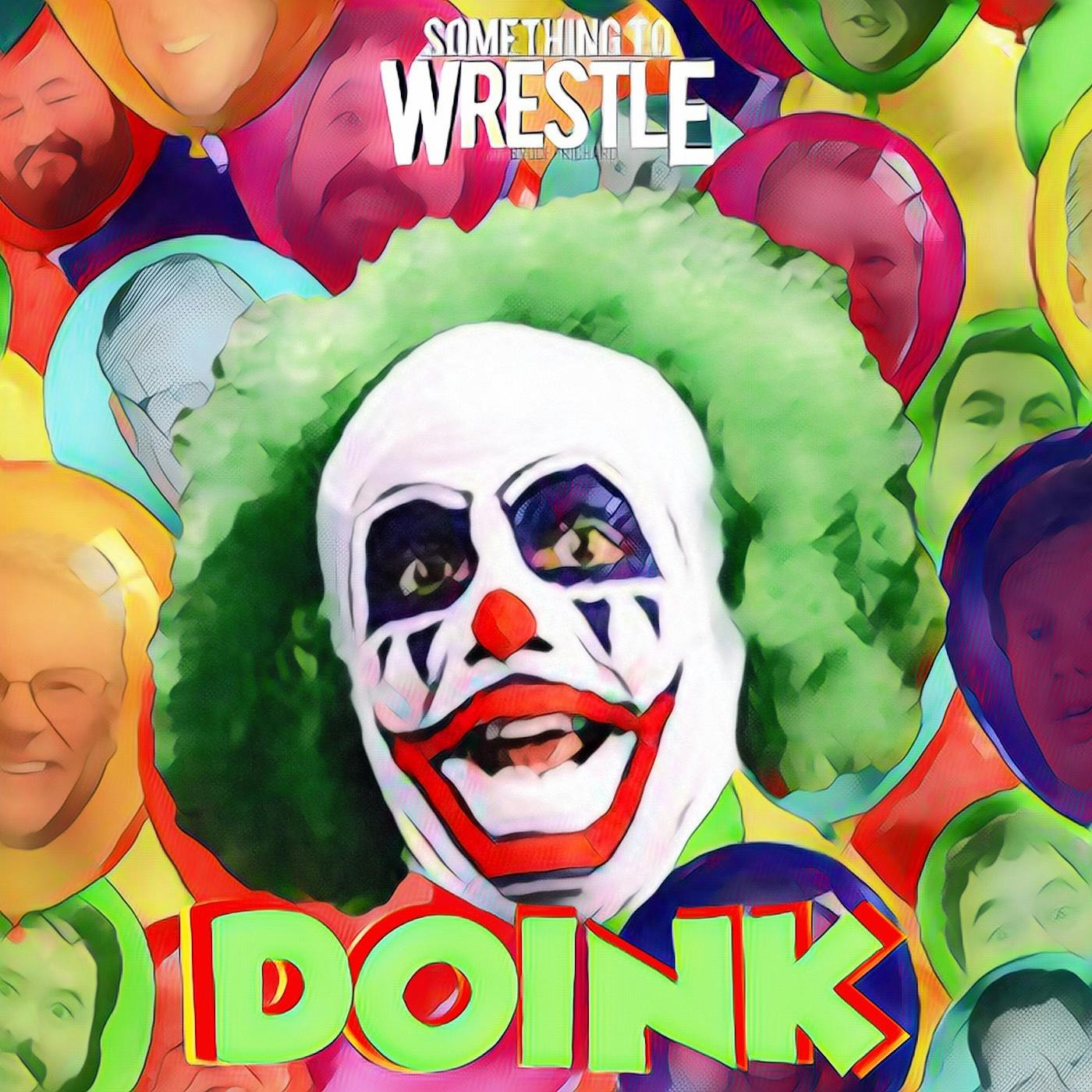
Episode 70: Doink the Clown
Who thought of the idea of an "evil clown" character? Who in the WWE dreamed of joining the circus as a kid? Where does a cartoon character fit into all of this? What movie did Bruce and Pat have Vince watch to understand the idea? How did Jim Johnston create the theme? We break down Jim's creative process with Vince, how Vince pitched Matt Borne on the character, the potential WrestleMania ideas, Crush in Hawaii, backlash from a neck injury angle right after a real life situation in the NFL, Doink working with Bret, rumors about working with Hogan, why Doink became a babyface, why Borne was suspended, why Borne was released, the Bigelow rumor, the replacement Doinks, Doink on the indies, the Alabama Doink at Golden Corral, Dink, Borne's run-ins with the law, the Borne-Nash and Borne-Duggan issues. Is Doink a Hall of a Famer? PLUS the biggest poll ever! Time Stamps: 3:48 Last week's recap 6:40 Next Week's poll 15:30 Doink the Clown 22:36 Undertaker's beef with Buzz Sawyer 25:45 Road Warrior Hawk starts the idea that would become Doink 30:36 Naming Doink 38:58 Doink's Raw debut 46:20 Doink vs Crush 1:12:13 Bruce responds to criticism 1:18:48 WrestleMania IX 1:32:37 Matt Bourne gets suspended 1:37:50 Ray Apollo becomes Doink 2:16:40 Twitter questions
Learn more about your ad choices. Visit megaphone.fm/adchoices
Available Results
Generated results are saved to your library for reuse and search.
Choose Template
Pick the result you want. You can review provider and model before generating.
A concise first-pass summary for understanding the episode quickly.
A comprehensive, source-grounded extraction of the reusable knowledge in an episode.
Technologies, AI models, technical methods, capabilities, limitations, and adoption implications.
Repeatable methods, frameworks, mental models, processes, and systems.
A dedicated analysis of warnings, limitations, trade-offs, weak evidence, and uncertainty.
A dedicated inventory of concrete resources named in the episode.
A concise first-pass summary for understanding the episode quickly.
A detailed readable summary organized by chapter or topic.
A navigable map of subjects, topic flow, and suggested chapters.
A comprehensive, source-grounded extraction of the reusable knowledge in an episode.
Reusable atomic knowledge units extracted from the episode.
A comprehensive extraction focused on health practices, protocols, claims, and safety caveats.
A comprehensive extraction focused on opportunities, strategy, markets, and company building.
Explicit actions, next steps, habits, recommendations, and things to avoid.
A dedicated inventory of concrete resources named in the episode.
A dedicated analysis of warnings, limitations, trade-offs, weak evidence, and uncertainty.
A concise first-pass summary for understanding the episode quickly.
A detailed readable summary organized by chapter or topic.
A navigable map of subjects, topic flow, and suggested chapters.
A comprehensive, source-grounded extraction of the reusable knowledge in an episode.
Reusable atomic knowledge units extracted from the episode.
A comprehensive extraction focused on health practices, protocols, claims, and safety caveats.
A comprehensive extraction focused on opportunities, strategy, markets, and company building.
Scientific findings, mechanisms, studies, hypotheses, and the limits of the evidence discussed.
Technologies, AI models, technical methods, capabilities, limitations, and adoption implications.
Investment theses, assets, catalysts, valuation reasoning, time horizons, and risks.
Chronologies, actors, causes, consequences, turning points, and competing historical interpretations.
Policies, proposals, stakeholders, arguments, implementation constraints, and predicted effects.
Career paths, skills, hiring signals, workplace decisions, transitions, and limitations of the advice.
Behavioral mechanisms, biases, motivation, habits, emotions, interventions, and evidence limitations.
Economic mechanisms, incentives, indicators, market structure, forecasts, and uncertainty.
Leadership principles, team systems, organizational design, culture, feedback, and failure modes.
Audience, positioning, messaging, acquisition, retention, experiments, metrics, and failed approaches.
Teaching methods, learning strategies, practice, feedback, assessment, and effectiveness evidence.
Theses, premises, arguments, objections, values, thought experiments, and unresolved questions.
Communication patterns, conflict, boundaries, expectations, repair methods, and contextual limitations.
Books, papers, authors, courses, and other learning resources mentioned in the episode.
Repeatable methods, frameworks, mental models, processes, and systems.
Explicit actions, next steps, habits, recommendations, and things to avoid.
Memorable statements and important claims with attribution and source context.
A dedicated inventory of concrete resources named in the episode.
A dedicated analysis of warnings, limitations, trade-offs, weak evidence, and uncertainty.