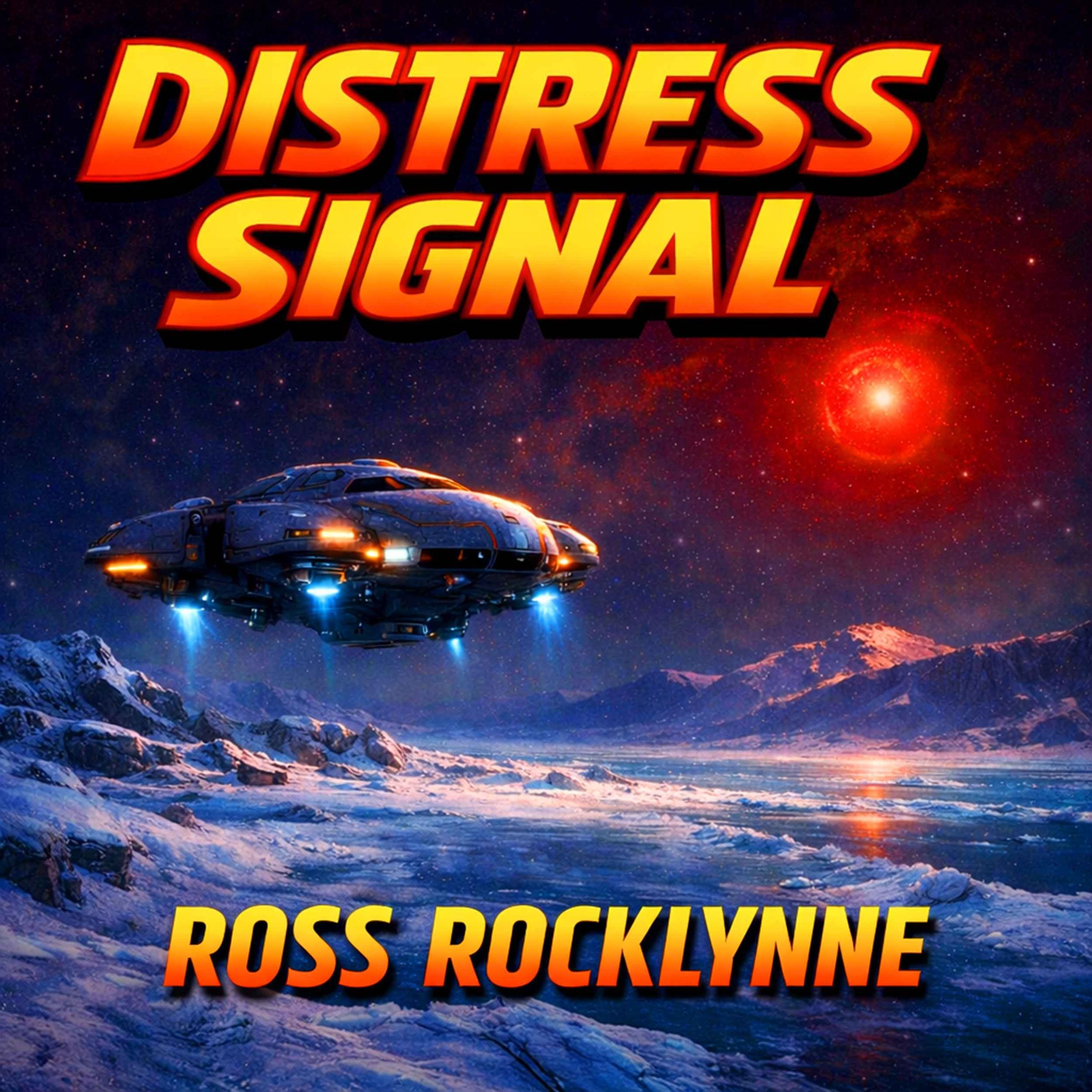
Distress Signal by Ross Rocklynne
Marooned! On the cold satellite of a dying sun, light-years away from home.... For Rex there was only one escape. But Carl called it murder! Distress Signal by Ross Rocklynne, that’s next on The Lost Sci-Fi Podcast, with at least one lost vintage sci-fi short story in every episode.
Born in 1913 in Cincinnati, Ohio, Ross Rocklynne said his love of science fiction began at the age of 12 when he said a Black janitor introduced him to the genre. Rocklynne remembered the story that turned him into a life-long fan, it was the first installment of E.E. Smith’s "The Skylark of Space" in the August 1928 issue of Amazing Stories.
In 1939, he attended the firstWorld Science Fiction Conventionin New York City where met and became life-long friends withRay Bradbury, among others.
Rocklynne’s professional writing debut, “Man of Iron” was published in Astounding Stories magazine in August 1935. He was 22. He followed that up with 7 more stories in the 1930s. The peak of his writing career occurred in the 1940s when he had 60 short science fiction stories published. There were 15 more in the 50s.
Rocklynne stopped writing in 1954 because he developed an extremely painful affliction of the face and jaw. He found that he could forget the pain only when he was involved in some kind of physical activity or when socially engaged with others. When he was alone the pain tended to monopolize his attention and thus made writing very difficult, if not impossible.
So, what do you do when you can’t do what you love? Well, Ross Rocklynne supported himself as a cab driver and dispatcher for the next 15 years. He resumed writing with about a dozen stories in the late 60s and early 70s.
Today’s story was his first and only offering in 1947. It appeared just before his friend Ray Bradbury’s story Rocket Summer in the Spring 1947 edition of Planet Stories Magazine. Turn to page 35 for Distress Signal by Ross Rocklynne…
Next week on The Lost Sci-Fi Podcast, Homer was a shy Faderfield bachelor; hisvisitor was a beautiful Pleiades girl. At anyrate she was a girl, and Homer had a problem—A Matterof Ethics by Russ Winterbotham
That’s next week onThe Lost Sci-Fi Podcast, with at least one lost vintage sci-fi short story in every episode.
https://lostscifi.com/podcast/distress-signal-by-ross-rocklynne-episode-67/
Listen without commercials and enjoy exclusive bonus episodes every month with Lost Sci-Fi Premium—start your free 7-day trial today. https://lostscifi.supercast.com/
Hosted by Simplecast, an AdsWizz company. See pcm.adswizz.com for information about our collection and use of personal data for advertising.
Available Results
Generated results are saved to your library for reuse and search.
Choose Template
Pick the result you want. You can review provider and model before generating.
A concise first-pass summary for understanding the episode quickly.
A comprehensive, source-grounded extraction of the reusable knowledge in an episode.
A comprehensive extraction focused on opportunities, strategy, markets, and company building.
Explicit actions, next steps, habits, recommendations, and things to avoid.
Repeatable methods, frameworks, mental models, processes, and systems.
A dedicated inventory of concrete resources named in the episode.
A concise first-pass summary for understanding the episode quickly.
A detailed readable summary organized by chapter or topic.
A navigable map of subjects, topic flow, and suggested chapters.
A comprehensive, source-grounded extraction of the reusable knowledge in an episode.
Reusable atomic knowledge units extracted from the episode.
A comprehensive extraction focused on health practices, protocols, claims, and safety caveats.
A comprehensive extraction focused on opportunities, strategy, markets, and company building.
Explicit actions, next steps, habits, recommendations, and things to avoid.
A dedicated inventory of concrete resources named in the episode.
A dedicated analysis of warnings, limitations, trade-offs, weak evidence, and uncertainty.
A concise first-pass summary for understanding the episode quickly.
A detailed readable summary organized by chapter or topic.
A navigable map of subjects, topic flow, and suggested chapters.
A comprehensive, source-grounded extraction of the reusable knowledge in an episode.
Reusable atomic knowledge units extracted from the episode.
A comprehensive extraction focused on health practices, protocols, claims, and safety caveats.
A comprehensive extraction focused on opportunities, strategy, markets, and company building.
Scientific findings, mechanisms, studies, hypotheses, and the limits of the evidence discussed.
Technologies, AI models, technical methods, capabilities, limitations, and adoption implications.
Investment theses, assets, catalysts, valuation reasoning, time horizons, and risks.
Chronologies, actors, causes, consequences, turning points, and competing historical interpretations.
Policies, proposals, stakeholders, arguments, implementation constraints, and predicted effects.
Career paths, skills, hiring signals, workplace decisions, transitions, and limitations of the advice.
Behavioral mechanisms, biases, motivation, habits, emotions, interventions, and evidence limitations.
Economic mechanisms, incentives, indicators, market structure, forecasts, and uncertainty.
Leadership principles, team systems, organizational design, culture, feedback, and failure modes.
Audience, positioning, messaging, acquisition, retention, experiments, metrics, and failed approaches.
Teaching methods, learning strategies, practice, feedback, assessment, and effectiveness evidence.
Theses, premises, arguments, objections, values, thought experiments, and unresolved questions.
Communication patterns, conflict, boundaries, expectations, repair methods, and contextual limitations.
Books, papers, authors, courses, and other learning resources mentioned in the episode.
Repeatable methods, frameworks, mental models, processes, and systems.
Explicit actions, next steps, habits, recommendations, and things to avoid.
Memorable statements and important claims with attribution and source context.
A dedicated inventory of concrete resources named in the episode.
A dedicated analysis of warnings, limitations, trade-offs, weak evidence, and uncertainty.