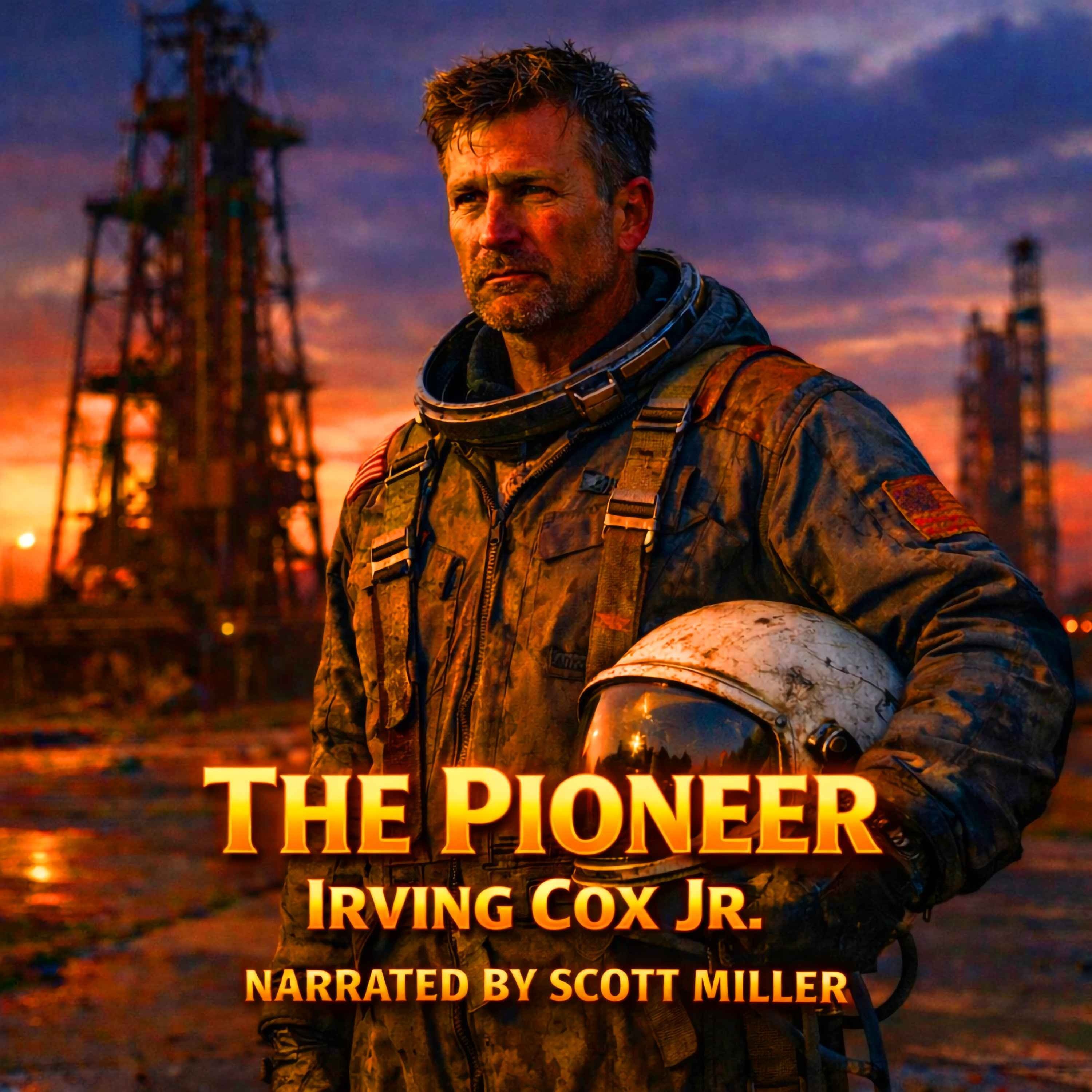
The Pioneer by Irving Cox Jr.
Welcome to The Lost Sci-Fi Podcast, today we begin celebrating our 1st anniversary with three episodes, featuring 4 stories in 5 days! Greg was sure the kids had no right being in control of a planet; after all what had they learned about life? Still, what had he learned? The Pioneer by Irving Cox Jr. that’s next on The Lost Sci-Fi Podcast, with at least one lost vintage sci-fi short story in every episode.
Thanks for all your emails and comments. We received this very flattering email from dragonstein yesterday. “I just found this series and I absolutely love it! I have been binge listening! Thank you, thank you, thank you! I love vintage sci-fi, there is something magical and special which sets it apart from contemporary sci-fi. You have also introduced me to authors I never knew existed. I would really love for you to read some stories from Asimov's "The complete robot". Thank you so much again and please keep up the excellent work!”
Thanks, dragonstein! We’re glad you discovered us too. By the way we will accommodate your request with an Asimov story that happens to be one of my favorites. Is this vintage sci-fi story the inspiration for The Terminator? We always enjoy your emails, send us an email, scott@lostscifi.com or comment on our YouTube channel.
We’re kicking off our 1st anniversary week with a story from an author whose work has largely been forgotten by today’s readers. This even though his writing career spanned several decades, during which he wrote over 100 science fiction and fantasy short stories, as well as a handful of novels. And the only audiobooks credited to Irving Cox Jr. we can find are audiobooks that we’ve narrated. We started narrating vintage sci-fi because of authors like Irving Cox Jr., who wrote great stories that had been forgotten. Stories that had never been available as audiobooks.
There’s been a lot of talk lately about Artificial Intelligence and its potential role in publishing books. But that’s not as new as you might think. Today’s author, Irving Cox Jr., was an early advocate for the use of computers in writing and publishing, and even wrote a computer program in the 1960s, 80 years ago, that could generate random plot outlines for science fiction stories. We don’t know if he ever used it.
Our story today comes from the pages of Imagination Stories of Science and Fantasy in October 1955. Greg had shown Man the way into space–and, ironically, the end of a way of life! Starting on page 82, The Pioneer by Irving Cox Jr…
In two days on The Lost Sci-Fi Podcast our 1st anniversary celebration continues. Did he have a right to feel this way? Was this really forbidden by law—this wonderful frightening emotion! And His plans were thorough. Every risk had beenclosely considered. Now Ron Carnavon, ruthless convict, was ready to loot the wrecked spaceship of its sapphire treasure, and thrust his warped power around the entire, antagonistic EMV triangle.The Robot Who Wanted To Know by Harry Harrison and Wreck Off Triton by Alfred Coppel.
That’s in two days on The Lost Sci-Fi Podcast, with at least one lost vintage sci-fi short story in every episode.
Buy Me a Coffee - https://lostscifi.com/coffee
Newsletter - https://lostscifi.com/free/
Facebook - https://lostscifi.com/facebook
YouTube - https://lostscifi.com/youtube
Instagram - https://www.instagram.com/lostscifiguy
Thanks to Our Listeners Who Bought Us a Coffee
https://lostscifi.com/podcast/the-pioneer-by-irving-cox-jr-episode-58/
Listen without commercials and enjoy exclusive bonus episodes every month with Lost Sci-Fi Premium—start your free 7-day trial today. https://lostscifi.supercast.com/
Hosted by Simplecast, an AdsWizz company. See pcm.adswizz.com for information about our collection and use of personal data for advertising.
Available Results
Generated results are saved to your library for reuse and search.
Choose Template
Pick the result you want. You can review provider and model before generating.
A concise first-pass summary for understanding the episode quickly.
A comprehensive, source-grounded extraction of the reusable knowledge in an episode.
A comprehensive extraction focused on opportunities, strategy, markets, and company building.
Explicit actions, next steps, habits, recommendations, and things to avoid.
Repeatable methods, frameworks, mental models, processes, and systems.
A dedicated inventory of concrete resources named in the episode.
A concise first-pass summary for understanding the episode quickly.
A detailed readable summary organized by chapter or topic.
A navigable map of subjects, topic flow, and suggested chapters.
A comprehensive, source-grounded extraction of the reusable knowledge in an episode.
Reusable atomic knowledge units extracted from the episode.
A comprehensive extraction focused on health practices, protocols, claims, and safety caveats.
A comprehensive extraction focused on opportunities, strategy, markets, and company building.
Explicit actions, next steps, habits, recommendations, and things to avoid.
A dedicated inventory of concrete resources named in the episode.
A dedicated analysis of warnings, limitations, trade-offs, weak evidence, and uncertainty.
A concise first-pass summary for understanding the episode quickly.
A detailed readable summary organized by chapter or topic.
A navigable map of subjects, topic flow, and suggested chapters.
A comprehensive, source-grounded extraction of the reusable knowledge in an episode.
Reusable atomic knowledge units extracted from the episode.
A comprehensive extraction focused on health practices, protocols, claims, and safety caveats.
A comprehensive extraction focused on opportunities, strategy, markets, and company building.
Scientific findings, mechanisms, studies, hypotheses, and the limits of the evidence discussed.
Technologies, AI models, technical methods, capabilities, limitations, and adoption implications.
Investment theses, assets, catalysts, valuation reasoning, time horizons, and risks.
Chronologies, actors, causes, consequences, turning points, and competing historical interpretations.
Policies, proposals, stakeholders, arguments, implementation constraints, and predicted effects.
Career paths, skills, hiring signals, workplace decisions, transitions, and limitations of the advice.
Behavioral mechanisms, biases, motivation, habits, emotions, interventions, and evidence limitations.
Economic mechanisms, incentives, indicators, market structure, forecasts, and uncertainty.
Leadership principles, team systems, organizational design, culture, feedback, and failure modes.
Audience, positioning, messaging, acquisition, retention, experiments, metrics, and failed approaches.
Teaching methods, learning strategies, practice, feedback, assessment, and effectiveness evidence.
Theses, premises, arguments, objections, values, thought experiments, and unresolved questions.
Communication patterns, conflict, boundaries, expectations, repair methods, and contextual limitations.
Books, papers, authors, courses, and other learning resources mentioned in the episode.
Repeatable methods, frameworks, mental models, processes, and systems.
Explicit actions, next steps, habits, recommendations, and things to avoid.
Memorable statements and important claims with attribution and source context.
A dedicated inventory of concrete resources named in the episode.
A dedicated analysis of warnings, limitations, trade-offs, weak evidence, and uncertainty.