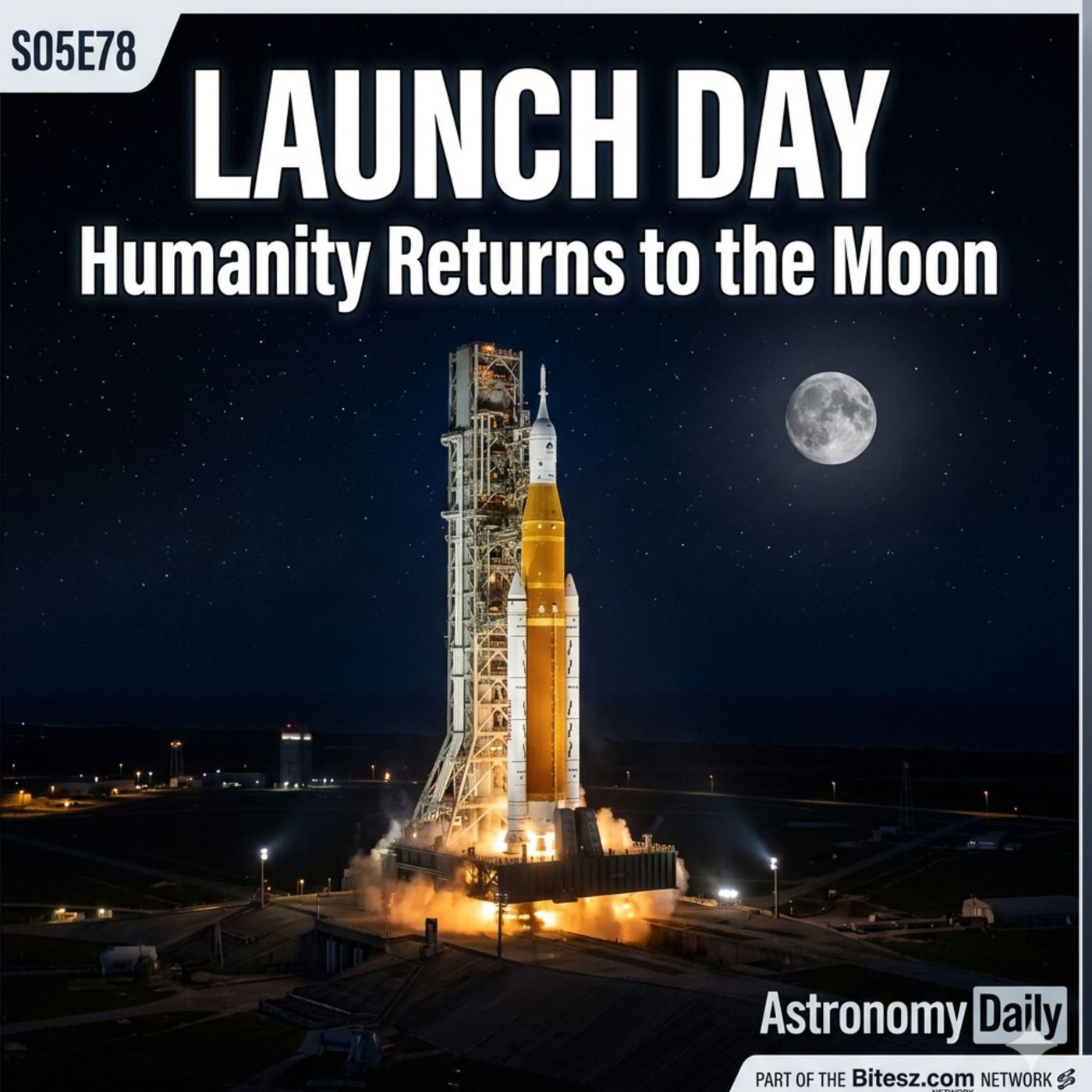
'Hey, Let's Go to the Moon' — Artemis II Launch Day
Launch day has arrived. In this episode of Astronomy Daily, Anna and Avery countdown to tonight's historic Artemis II launch — humanity's first crewed lunar mission since 1972 — and explore the dramatic stories unfolding alongside it: a sungrazing comet faces its moment of truth just three days from perihelion; astronomers raise urgent alarms over plans for one million new satellites; the interstellar comet 3I/ATLAS leaves its open-data legacy; and fascinating new science unpacks the hellish reality of Venus and a creative low-tech solution for mapping the Moon's interior. Story References Story 1: Artemis II Launch • NASA Artemis II Mission Hub: nasa.gov/mission/artemis-ii • NASA Live Coverage (NASA+, YouTube, Amazon Prime) — begins 7:45 AM EDT April 1 • Launch window: 6:24–8:24 PM EDT Wednesday April 1 (09:24–11:24 AEDT Thursday April 2) • Crew: Reid Wiseman (Commander), Victor Glover (Pilot), Christina Koch, Jeremy Hansen (CSA) • Mission duration: 10 days, splashdown April 10 off San Diego Story 2: Comet MAPS • C/2026 A1 (MAPS) perihelion: April 4, 2026 at ~14:23 UTC • Perihelion distance: ~160,000 km above Sun's surface (solar corona passage) • Kreutz sungrazer family — related to Great Comet of 1106 • Nucleus estimated ~400m diameter (JWST MIRI observation, Feb 7 2026) • Best-case post-perihelion brightness: magnitude -5 to -10 • Source: Sky & Telescope, EarthSky, Universe Today, Wikipedia Story 3: Satellite Megaconstellations • SpaceX proposal: 1,000,000 satellites (AI orbital data centres) — FCC filing Jan 30, 2026 • Reflect Orbital proposal: 50,000 mirror satellites — FCC filing July 31, 2025 • IAU, RAS, and ESO have all filed formal FCC objections • Nature study (Dec 2025): 96%+ of future space telescope exposures affected if constellations completed • Hubble: up to 1/3 of images contaminated • Source: Universe Today, Astronomy Magazine, Nature Story 4: 3I/ATLAS Open Data • NASA open data archive now available: science.nasa.gov/solar-system/comets/3i-atlas • Key finding: 3I/ATLAS unusually rich in methanol vs hydrogen cyanide • Observed by 12+ NASA missions including Hubble, JWST, TESS, SPHEREx, MAVEN, Perseverance • Jupiter flyby: March 16, 2026 at 0.358 AU • Source: NASA Science, Space.com, NRAO Story 5: Venus • Surface temperature: 464°C average • Atmospheric pressure: 92× Earth (equivalent to ~1km ocean depth) • Longest spacecraft survival: ~2 hours (Soviet Venera probes) • Source: Universe Today, April 1 2026 Story 6: Lunar Optical Fibre • Two new journal papers propose telecom-grade optical fibre for lunar seismic mapping • Could map deep interior and identify lava tube locations • Lava tubes: potential natural shelters for future astronauts • Source: Universe Today, April 1 2026
Become a supporter of this podcast: https://www.spreaker.com/podcast/astronomy-daily-space-news-updates--5648921/support.
Sponsor Details:
Ensure your online privacy by using NordVPN. To get our special listener deal and save a lot of money, visit www.bitesz.com/nordvpn. You'll be glad you did!
Become a supporter of Astronomy Daily by joining our Supporters Club. Commercial free episodes daily are only a click way... Click Here
This episode includes AI-generated content.
Become a supporter of this podcast: https://www.spreaker.com/podcast/astronomy-daily-space-news-updates--5648921/support.
Sponsor Details:
Ensure your online privacy by using NordVPN. To get our special listener deal and save a lot of money, visit www.bitesz.com/nordvpn. You'll be glad you did!
Become a supporter of Astronomy Daily by joining our Supporters Club. Commercial free episodes daily are only a click way... Click Here
This episode includes AI-generated content.
More description
Launch day has arrived. In this episode of Astronomy Daily, Anna and Avery countdown to tonight's historic Artemis II launch — humanity's first crewed lunar mission since 1972 — and explore the dramatic stories unfolding alongside it: a sungrazing comet faces its moment of truth just three days from perihelion; astronomers raise urgent alarms over plans for one million new satellites; the interstellar comet 3I/ATLAS leaves its open-data legacy; and fascinating new science unpacks the hellish reality of Venus and a creative low-tech solution for mapping the Moon's interior. Story References Story 1: Artemis II Launch • NASA Artemis II Mission Hub: nasa.gov/mission/artemis-ii • NASA Live Coverage (NASA+, YouTube, Amazon Prime) — begins 7:45 AM EDT April 1 • Launch window: 6:24–8:24 PM EDT Wednesday April 1 (09:24–11:24 AEDT Thursday April 2) • Crew: Reid Wiseman (Commander), Victor Glover (Pilot), Christina Koch, Jeremy Hansen (CSA) • Mission duration: 10 days, splashdown April 10 off San Diego Story 2: Comet MAPS • C/2026 A1 (MAPS) perihelion: April 4, 2026 at ~14:23 UTC • Perihelion distance: ~160,000 km above Sun's surface (solar corona passage) • Kreutz sungrazer family — related to Great Comet of 1106 • Nucleus estimated ~400m diameter (JWST MIRI observation, Feb 7 2026) • Best-case post-perihelion brightness: magnitude -5 to -10 • Source: Sky & Telescope, EarthSky, Universe Today, Wikipedia Story 3: Satellite Megaconstellations • SpaceX proposal: 1,000,000 satellites (AI orbital data centres) — FCC filing Jan 30, 2026 • Reflect Orbital proposal: 50,000 mirror satellites — FCC filing July 31, 2025 • IAU, RAS, and ESO have all filed formal FCC objections • Nature study (Dec 2025): 96%+ of future space telescope exposures affected if constellations completed • Hubble: up to 1/3 of images contaminated • Source: Universe Today, Astronomy Magazine, Nature Story 4: 3I/ATLAS Open Data • NASA open data archive now available: science.nasa.gov/solar-system/comets/3i-atlas • Key finding: 3I/ATLAS unusually rich in methanol vs hydrogen cyanide • Observed by 12+ NASA missions including Hubble, JWST, TESS, SPHEREx, MAVEN, Perseverance • Jupiter flyby: March 16, 2026 at 0.358 AU • Source: NASA Science, Space.com, NRAO Story 5: Venus • Surface temperature: 464°C average • Atmospheric pressure: 92× Earth (equivalent to ~1km ocean depth) • Longest spacecraft survival: ~2 hours (Soviet Venera probes) • Source: Universe Today, April 1 2026 Story 6: Lunar Optical Fibre • Two new journal papers propose telecom-grade optical fibre for lunar seismic mapping • Could map deep interior and identify lava tube locations • Lava tubes: potential natural shelters for future astronauts • Source: Universe Today, April 1 2026
Become a supporter of this podcast: https://www.spreaker.com/podcast/astronomy-daily-space-news-updates--5648921/support.
Sponsor Details:
Ensure your online privacy by using NordVPN. To get our special listener deal and save a lot of money, visit www.bitesz.com/nordvpn. You'll be glad you did!
Become a supporter of Astronomy Daily by joining our Supporters Club. Commercial free episodes daily are only a click way... Click Here
This episode includes AI-generated content.
Become a supporter of this podcast: https://www.spreaker.com/podcast/astronomy-daily-space-news-updates--5648921/support.
Sponsor Details:
Ensure your online privacy by using NordVPN. To get our special listener deal and save a lot of money, visit www.bitesz.com/nordvpn. You'll be glad you did!
Become a supporter of Astronomy Daily by joining our Supporters Club. Commercial free episodes daily are only a click way... Click Here
This episode includes AI-generated content.
2026-04-01
16 min
Transcript
Listen elsewhere
Available Results
Generated results are saved to your library for reuse and search.
No generated results are available for this episode yet.
Transcript
Open the Transcript tab to load the transcript.
Chapters
No chapters available.