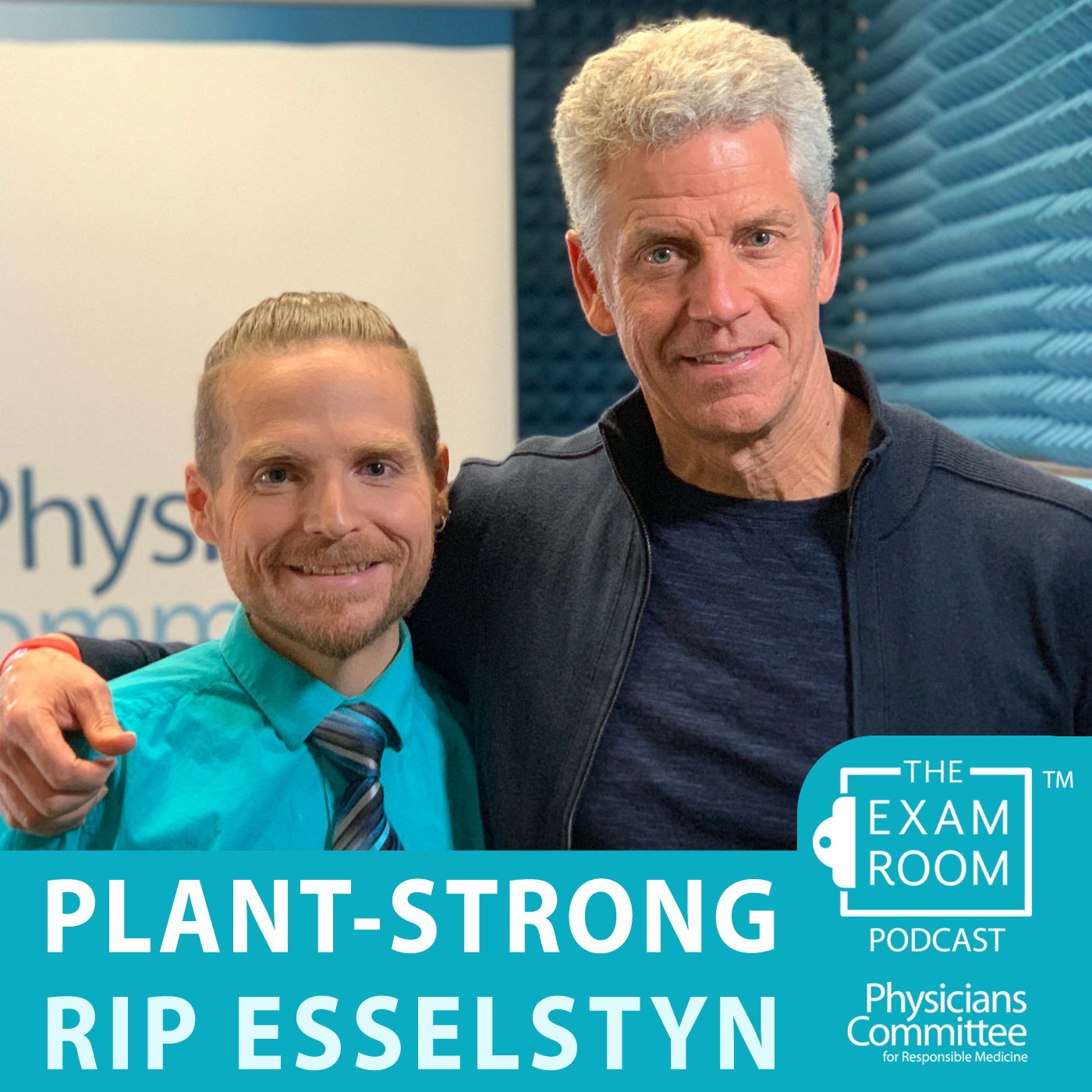
Plant-Strong with Rip Esselstyn!
Rip Esselstyn has quite the story to tell! After retiring as an elite professional athlete and later hanging up the boots as a firefighter, he devoted his life to inspiring and improving the health of so many people through the plant-based Engine 2 Diet. It's a program born out of his desire to help a fellow firefighter in desperate need of change.
On this episode of The Exam Room Podcast™, "The Weight Loss Champion" Chuck Carroll is joined by Rip who shares how his drive to help just one person is now changing the lives of countless others.
If the name Esselstyn seems familiar, you might be thinking of his father, and famed surgeon, Caldwell Esselstyn whose work has been a major influence in the plant-based community.
With a lineage like that, you might think that Rip has been plant-strong from day one, but that's not the case. Even as a scholarship athlete in college Rip was chowing down on hamburgers, steaks and BLTs. He tells Chuck that he only opted to ditch meat and dairy after graduating from school. And the rest, as they say, is history.
Join them as they recount this incredible moving journey.
Rip is also adding another piece to his resume as a podcaster! He recently launched the Plant-Strong Podcast where teams with a renowned team of plant-based doctors, including Dr. Neal Barnard and Dr. Jim Loomis, as well as other experts to save the life of New York City firefighter Joe Inga. The show chronicles Joe's journey as he wrestles with his own mortality and tries to break a lifetime of unhealthy habits.
Follow
Twitter: @ChuckCarrollWLC / @RipEsselstyn / @PCRM
IG: @ChuckCarrollWLC / @RipEsselstyn / @PhysiciansCommittee
Share the Show
Please pass along what you've learned on the show by sharing it with a friend and by subscribing on Apple Podcasts, Spotify or many other podcast providers. Also, please leave 5-star rating.
Available Results
Generated results are saved to your library for reuse and search.
Choose Template
Pick the result you want. You can review provider and model before generating.
A concise first-pass summary for understanding the episode quickly.
A comprehensive, source-grounded extraction of the reusable knowledge in an episode.
A comprehensive extraction focused on health practices, protocols, claims, and safety caveats.
A dedicated analysis of warnings, limitations, trade-offs, weak evidence, and uncertainty.
Repeatable methods, frameworks, mental models, processes, and systems.
Technologies, AI models, technical methods, capabilities, limitations, and adoption implications.
A concise first-pass summary for understanding the episode quickly.
A detailed readable summary organized by chapter or topic.
A navigable map of subjects, topic flow, and suggested chapters.
A comprehensive, source-grounded extraction of the reusable knowledge in an episode.
Reusable atomic knowledge units extracted from the episode.
A comprehensive extraction focused on health practices, protocols, claims, and safety caveats.
A comprehensive extraction focused on opportunities, strategy, markets, and company building.
Explicit actions, next steps, habits, recommendations, and things to avoid.
A dedicated inventory of concrete resources named in the episode.
A dedicated analysis of warnings, limitations, trade-offs, weak evidence, and uncertainty.
A concise first-pass summary for understanding the episode quickly.
A detailed readable summary organized by chapter or topic.
A navigable map of subjects, topic flow, and suggested chapters.
A comprehensive, source-grounded extraction of the reusable knowledge in an episode.
Reusable atomic knowledge units extracted from the episode.
A comprehensive extraction focused on health practices, protocols, claims, and safety caveats.
A comprehensive extraction focused on opportunities, strategy, markets, and company building.
Scientific findings, mechanisms, studies, hypotheses, and the limits of the evidence discussed.
Technologies, AI models, technical methods, capabilities, limitations, and adoption implications.
Investment theses, assets, catalysts, valuation reasoning, time horizons, and risks.
Chronologies, actors, causes, consequences, turning points, and competing historical interpretations.
Policies, proposals, stakeholders, arguments, implementation constraints, and predicted effects.
Career paths, skills, hiring signals, workplace decisions, transitions, and limitations of the advice.
Behavioral mechanisms, biases, motivation, habits, emotions, interventions, and evidence limitations.
Economic mechanisms, incentives, indicators, market structure, forecasts, and uncertainty.
Leadership principles, team systems, organizational design, culture, feedback, and failure modes.
Audience, positioning, messaging, acquisition, retention, experiments, metrics, and failed approaches.
Teaching methods, learning strategies, practice, feedback, assessment, and effectiveness evidence.
Theses, premises, arguments, objections, values, thought experiments, and unresolved questions.
Communication patterns, conflict, boundaries, expectations, repair methods, and contextual limitations.
Books, papers, authors, courses, and other learning resources mentioned in the episode.
Repeatable methods, frameworks, mental models, processes, and systems.
Explicit actions, next steps, habits, recommendations, and things to avoid.
Memorable statements and important claims with attribution and source context.
A dedicated inventory of concrete resources named in the episode.
A dedicated analysis of warnings, limitations, trade-offs, weak evidence, and uncertainty.