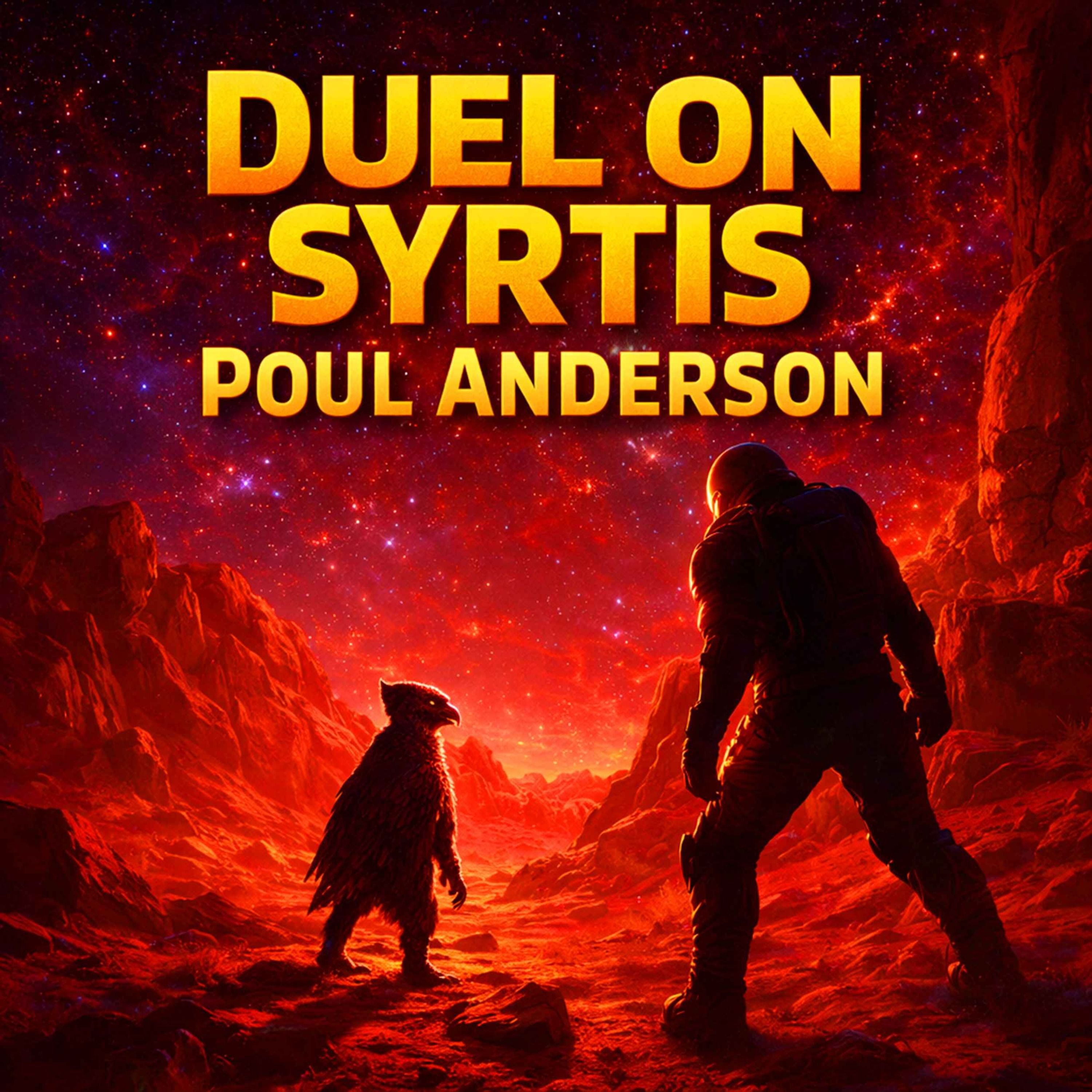
Duel on Syrtis by Poul Anderson
Bold and ruthless, he was famed throughout the System as a big-game hunter. From the firedrakes of Mercury to the ice-crawlers of Pluto, he'd slain them all. But his trophy-room lacked one item; and now Riordan swore he'd bag the forbidden game that roamed the red deserts ... a Martian! Duel on Syrtis by Poul Anderson, that’s next on The Lost Sci-Fi Podcast, with at least one lost vintage sci-fi short story in every episode.
Today’s episode of the podcast marks the debut of Poul Anderson. Anderson was no ordinary science fiction author. He has been called ''one of the five or six most important writers to appear during the science-fiction publishing boom of the decade following the end of World War II.''
To call him prolific would be a vast understatement. His wife, Karen, said she did not know how many books he wrote, saying. ''We lost count after 100.'' As for short stories, I stopped counting at 150.
Poul William Anderson was born on November 25th, 1926, in Bristol, Pennsylvania, to Anton and Astrid Anderson. His father had anglicized the spelling of the family name, originally Andersen. He told his wife she could name their first child, and she chose Poul.
His father died in a car crash when Poul was 11. His mother took him and his brother first to Denmark, then to Maryland, and finally to a 40-acre farm in southern Minnesota.
While growing up in Minnesota Poul found himself spending all of his tiny allowance on subscriptions to science fiction magazines. And so, his love of science fiction began.
A former president of the Science Fiction and Fantasy Writers of America, he won numerous awards, including three Nebula and seven Hugo awards. In 1997 the association named him a Grandmaster and he was inducted into the Science Fiction Fantasy Hall of Fame.
He had a few short science fiction stories published in the 1940s, but his career really took off in the 1950s when more than 70 of his stories appeared in Astounding Science Fiction, Super Science Stories, Imagination Stories of Science and Fantasy and other publications. Today’s story appeared in March 1951 in Planet Stories magazine. Let’s turn to page 5 for Duel on Syrtis by Poul Anderson…
Next week on The Lost Sci-Fi Podcast, After space, there was always one more river to cross ... the far side of hatred and murder! The Hated by Frederik Pohl. That’s next week onThe Lost Sci-Fi Podcast, with at least one lost vintage sci-fi short story in every episode.
Buy Me a Coffee - https://lostscifi.com/coffee
Newsletter - https://lostscifi.com/free/
Facebook - https://lostscifi.com/facebook
YouTube - https://lostscifi.com/youtube
Instagram - https://www.instagram.com/lostscifiguy
https://lostscifi.com/podcast/duel-on-syrtis-by-poul-anderson-episode-74/
Listen without commercials and enjoy exclusive bonus episodes every month with Lost Sci-Fi Premium—start your free 7-day trial today. https://lostscifi.supercast.com/
Hosted by Simplecast, an AdsWizz company. See pcm.adswizz.com for information about our collection and use of personal data for advertising.
Available Results
Generated results are saved to your library for reuse and search.
Choose Template
Pick the result you want. You can review provider and model before generating.
A concise first-pass summary for understanding the episode quickly.
A comprehensive, source-grounded extraction of the reusable knowledge in an episode.
A comprehensive extraction focused on opportunities, strategy, markets, and company building.
Explicit actions, next steps, habits, recommendations, and things to avoid.
Repeatable methods, frameworks, mental models, processes, and systems.
A dedicated inventory of concrete resources named in the episode.
A concise first-pass summary for understanding the episode quickly.
A detailed readable summary organized by chapter or topic.
A navigable map of subjects, topic flow, and suggested chapters.
A comprehensive, source-grounded extraction of the reusable knowledge in an episode.
Reusable atomic knowledge units extracted from the episode.
A comprehensive extraction focused on health practices, protocols, claims, and safety caveats.
A comprehensive extraction focused on opportunities, strategy, markets, and company building.
Explicit actions, next steps, habits, recommendations, and things to avoid.
A dedicated inventory of concrete resources named in the episode.
A dedicated analysis of warnings, limitations, trade-offs, weak evidence, and uncertainty.
A concise first-pass summary for understanding the episode quickly.
A detailed readable summary organized by chapter or topic.
A navigable map of subjects, topic flow, and suggested chapters.
A comprehensive, source-grounded extraction of the reusable knowledge in an episode.
Reusable atomic knowledge units extracted from the episode.
A comprehensive extraction focused on health practices, protocols, claims, and safety caveats.
A comprehensive extraction focused on opportunities, strategy, markets, and company building.
Scientific findings, mechanisms, studies, hypotheses, and the limits of the evidence discussed.
Technologies, AI models, technical methods, capabilities, limitations, and adoption implications.
Investment theses, assets, catalysts, valuation reasoning, time horizons, and risks.
Chronologies, actors, causes, consequences, turning points, and competing historical interpretations.
Policies, proposals, stakeholders, arguments, implementation constraints, and predicted effects.
Career paths, skills, hiring signals, workplace decisions, transitions, and limitations of the advice.
Behavioral mechanisms, biases, motivation, habits, emotions, interventions, and evidence limitations.
Economic mechanisms, incentives, indicators, market structure, forecasts, and uncertainty.
Leadership principles, team systems, organizational design, culture, feedback, and failure modes.
Audience, positioning, messaging, acquisition, retention, experiments, metrics, and failed approaches.
Teaching methods, learning strategies, practice, feedback, assessment, and effectiveness evidence.
Theses, premises, arguments, objections, values, thought experiments, and unresolved questions.
Communication patterns, conflict, boundaries, expectations, repair methods, and contextual limitations.
Books, papers, authors, courses, and other learning resources mentioned in the episode.
Repeatable methods, frameworks, mental models, processes, and systems.
Explicit actions, next steps, habits, recommendations, and things to avoid.
Memorable statements and important claims with attribution and source context.
A dedicated inventory of concrete resources named in the episode.
A dedicated analysis of warnings, limitations, trade-offs, weak evidence, and uncertainty.