Our Broken Plate: Disrupting Nutritional Science, Intermittent Fasting & How He Helped Penn Jillette Lose Over 100 Pounds
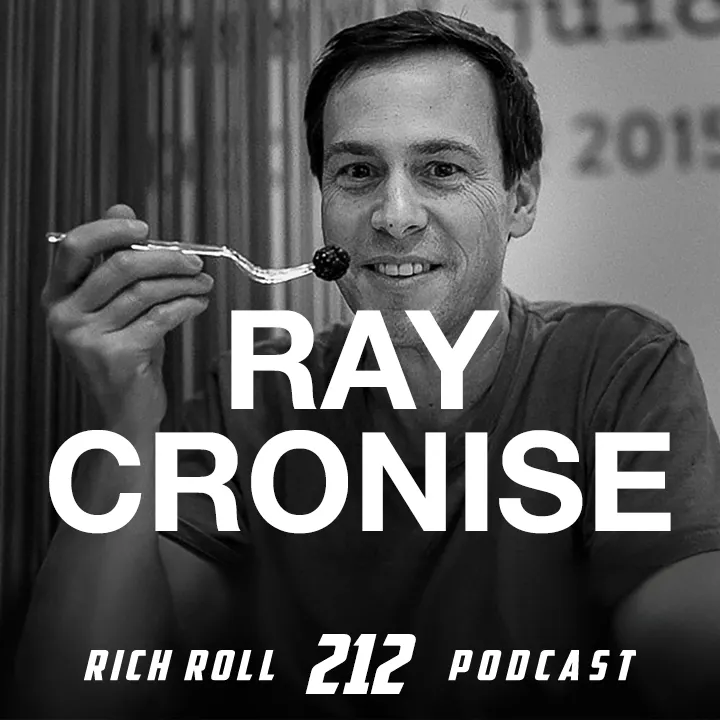
If you enjoyed my conversation with Dr. Rhonda Patrick, you're going to love today's conversation with my new friend Ray Cronise.
A passionate innovator, disrupter and scientist, Ray began his career as a Materials Scientist at NASA’s Marshall Space Flight Center, where he worked for 15 years in Physical and Analytical Chemistry and Biophysics as Assistant Mission Scientist on four Spacelab missions and projects like the impact of microgravity on biophysics; and space station environmental life support systems.
I have no idea what any of that means, but it sounds impressive.
Ray went on to co-found ZERO-G– the world’s first private parabolic flight operation – with XPRIZE creator Peter Diamandis. Otherwise known as vomit comets, ZERO-G flights produce weightlessness and approximate space flight conditions for purposes of scientific research, cinema and entertainment.
But it wasn't until Tim Ferriss' The 4-Hour Body* featured Ray's pioneering work with cold stress therapy as as a tool for fat loss that Ray began popping up everywhere as the man behind the Metabolic Winter Hypothesis.
Results motivated this prodigious scientific mind next to peer keenly into the chemistry, physiology, mechanics and research methodology behind human nutrition — specifically, what is wrong with current nutrition research and how to fix it. After copious investigation, analysis and self-experimentation, he has arrived upon a well supported but perhaps contrarian conclusion: a whole food plant-based diet is optimal for long-term health and wellness.
Despite decades spent struggling to manage his own weight and stay fit, for the past six years Ray has kept the weight off using a combination of cold stress, healthful sleep cycles, and a plant-based nutritional regimen.
Mainstream culture would deem Ray's ways extreme. But ask Ray and he will tell you that the way most people live and eat today is actually a radical departure from our natural state and is likely the root cause of our epidemic of chronic lifestyle illness.
After listening to this guy you will realize one thing – he did not arrive at his conclusions lightly. Conclusions soon to be explored in his upcoming book, Our Broken Plate, which aims to change the way people look at all diets so they can make lasting lifestyle changes that improve what Ray calls healthspan.
Over the course of an amazing 3 hours, we cover an absurd amount of territory, including:
* Ray's upcoming book ‘Our Broken Plate'
* the insanity of our protein obsession
* the “over nourishment” of America
* the impact of caloric & protein restriction on longevity & cancer
* the impact of thermogenesis on diet and exercise
* the importance of separating diet and exercise
* telomeres and aging
* nutrient deficiencies, supplements, instinctive eating; and
* exactly how Penn Jillette lost 100 pounds
Enjoy!
Rich
Learn more about your ad choices. Visit podcastchoices.com/adchoices
Available Results
Generated results are saved to your library for reuse and search.
Choose Template
Pick the result you want. You can review provider and model before generating.
A concise first-pass summary for understanding the episode quickly.
A comprehensive, source-grounded extraction of the reusable knowledge in an episode.
A comprehensive extraction focused on health practices, protocols, claims, and safety caveats.
A dedicated analysis of warnings, limitations, trade-offs, weak evidence, and uncertainty.
Repeatable methods, frameworks, mental models, processes, and systems.
Scientific findings, mechanisms, studies, hypotheses, and the limits of the evidence discussed.
A concise first-pass summary for understanding the episode quickly.
A detailed readable summary organized by chapter or topic.
A navigable map of subjects, topic flow, and suggested chapters.
A comprehensive, source-grounded extraction of the reusable knowledge in an episode.
Reusable atomic knowledge units extracted from the episode.
A comprehensive extraction focused on health practices, protocols, claims, and safety caveats.
A comprehensive extraction focused on opportunities, strategy, markets, and company building.
Explicit actions, next steps, habits, recommendations, and things to avoid.
A dedicated inventory of concrete resources named in the episode.
A dedicated analysis of warnings, limitations, trade-offs, weak evidence, and uncertainty.
A concise first-pass summary for understanding the episode quickly.
A detailed readable summary organized by chapter or topic.
A navigable map of subjects, topic flow, and suggested chapters.
A comprehensive, source-grounded extraction of the reusable knowledge in an episode.
Reusable atomic knowledge units extracted from the episode.
A comprehensive extraction focused on health practices, protocols, claims, and safety caveats.
A comprehensive extraction focused on opportunities, strategy, markets, and company building.
Scientific findings, mechanisms, studies, hypotheses, and the limits of the evidence discussed.
Technologies, AI models, technical methods, capabilities, limitations, and adoption implications.
Investment theses, assets, catalysts, valuation reasoning, time horizons, and risks.
Chronologies, actors, causes, consequences, turning points, and competing historical interpretations.
Policies, proposals, stakeholders, arguments, implementation constraints, and predicted effects.
Career paths, skills, hiring signals, workplace decisions, transitions, and limitations of the advice.
Behavioral mechanisms, biases, motivation, habits, emotions, interventions, and evidence limitations.
Economic mechanisms, incentives, indicators, market structure, forecasts, and uncertainty.
Leadership principles, team systems, organizational design, culture, feedback, and failure modes.
Audience, positioning, messaging, acquisition, retention, experiments, metrics, and failed approaches.
Teaching methods, learning strategies, practice, feedback, assessment, and effectiveness evidence.
Theses, premises, arguments, objections, values, thought experiments, and unresolved questions.
Communication patterns, conflict, boundaries, expectations, repair methods, and contextual limitations.
Books, papers, authors, courses, and other learning resources mentioned in the episode.
Repeatable methods, frameworks, mental models, processes, and systems.
Explicit actions, next steps, habits, recommendations, and things to avoid.
Memorable statements and important claims with attribution and source context.
A dedicated inventory of concrete resources named in the episode.
A dedicated analysis of warnings, limitations, trade-offs, weak evidence, and uncertainty.