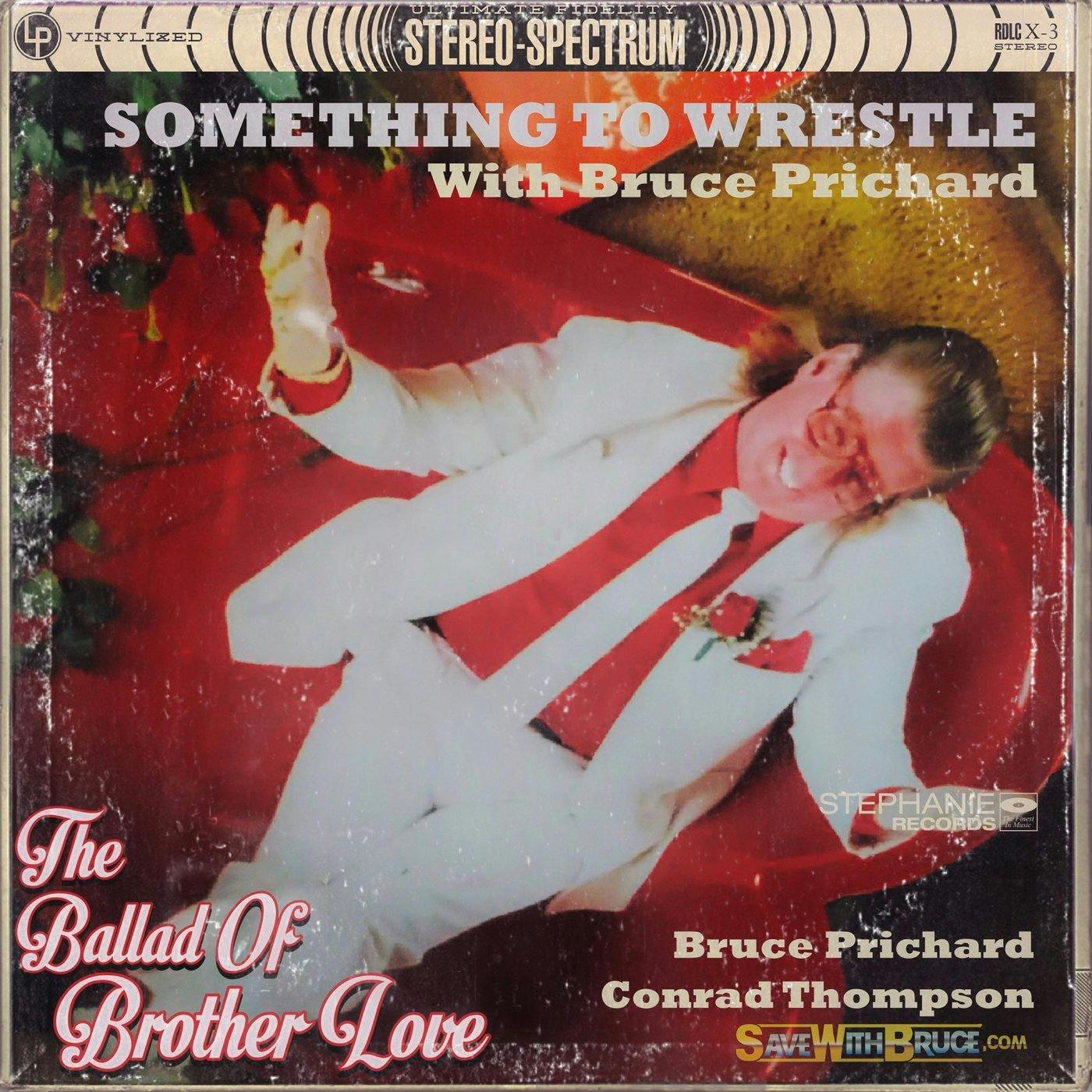
Episode 100: Brother Love
"I LOOOOOOOOOVE YOOOOOOOOU!" made Bruce Prichard a television star for the WWF as "Brother Love" back in 1988. But how did a 25-year-old kid working behind the scenes suddenly become a television character? Bruce tells the full story of the Brother Love character, who loved the idea, who hated the idea, and how it was never supposed to be him portraying the character. How did Bruce land the job? How did they "disguise" Bruce originally? How did the make up, the white suit, and the red shirt come to be? What was the process for creating the Brother Love Show set and format? Plus Bruce discusses the strategy for airing it on Wrestling Challenge before Superstars, his memories of being on NBC, the incredible story where he wound up "in the main event" against Hulk Hogan, who had heat with the character, a hilarious Andre story, and much more from the "golden era" of the WWF! Conrad also asks Bruce about all of the returns of Brother Love including WrestleMania 17! Stay tuned for a surprise at the end that you've got to see to believe as a special "bonus" for Episode 100! Come see us in Rochester in July, New York in August: www.BrucePrichard.com Ask questions for the "British Bulldog episode" right now: www.twitter.com/PrichardShow Catch up with the Morning Deuce with Bruce every morning: www.facebook.com/SomethingToWrestle Tees are at BrucePrichard.com and everything else is at BoxOfGimmicks.com Save Yourself Some Money: www.SaveWithBruce.com And don't miss "Something ELSE to Wrestle" covering the Roddy Piper this Wednesday on the WWE Network!
Learn more about your ad choices. Visit megaphone.fm/adchoices
Available Results
Generated results are saved to your library for reuse and search.
Choose Template
Pick the result you want. You can review provider and model before generating.
A concise first-pass summary for understanding the episode quickly.
A comprehensive, source-grounded extraction of the reusable knowledge in an episode.
A comprehensive extraction focused on opportunities, strategy, markets, and company building.
Explicit actions, next steps, habits, recommendations, and things to avoid.
Repeatable methods, frameworks, mental models, processes, and systems.
A dedicated inventory of concrete resources named in the episode.
A concise first-pass summary for understanding the episode quickly.
A detailed readable summary organized by chapter or topic.
A navigable map of subjects, topic flow, and suggested chapters.
A comprehensive, source-grounded extraction of the reusable knowledge in an episode.
Reusable atomic knowledge units extracted from the episode.
A comprehensive extraction focused on health practices, protocols, claims, and safety caveats.
A comprehensive extraction focused on opportunities, strategy, markets, and company building.
Explicit actions, next steps, habits, recommendations, and things to avoid.
A dedicated inventory of concrete resources named in the episode.
A dedicated analysis of warnings, limitations, trade-offs, weak evidence, and uncertainty.
A concise first-pass summary for understanding the episode quickly.
A detailed readable summary organized by chapter or topic.
A navigable map of subjects, topic flow, and suggested chapters.
A comprehensive, source-grounded extraction of the reusable knowledge in an episode.
Reusable atomic knowledge units extracted from the episode.
A comprehensive extraction focused on health practices, protocols, claims, and safety caveats.
A comprehensive extraction focused on opportunities, strategy, markets, and company building.
Scientific findings, mechanisms, studies, hypotheses, and the limits of the evidence discussed.
Technologies, AI models, technical methods, capabilities, limitations, and adoption implications.
Investment theses, assets, catalysts, valuation reasoning, time horizons, and risks.
Chronologies, actors, causes, consequences, turning points, and competing historical interpretations.
Policies, proposals, stakeholders, arguments, implementation constraints, and predicted effects.
Career paths, skills, hiring signals, workplace decisions, transitions, and limitations of the advice.
Behavioral mechanisms, biases, motivation, habits, emotions, interventions, and evidence limitations.
Economic mechanisms, incentives, indicators, market structure, forecasts, and uncertainty.
Leadership principles, team systems, organizational design, culture, feedback, and failure modes.
Audience, positioning, messaging, acquisition, retention, experiments, metrics, and failed approaches.
Teaching methods, learning strategies, practice, feedback, assessment, and effectiveness evidence.
Theses, premises, arguments, objections, values, thought experiments, and unresolved questions.
Communication patterns, conflict, boundaries, expectations, repair methods, and contextual limitations.
Books, papers, authors, courses, and other learning resources mentioned in the episode.
Repeatable methods, frameworks, mental models, processes, and systems.
Explicit actions, next steps, habits, recommendations, and things to avoid.
Memorable statements and important claims with attribution and source context.
A dedicated inventory of concrete resources named in the episode.
A dedicated analysis of warnings, limitations, trade-offs, weak evidence, and uncertainty.