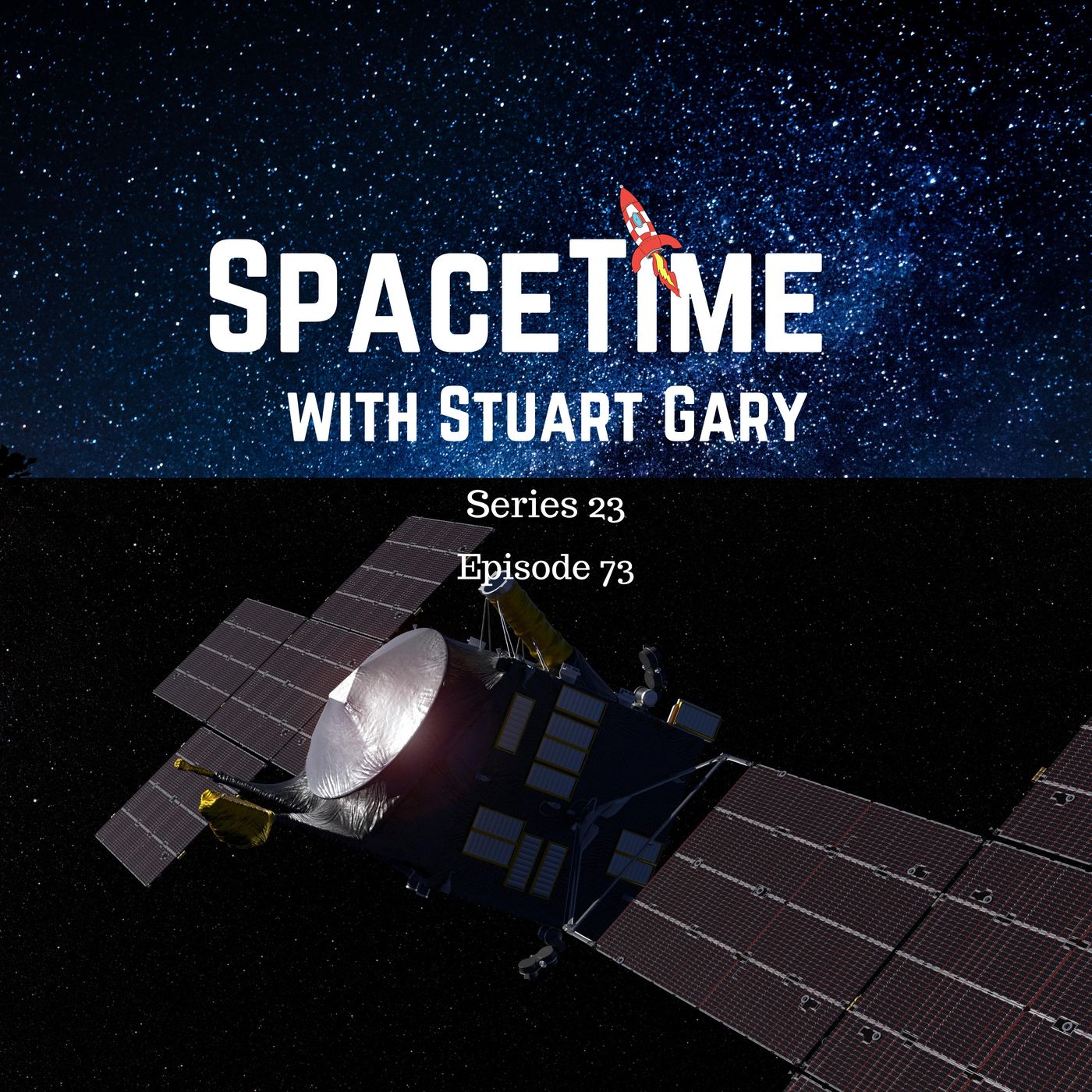
Construction Starts on NASA’s Psyche Spacecraft
*Construction starts on NASA’s Psyche spacecraft
Construction is now underway on NASA’s new spacecraft to explore the metal-rich main-belt asteroid 16 Psyche.
*A new hypothesis to try to explain the Tunguska event
Scientists have come up with a new explanation for the lack of debris from the Tunguska event – the largest asteroid impact with Earth in recent history.
*Space station forced to change course because of space junk
The International Space Station has been forced to make an unscheduled course correction to avoid a possible collision with a piece of space junk.
*China launches its 92nd reconnaissance spy satellite
China’s armada of spy satellites is continuing to expand with the launch of two more high-resolution reconnaissance satellites.
*The Science Report
A new more contagious variant of the COVID-19 virus.
The loss of seagrass meadows around Australia equates to carbon dioxide emissions from 5 million cars.
New semi-transparent solar cells that can be incorporated into window glass.
A new look at the history of flowering plants.
The new AI software capable of predicting whether a person is likely to be a criminal.
For more SpaceTime visit https://spacetimewithstuartgary.com (mobile friendly).
For enhanced Show Notes including photos to accompany this episode, visit: http://www.bitesz.com/spacetimeshownotes
Get immediate access to over 200 commercial-free, double and triple episode editions of SpaceTime plus extended interview bonus content. Subscribe via Patreon or Supercast....and share in the rewards. Details at www.patreon.com/spacetimewithstuartgary or Supercast - https://bitesznetwork.supercast.tech/
RSS feed: https://rss.acast.com/spacetime
Email: SpaceTime@bitesz.com
To receive the Astronomy Daily Newsletter free, direct to your inbox...just join our mailing list at www.bitesz.com/mailinglist or visit https://www.bitesz.com/astronomy-daily
See acast.com/privacy for privacy and opt-out information.
Become a supporter of this podcast: https://www.spreaker.com/podcast/spacetime-with-stuart-gary--2458531/support.
Available Results
Generated results are saved to your library for reuse and search.
Choose Template
Pick the result you want. You can review provider and model before generating.
A concise first-pass summary for understanding the episode quickly.
A comprehensive, source-grounded extraction of the reusable knowledge in an episode.
A comprehensive extraction focused on opportunities, strategy, markets, and company building.
Explicit actions, next steps, habits, recommendations, and things to avoid.
Repeatable methods, frameworks, mental models, processes, and systems.
A dedicated inventory of concrete resources named in the episode.
A concise first-pass summary for understanding the episode quickly.
A detailed readable summary organized by chapter or topic.
A navigable map of subjects, topic flow, and suggested chapters.
A comprehensive, source-grounded extraction of the reusable knowledge in an episode.
Reusable atomic knowledge units extracted from the episode.
A comprehensive extraction focused on health practices, protocols, claims, and safety caveats.
A comprehensive extraction focused on opportunities, strategy, markets, and company building.
Explicit actions, next steps, habits, recommendations, and things to avoid.
A dedicated inventory of concrete resources named in the episode.
A dedicated analysis of warnings, limitations, trade-offs, weak evidence, and uncertainty.
A concise first-pass summary for understanding the episode quickly.
A detailed readable summary organized by chapter or topic.
A navigable map of subjects, topic flow, and suggested chapters.
A comprehensive, source-grounded extraction of the reusable knowledge in an episode.
Reusable atomic knowledge units extracted from the episode.
A comprehensive extraction focused on health practices, protocols, claims, and safety caveats.
A comprehensive extraction focused on opportunities, strategy, markets, and company building.
Scientific findings, mechanisms, studies, hypotheses, and the limits of the evidence discussed.
Technologies, AI models, technical methods, capabilities, limitations, and adoption implications.
Investment theses, assets, catalysts, valuation reasoning, time horizons, and risks.
Chronologies, actors, causes, consequences, turning points, and competing historical interpretations.
Policies, proposals, stakeholders, arguments, implementation constraints, and predicted effects.
Career paths, skills, hiring signals, workplace decisions, transitions, and limitations of the advice.
Behavioral mechanisms, biases, motivation, habits, emotions, interventions, and evidence limitations.
Economic mechanisms, incentives, indicators, market structure, forecasts, and uncertainty.
Leadership principles, team systems, organizational design, culture, feedback, and failure modes.
Audience, positioning, messaging, acquisition, retention, experiments, metrics, and failed approaches.
Teaching methods, learning strategies, practice, feedback, assessment, and effectiveness evidence.
Theses, premises, arguments, objections, values, thought experiments, and unresolved questions.
Communication patterns, conflict, boundaries, expectations, repair methods, and contextual limitations.
Books, papers, authors, courses, and other learning resources mentioned in the episode.
Repeatable methods, frameworks, mental models, processes, and systems.
Explicit actions, next steps, habits, recommendations, and things to avoid.
Memorable statements and important claims with attribution and source context.
A dedicated inventory of concrete resources named in the episode.
A dedicated analysis of warnings, limitations, trade-offs, weak evidence, and uncertainty.