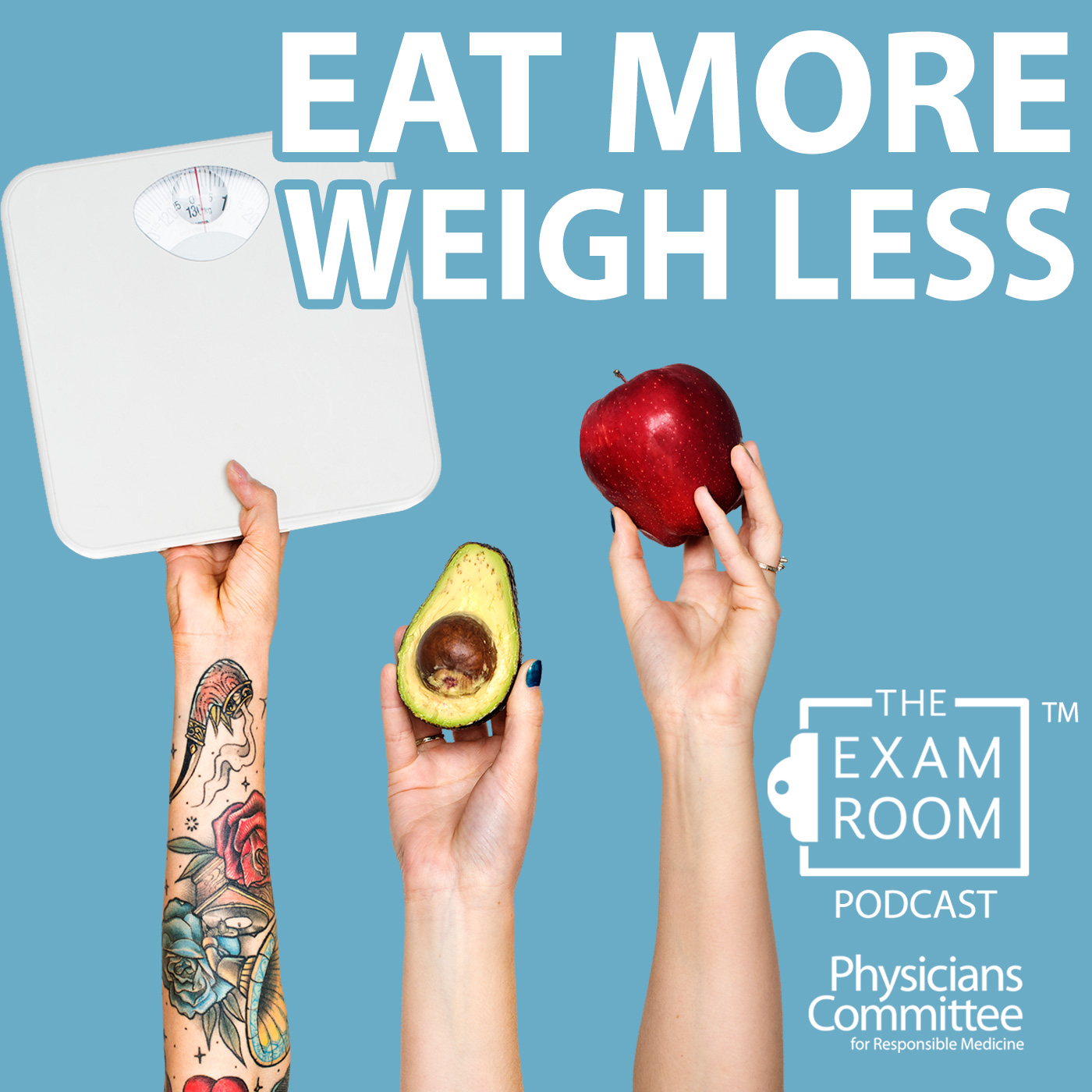
Eat More, Weigh Less: Calories & Plant-Based Diets
What if losing weight doesn't mean cutting back on portion sizes? Is there a way to really eat more but weigh less?
That's what "The Weight Loss Champion" Chuck Carroll explores on this episode of The Exam Room™.
The concept may sound too good to be true, but Dr. Steve Neabore sits down with Chuck to explore the science behind a plant-based diet and why many stop counting calories altogether once they've adopted it. Dr. Neabore also shows how empty the stomach looks after consuming 500 calories of oil, meat, or dairy compared to the same amount of calories from fruits and vegetables. The difference is amazing.
Then, dietician Maggie Neola returns to the show with a head-to-head comparison of some of America's most popular foods. How does the fat and calories found in the traditional recipes compare to the equally tasty vegan versions? In many instances you can save hundreds of calories by simply choosing the plant-based option!
As you'll hear, the benefits also extend beyond the new-and-improved person you see in the mirror. Opting for plant-based meals can also reduce cholesterol, heart disease, and cancer while increasing your life expectancy. Who wouldn't want to stick around a few more years after losing all that weight?!
If you live in the Washington, D.C. area, Dr. Neabore and Maggie Neola are available for consultation at the Barnard Medical Center.
Follow
Twitter: @ChuckCarrollWLC / @PCRM
IG: @ChuckCarrollWLC / @PhysiciansCommittee
Share the Show
Please pass along what you've learned on the show by sharing it with a friend and by subscribing on Apple Podcasts, Spotify or many other podcast providers. Also, please leave 5-star rating.
Available Results
Generated results are saved to your library for reuse and search.
Choose Template
Pick the result you want. You can review provider and model before generating.
A concise first-pass summary for understanding the episode quickly.
A comprehensive, source-grounded extraction of the reusable knowledge in an episode.
Scientific findings, mechanisms, studies, hypotheses, and the limits of the evidence discussed.
A dedicated analysis of warnings, limitations, trade-offs, weak evidence, and uncertainty.
Memorable statements and important claims with attribution and source context.
Technologies, AI models, technical methods, capabilities, limitations, and adoption implications.
A concise first-pass summary for understanding the episode quickly.
A detailed readable summary organized by chapter or topic.
A navigable map of subjects, topic flow, and suggested chapters.
A comprehensive, source-grounded extraction of the reusable knowledge in an episode.
Reusable atomic knowledge units extracted from the episode.
A comprehensive extraction focused on health practices, protocols, claims, and safety caveats.
A comprehensive extraction focused on opportunities, strategy, markets, and company building.
Explicit actions, next steps, habits, recommendations, and things to avoid.
A dedicated inventory of concrete resources named in the episode.
A dedicated analysis of warnings, limitations, trade-offs, weak evidence, and uncertainty.
A concise first-pass summary for understanding the episode quickly.
A detailed readable summary organized by chapter or topic.
A navigable map of subjects, topic flow, and suggested chapters.
A comprehensive, source-grounded extraction of the reusable knowledge in an episode.
Reusable atomic knowledge units extracted from the episode.
A comprehensive extraction focused on health practices, protocols, claims, and safety caveats.
A comprehensive extraction focused on opportunities, strategy, markets, and company building.
Scientific findings, mechanisms, studies, hypotheses, and the limits of the evidence discussed.
Technologies, AI models, technical methods, capabilities, limitations, and adoption implications.
Investment theses, assets, catalysts, valuation reasoning, time horizons, and risks.
Chronologies, actors, causes, consequences, turning points, and competing historical interpretations.
Policies, proposals, stakeholders, arguments, implementation constraints, and predicted effects.
Career paths, skills, hiring signals, workplace decisions, transitions, and limitations of the advice.
Behavioral mechanisms, biases, motivation, habits, emotions, interventions, and evidence limitations.
Economic mechanisms, incentives, indicators, market structure, forecasts, and uncertainty.
Leadership principles, team systems, organizational design, culture, feedback, and failure modes.
Audience, positioning, messaging, acquisition, retention, experiments, metrics, and failed approaches.
Teaching methods, learning strategies, practice, feedback, assessment, and effectiveness evidence.
Theses, premises, arguments, objections, values, thought experiments, and unresolved questions.
Communication patterns, conflict, boundaries, expectations, repair methods, and contextual limitations.
Books, papers, authors, courses, and other learning resources mentioned in the episode.
Repeatable methods, frameworks, mental models, processes, and systems.
Explicit actions, next steps, habits, recommendations, and things to avoid.
Memorable statements and important claims with attribution and source context.
A dedicated inventory of concrete resources named in the episode.
A dedicated analysis of warnings, limitations, trade-offs, weak evidence, and uncertainty.