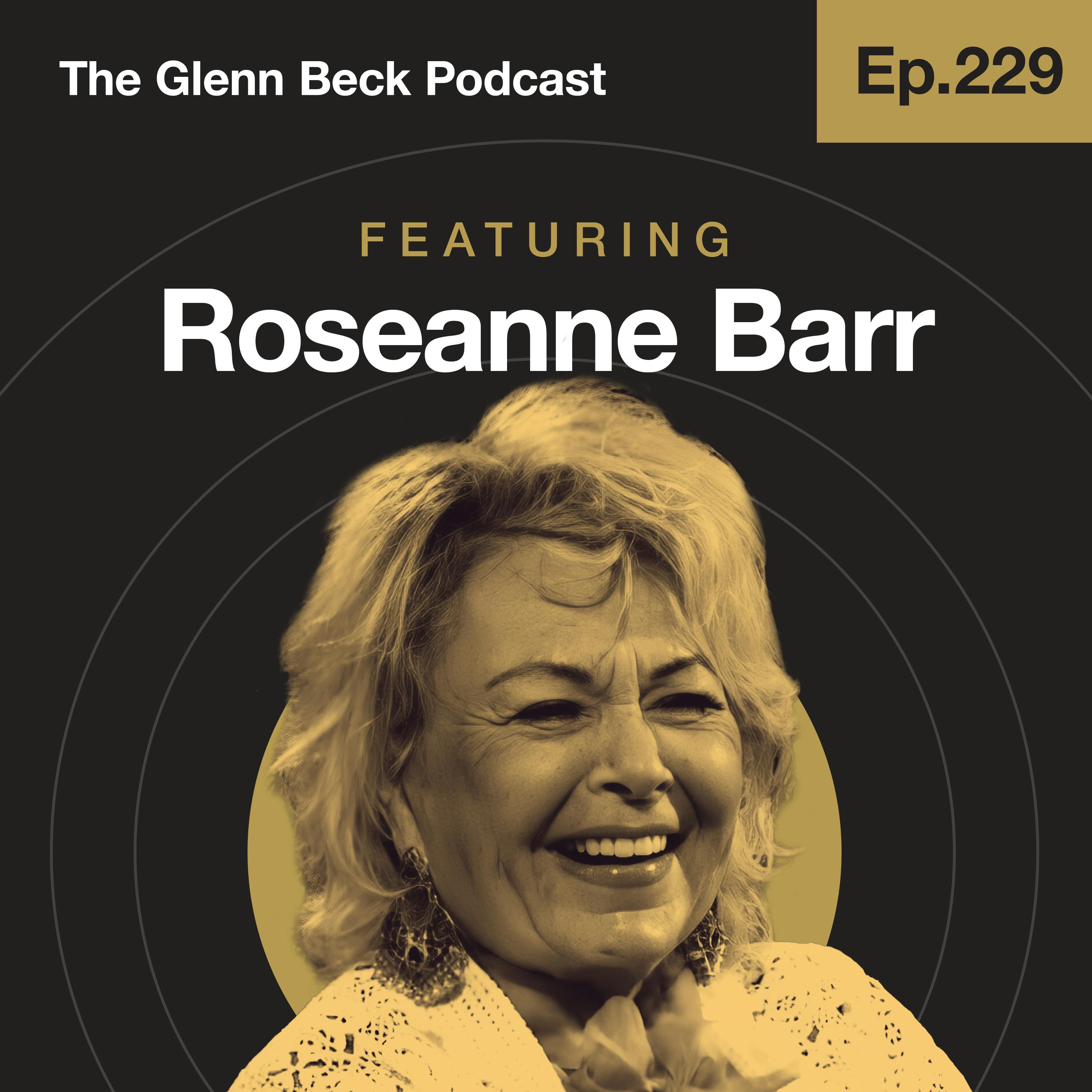
Ep 229 | Roseanne Barr ISN’T Sorry About All That | The Glenn Beck Podcast
If you’re waiting for Roseanne Barr to apologize, then she has one message for you: “Kiss my big, fat ass.” ABC canceled her hit sitcom and killed her off her character for a tweet about an adviser to President Barack Obama, but now she’s “back and stronger than ever.” After running for the presidential nomination of the Green Party in 2012 and seeing the “ungrateful little leftists bastards” at Occupy Wall Street for herself, she set off on a journey that landed her on the wrong side of the television industry that had once embraced as her a feminist pioneer and LGBT champion. The bawdy and beloved comedian, told by Johnny Carson that she would be a star, landed in hot water after her decision to portray "Roseanne" as a Trump supporter, a political position that John Goodman and the rest of the show's cast refused to take on, even as their characters. But being raised as the “only Jew in Salt Lake City,” Roseanne wasn’t afraid of being different. She and Glenn dish about the lifestyles of the rich and famous, and Roseanne gives her takes on stars like Taylor Swift, Marie Osmond, Mel Gibson, Robert De Niro, and even the ladies from "The View." No one, not even, as she describes it, “the lesbian-witch publicist cabal” pressuring her to apologize for her view on transgenderism, could stop Roseanne from calling it as she sees it, and she thinks our government is looking like a “Monty Python skit” and that whether Trump or Harris is elected in 2024, we may be facing a “big-ass civil war.” That’s why she had to drunkenly pray over Donald Trump that one time and also why she tells young comedians that “we have to be braver than we’ve ever been.”
Sponsors
Relief Factor
Relief Factor can help you live pain-free!
Visit https://www.relieffactor.com/ or call 800-4-RELIEF to save on your first order.
Good Ranchers
Bring 100% American meat to your family with Good Ranchers. For a limited time, claim the Good Ranchers Presential Promo by going to https://www.goodranchers.com/. Use the promo code GLENN for up to $1,200 in savings.
Learn more about your ad choices. Visit megaphone.fm/adchoices
Available Results
Generated results are saved to your library for reuse and search.
Choose Template
Pick the result you want. You can review provider and model before generating.
A concise first-pass summary for understanding the episode quickly.
A comprehensive, source-grounded extraction of the reusable knowledge in an episode.
Technologies, AI models, technical methods, capabilities, limitations, and adoption implications.
Repeatable methods, frameworks, mental models, processes, and systems.
A dedicated analysis of warnings, limitations, trade-offs, weak evidence, and uncertainty.
A dedicated inventory of concrete resources named in the episode.
A concise first-pass summary for understanding the episode quickly.
A detailed readable summary organized by chapter or topic.
A navigable map of subjects, topic flow, and suggested chapters.
A comprehensive, source-grounded extraction of the reusable knowledge in an episode.
Reusable atomic knowledge units extracted from the episode.
A comprehensive extraction focused on health practices, protocols, claims, and safety caveats.
A comprehensive extraction focused on opportunities, strategy, markets, and company building.
Explicit actions, next steps, habits, recommendations, and things to avoid.
A dedicated inventory of concrete resources named in the episode.
A dedicated analysis of warnings, limitations, trade-offs, weak evidence, and uncertainty.
A concise first-pass summary for understanding the episode quickly.
A detailed readable summary organized by chapter or topic.
A navigable map of subjects, topic flow, and suggested chapters.
A comprehensive, source-grounded extraction of the reusable knowledge in an episode.
Reusable atomic knowledge units extracted from the episode.
A comprehensive extraction focused on health practices, protocols, claims, and safety caveats.
A comprehensive extraction focused on opportunities, strategy, markets, and company building.
Scientific findings, mechanisms, studies, hypotheses, and the limits of the evidence discussed.
Technologies, AI models, technical methods, capabilities, limitations, and adoption implications.
Investment theses, assets, catalysts, valuation reasoning, time horizons, and risks.
Chronologies, actors, causes, consequences, turning points, and competing historical interpretations.
Policies, proposals, stakeholders, arguments, implementation constraints, and predicted effects.
Career paths, skills, hiring signals, workplace decisions, transitions, and limitations of the advice.
Behavioral mechanisms, biases, motivation, habits, emotions, interventions, and evidence limitations.
Economic mechanisms, incentives, indicators, market structure, forecasts, and uncertainty.
Leadership principles, team systems, organizational design, culture, feedback, and failure modes.
Audience, positioning, messaging, acquisition, retention, experiments, metrics, and failed approaches.
Teaching methods, learning strategies, practice, feedback, assessment, and effectiveness evidence.
Theses, premises, arguments, objections, values, thought experiments, and unresolved questions.
Communication patterns, conflict, boundaries, expectations, repair methods, and contextual limitations.
Books, papers, authors, courses, and other learning resources mentioned in the episode.
Repeatable methods, frameworks, mental models, processes, and systems.
Explicit actions, next steps, habits, recommendations, and things to avoid.
Memorable statements and important claims with attribution and source context.
A dedicated inventory of concrete resources named in the episode.
A dedicated analysis of warnings, limitations, trade-offs, weak evidence, and uncertainty.