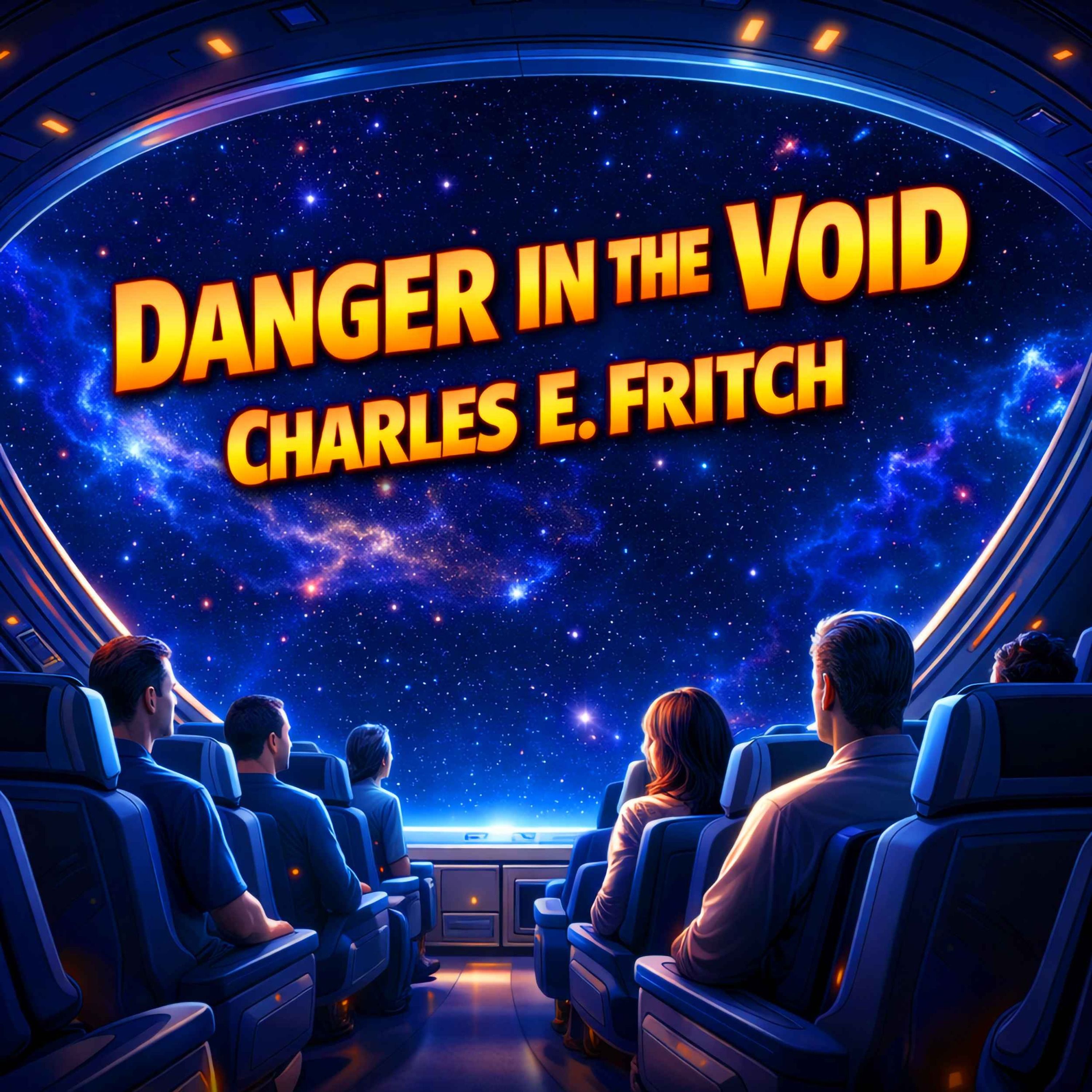
Danger In The Void by Charles E. Fritch - Charles E. Fritch Sci Fi
Today on the lost sci-fi podcast an author who knew what he wanted to be when he was only 10 years old, how many of us can say that? This native New Yorker kept story ideas in a notebook before he was a teenager.
Born in Utica New York on the 20th of January 1927. Like many authors of his time he served in the United States Army during World War II, he was a paratrooper with the 82nd Airborne. After the war he graduated from Syracuse University with a degree in English and a minor in Psychology. Why Psychology? He said he did it so he could "get inside the heads of the characters in his stories“. Obviously this man had a plan!
Buy Me a Coffee - https://lostscifi.com/coffee
Newsletter - https://lostscifi.com/free/
Facebook - https://lostscifi.com/facebook
YouTube - https://lostscifi.com/youtube
Instagram - https://www.instagram.com/lostscifiguy
Although we know of him because of his work as a Science Fiction author he didn’t stop there, he also wrote fantasy, horror and mysteries. He wrote more than 50 short fiction stories starting in 1951 and kept writing short sci-fi for almost 50 years. In addition to writing he was the editor of Mike Shayne Mystery Magazine from 1979 until 1985 and he was the editor and publisher of the sci-fi magazine Gamma. Gamma wasn’t exactly a success, publishing only 5 issues between 1963 and 1965. Gamma didn’t fail because of a lack of talented writers. The debut of Gamma in 1963 featured a story by Thomas Lanier Williams the 3rd, better known as American playwright and screenwriter Tennessee Williams. Oh and Ray Bradbury and Rod Serling also contributed stories to the magazines very first offering. A near mint condition copy of that first issue of Gamma sold not that long ago for $125, but don’t worry a slightly less pristine copy is still available if you’re an aspiring collector for only $16.
I thought about buying it but shipping to Costa Rica where I have lived for the last 5 years would add another $50 and take up to month to get here.
Our accomplished and successful author wrote a few provocative mystery novels, including Strip for Murder and Psycho Sinner as Eric Thomas, 7 Deadly Sinners as Christopher Sly and Negative of a Nude. He was also known to have used the pen name Chester H. Carlfi and may have written at least one novel under the House Name Troy Conway, but we don’t know for sure.
His writing career began in 1951 with "The Wallpaper" which was published in Other Worlds magazine. His legal name is Charles Edward Fritch, but most know of him as Charles E. Fritch.
You’ll find Fritch in the Internet Movie Database, also known as IMDB, thanks to a short story he wrote titled The Misfortune Cookie, which was adapted for an episode of the television series The Twilight Zone which aired in 1986.
Silvia secretly planned to divorce George when they reached Arcturus. But a space journey can alter a careful plan—or hatch a worse one!
From Imagination Stories of Science and Fantasy in August 1954, Danger In The Void by Charles E. Fritch...
https://lostscifi.com/podcast/danger-in-the-void-by-charles-e-fritch-episode-7/
Listen without commercials and enjoy exclusive bonus episodes every month with Lost Sci-Fi Premium—start your free 7-day trial today. https://lostscifi.supercast.com/
Hosted by Simplecast, an AdsWizz company. See pcm.adswizz.com for information about our collection and use of personal data for advertising.
Available Results
Generated results are saved to your library for reuse and search.
Choose Template
Pick the result you want. You can review provider and model before generating.
A concise first-pass summary for understanding the episode quickly.
A comprehensive, source-grounded extraction of the reusable knowledge in an episode.
A comprehensive extraction focused on opportunities, strategy, markets, and company building.
Explicit actions, next steps, habits, recommendations, and things to avoid.
Repeatable methods, frameworks, mental models, processes, and systems.
A dedicated inventory of concrete resources named in the episode.
A concise first-pass summary for understanding the episode quickly.
A detailed readable summary organized by chapter or topic.
A navigable map of subjects, topic flow, and suggested chapters.
A comprehensive, source-grounded extraction of the reusable knowledge in an episode.
Reusable atomic knowledge units extracted from the episode.
A comprehensive extraction focused on health practices, protocols, claims, and safety caveats.
A comprehensive extraction focused on opportunities, strategy, markets, and company building.
Explicit actions, next steps, habits, recommendations, and things to avoid.
A dedicated inventory of concrete resources named in the episode.
A dedicated analysis of warnings, limitations, trade-offs, weak evidence, and uncertainty.
A concise first-pass summary for understanding the episode quickly.
A detailed readable summary organized by chapter or topic.
A navigable map of subjects, topic flow, and suggested chapters.
A comprehensive, source-grounded extraction of the reusable knowledge in an episode.
Reusable atomic knowledge units extracted from the episode.
A comprehensive extraction focused on health practices, protocols, claims, and safety caveats.
A comprehensive extraction focused on opportunities, strategy, markets, and company building.
Scientific findings, mechanisms, studies, hypotheses, and the limits of the evidence discussed.
Technologies, AI models, technical methods, capabilities, limitations, and adoption implications.
Investment theses, assets, catalysts, valuation reasoning, time horizons, and risks.
Chronologies, actors, causes, consequences, turning points, and competing historical interpretations.
Policies, proposals, stakeholders, arguments, implementation constraints, and predicted effects.
Career paths, skills, hiring signals, workplace decisions, transitions, and limitations of the advice.
Behavioral mechanisms, biases, motivation, habits, emotions, interventions, and evidence limitations.
Economic mechanisms, incentives, indicators, market structure, forecasts, and uncertainty.
Leadership principles, team systems, organizational design, culture, feedback, and failure modes.
Audience, positioning, messaging, acquisition, retention, experiments, metrics, and failed approaches.
Teaching methods, learning strategies, practice, feedback, assessment, and effectiveness evidence.
Theses, premises, arguments, objections, values, thought experiments, and unresolved questions.
Communication patterns, conflict, boundaries, expectations, repair methods, and contextual limitations.
Books, papers, authors, courses, and other learning resources mentioned in the episode.
Repeatable methods, frameworks, mental models, processes, and systems.
Explicit actions, next steps, habits, recommendations, and things to avoid.
Memorable statements and important claims with attribution and source context.
A dedicated inventory of concrete resources named in the episode.
A dedicated analysis of warnings, limitations, trade-offs, weak evidence, and uncertainty.