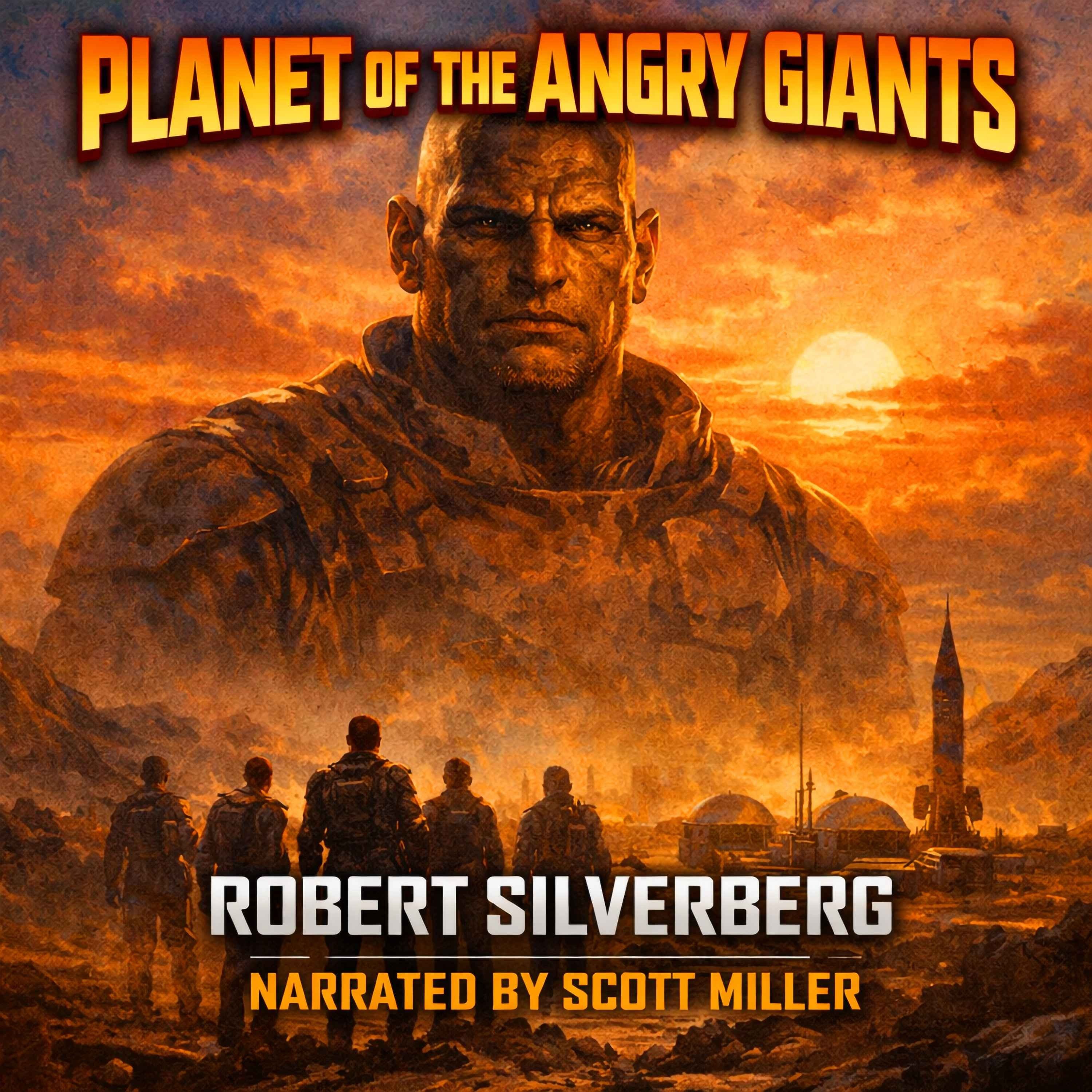
Planet of the Angry Giants by Robert Silverberg
The inhabitants of Dunhill V were gigantic. They were peaceful and good natured until something happened to upset them–and then their wrath was truly terrific! Planet of the Angry Giants by Robert Silverberg, that’s next on The Lost Sci-Fi Podcast, with at least one lost vintage sci-fi short story in every episode.
Welcome to our new listeners in Leicester England, Luxembourg, Omaha Nebraska, Inglewood California, Vancouver British Columbia and Annadale Minnesota.
More new 5 star ratings and reviews on Apple Podcasts. Mo_San says, “By far the most bang for your buck short stories podcast. I’ve listened to a ton of short story podcasts over the years, I can safely say, this is a keeper. I come every week to listen to the latest gem posted on this podcast. The narrator makes it extra special with his performance taking the listener to the universe of the story.” Thanks Mo_San!
And this 5 star rating and review on Apple podcasts comes to us from Zr357, “Outstanding!!! This is hands down the best sci-fi podcast on the planet!! The narration is out of this world!!” Thank you Zr357!
This is our third podcast this week and we’re doing three more podcasts next week. It’s our way of saying thank you to the hundreds of new podcast and Youtube listeners from all over the world. We appreciate you and we listen to you. Send us an email anytime about anything at scott@lostscifi.com.
Big things were happening in August 1959. On August 7th Explorer VI became the first satellite to transmit a live photo of Earth from space. Also, in August 1959 Super Science Fiction magazine featured two stories by Robert Silverberg even though his name isn’t listed in the credits. Silverberg used a pen name for Monsters That Once Were Men which was featured previously on The Lost Sci-Fi Podcast. He used the pen name Dirk Clinton for the second story in the issue. Turn with me to page 62 for Planet of The Angry Giants by Robert Silverberg
Next week on The Lost Sci-Fi Podcast, a request from Jesse, Strange how often the Millenium has been at hand. The idea is peace on Earth, see, and the way to do it is by figuring out angles. Watchbird by Robert Sheckley. That’s next week on The Lost Sci-Fi Podcast, with at least one lost vintage sci-fi short story in every episode.
Buy Me a Coffee - https://lostscifi.com/coffee
Newsletter - https://lostscifi.com/free/
Facebook - https://lostscifi.com/facebook
YouTube - https://lostscifi.com/youtube
Instagram - https://www.instagram.com/lostscifiguy
Merch - https://lostscifi.creator-spring.com/
https://lostscifi.com/podcast/planet-of-the-angry-giants-by-robert-silverberg-episode-80/
Listen without commercials and enjoy exclusive bonus episodes every month with Lost Sci-Fi Premium—start your free 7-day trial today. https://lostscifi.supercast.com/
Hosted by Simplecast, an AdsWizz company. See pcm.adswizz.com for information about our collection and use of personal data for advertising.
Available Results
Generated results are saved to your library for reuse and search.
Choose Template
Pick the result you want. You can review provider and model before generating.
A concise first-pass summary for understanding the episode quickly.
A comprehensive, source-grounded extraction of the reusable knowledge in an episode.
A comprehensive extraction focused on opportunities, strategy, markets, and company building.
Explicit actions, next steps, habits, recommendations, and things to avoid.
Repeatable methods, frameworks, mental models, processes, and systems.
A dedicated inventory of concrete resources named in the episode.
A concise first-pass summary for understanding the episode quickly.
A detailed readable summary organized by chapter or topic.
A navigable map of subjects, topic flow, and suggested chapters.
A comprehensive, source-grounded extraction of the reusable knowledge in an episode.
Reusable atomic knowledge units extracted from the episode.
A comprehensive extraction focused on health practices, protocols, claims, and safety caveats.
A comprehensive extraction focused on opportunities, strategy, markets, and company building.
Explicit actions, next steps, habits, recommendations, and things to avoid.
A dedicated inventory of concrete resources named in the episode.
A dedicated analysis of warnings, limitations, trade-offs, weak evidence, and uncertainty.
A concise first-pass summary for understanding the episode quickly.
A detailed readable summary organized by chapter or topic.
A navigable map of subjects, topic flow, and suggested chapters.
A comprehensive, source-grounded extraction of the reusable knowledge in an episode.
Reusable atomic knowledge units extracted from the episode.
A comprehensive extraction focused on health practices, protocols, claims, and safety caveats.
A comprehensive extraction focused on opportunities, strategy, markets, and company building.
Scientific findings, mechanisms, studies, hypotheses, and the limits of the evidence discussed.
Technologies, AI models, technical methods, capabilities, limitations, and adoption implications.
Investment theses, assets, catalysts, valuation reasoning, time horizons, and risks.
Chronologies, actors, causes, consequences, turning points, and competing historical interpretations.
Policies, proposals, stakeholders, arguments, implementation constraints, and predicted effects.
Career paths, skills, hiring signals, workplace decisions, transitions, and limitations of the advice.
Behavioral mechanisms, biases, motivation, habits, emotions, interventions, and evidence limitations.
Economic mechanisms, incentives, indicators, market structure, forecasts, and uncertainty.
Leadership principles, team systems, organizational design, culture, feedback, and failure modes.
Audience, positioning, messaging, acquisition, retention, experiments, metrics, and failed approaches.
Teaching methods, learning strategies, practice, feedback, assessment, and effectiveness evidence.
Theses, premises, arguments, objections, values, thought experiments, and unresolved questions.
Communication patterns, conflict, boundaries, expectations, repair methods, and contextual limitations.
Books, papers, authors, courses, and other learning resources mentioned in the episode.
Repeatable methods, frameworks, mental models, processes, and systems.
Explicit actions, next steps, habits, recommendations, and things to avoid.
Memorable statements and important claims with attribution and source context.
A dedicated inventory of concrete resources named in the episode.
A dedicated analysis of warnings, limitations, trade-offs, weak evidence, and uncertainty.