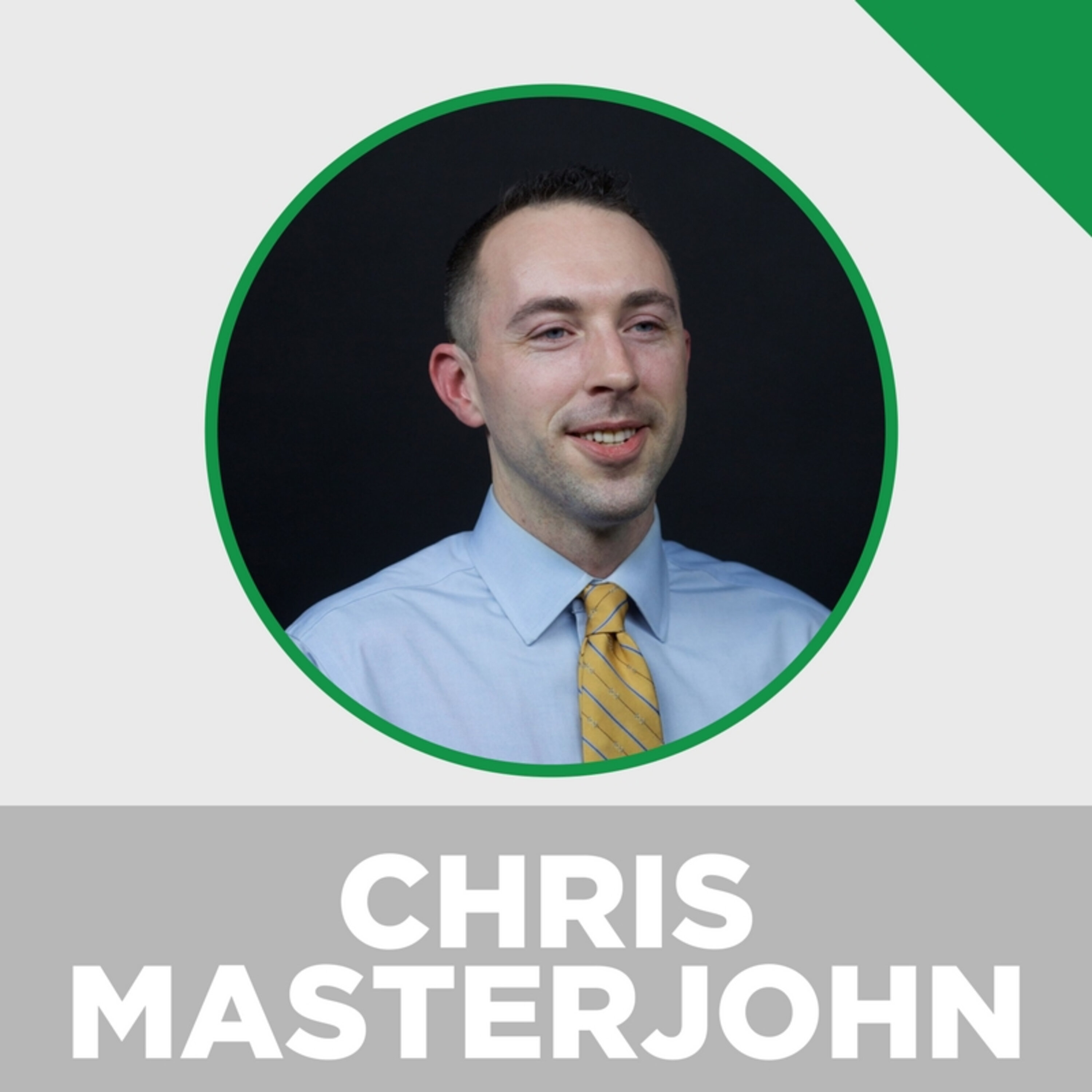
What Happens If You Take Too Much Creatine, A Notorious Deficiency On High-Protein Diets, How To Become A Nutrition Ninja & More With Chris Masterjohn.
https://bengreenfieldfitness.com/masterjohn
Do you love health and wellness so much that you just want to read everything you can about it, but often find yourself understanding only half (or even less) of what you read?
Do you need to learn biochemistry for school but wish you could learn the material in a more relevant, lively, or entertaining way? Do you already have a good foundation, but want a unique out-of-the-box perspective synthesized from a deep dive into the scientific literature?
If so, today's podcast is for you. My guest is Dr. Chris Masterjohn, former podcast guest from the episode "Why Sugar Isn’t As Dangerous As You Might Think, How Your Genetics Affect Your Sleep, Liver Toxicity & More With Dr. Chris Masterjohn." Chris earned his PhD in Nutritional Sciences in 2012 from the University of Connecticut at Storrs, served as a Postdoctoral Research Associate at the University of Illinois at Urbana-Champaign from 2012 to 2014, and served as Assistant Professor of Health and Nutrition Sciences at Brooklyn College from 2014 to 2016. He now works independently in health and nutrition research, education, and consulting. Chris has authored or co-authored ten peer-reviewed publications. His podcast, Mastering Nutrition, his two video series, Chris Masterjohn Lite and Masterclass With Masterjohn, and his blog can all be found on his web site at chrismasterjohnphd.com. You can also find him on Facebook, Instagram, Twitter, YouTube, and Snapchat, where his username is @chrismasterjohn.
In today's podcast, we take a deep dive into Chris's brand new program entitled "Masterclass With Masterjohn Pro: Energy Metabolism", and you'll discover:
-Why human beings need to eat such an enormous amount of food...[9:35]
-What happens if you take too much creatine...[23:57]
-Why it matters whether you eat protein, carbs, or fat, since all depend on cellular respiration...[32:45]
-Why some macronutrients actually require more micronutrients than others to be burnt...[49:18 & 56:05]
-A missing nutrient that you must take in if you are on a high protein diet...[60:45]
-Why anyone should bother learning this stuff in mechanistic detail rather than just learning what to eat and when...[64:55]
-The new online "masterclasses" that Chris is now teaching...[68:50]
-And much more!
Resources from this episode:
-Masterclass With Masterjohn Pro (special discount when you use that link!)
Show Sponsors:
-HealthGains - Text the word "GREENFIELD" to 313131 to receive a $150 voucher toward your HealthGAINS treatment.
-KION - Purchase any three products and receive a free organic bamboo T-shirt! Go to GetKion.com to check out the sale, and choose your three products.
-Organifi - Go to BenGreenfieldFitness.com/Organifi and use discount code BEN for 20% anything else!
Do you have questions, thoughts or feedback for Chris or me? Leave your comments at BenGreenfieldFitness.com and one of us will reply!
See omnystudio.com/listener for privacy information.
Available Results
Generated results are saved to your library for reuse and search.
Choose Template
Pick the result you want. You can review provider and model before generating.
A concise first-pass summary for understanding the episode quickly.
A comprehensive, source-grounded extraction of the reusable knowledge in an episode.
A comprehensive extraction focused on health practices, protocols, claims, and safety caveats.
A dedicated analysis of warnings, limitations, trade-offs, weak evidence, and uncertainty.
Repeatable methods, frameworks, mental models, processes, and systems.
Scientific findings, mechanisms, studies, hypotheses, and the limits of the evidence discussed.
A concise first-pass summary for understanding the episode quickly.
A detailed readable summary organized by chapter or topic.
A navigable map of subjects, topic flow, and suggested chapters.
A comprehensive, source-grounded extraction of the reusable knowledge in an episode.
Reusable atomic knowledge units extracted from the episode.
A comprehensive extraction focused on health practices, protocols, claims, and safety caveats.
A comprehensive extraction focused on opportunities, strategy, markets, and company building.
Explicit actions, next steps, habits, recommendations, and things to avoid.
A dedicated inventory of concrete resources named in the episode.
A dedicated analysis of warnings, limitations, trade-offs, weak evidence, and uncertainty.
A concise first-pass summary for understanding the episode quickly.
A detailed readable summary organized by chapter or topic.
A navigable map of subjects, topic flow, and suggested chapters.
A comprehensive, source-grounded extraction of the reusable knowledge in an episode.
Reusable atomic knowledge units extracted from the episode.
A comprehensive extraction focused on health practices, protocols, claims, and safety caveats.
A comprehensive extraction focused on opportunities, strategy, markets, and company building.
Scientific findings, mechanisms, studies, hypotheses, and the limits of the evidence discussed.
Technologies, AI models, technical methods, capabilities, limitations, and adoption implications.
Investment theses, assets, catalysts, valuation reasoning, time horizons, and risks.
Chronologies, actors, causes, consequences, turning points, and competing historical interpretations.
Policies, proposals, stakeholders, arguments, implementation constraints, and predicted effects.
Career paths, skills, hiring signals, workplace decisions, transitions, and limitations of the advice.
Behavioral mechanisms, biases, motivation, habits, emotions, interventions, and evidence limitations.
Economic mechanisms, incentives, indicators, market structure, forecasts, and uncertainty.
Leadership principles, team systems, organizational design, culture, feedback, and failure modes.
Audience, positioning, messaging, acquisition, retention, experiments, metrics, and failed approaches.
Teaching methods, learning strategies, practice, feedback, assessment, and effectiveness evidence.
Theses, premises, arguments, objections, values, thought experiments, and unresolved questions.
Communication patterns, conflict, boundaries, expectations, repair methods, and contextual limitations.
Books, papers, authors, courses, and other learning resources mentioned in the episode.
Repeatable methods, frameworks, mental models, processes, and systems.
Explicit actions, next steps, habits, recommendations, and things to avoid.
Memorable statements and important claims with attribution and source context.
A dedicated inventory of concrete resources named in the episode.
A dedicated analysis of warnings, limitations, trade-offs, weak evidence, and uncertainty.