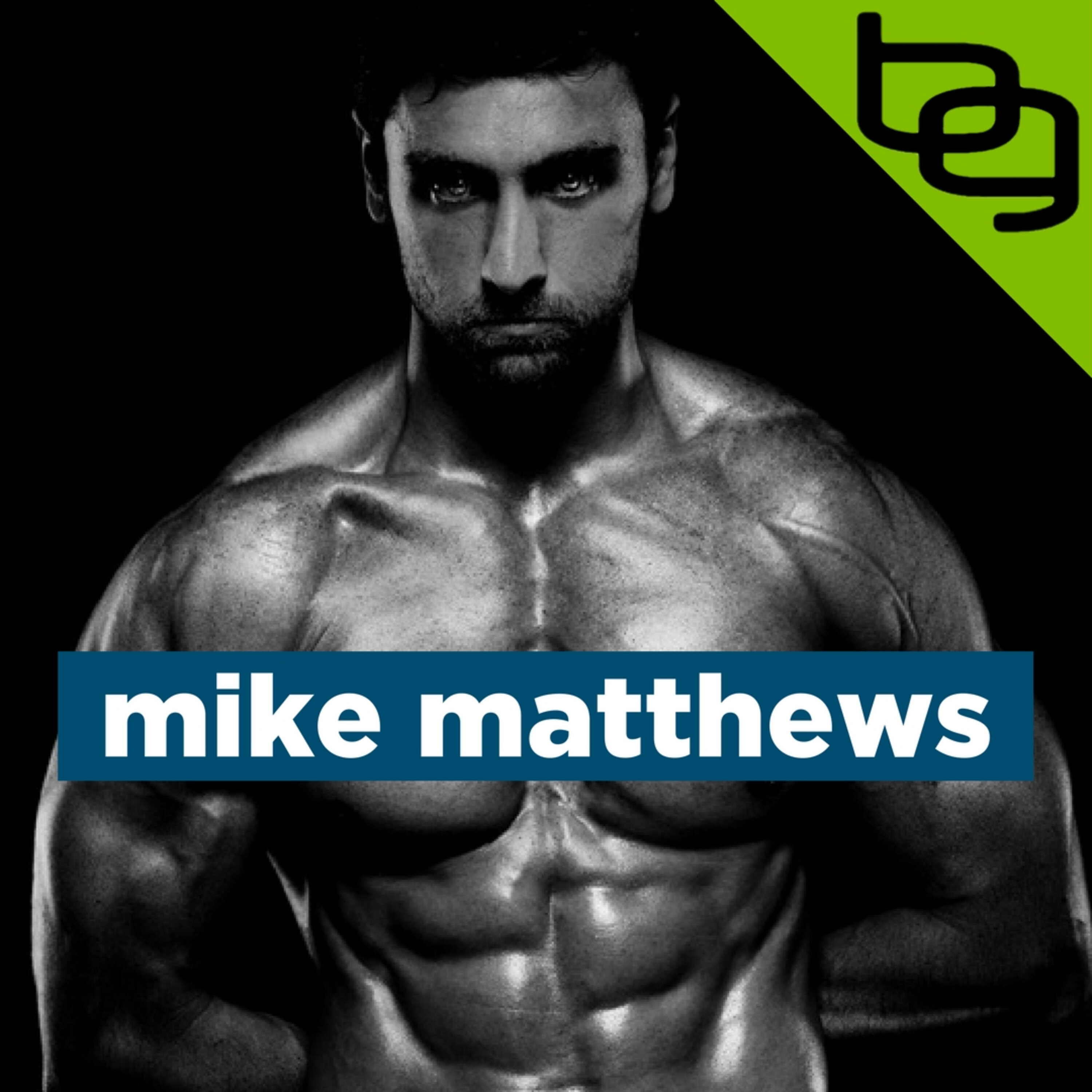
"If It Fits Your Macros", Is Clean Eating A Waste Of Time, Hex Bars, Can't-Miss Supplements & More With Mike Matthews.
https://bengreenfieldfitness.com/mikematthews
Mike Matthews is a bestselling fitness author of books like "Bigger, Leaner, Stronger" and "Thinner, Leaner, Stronger". He is also the creator of the blog MuscleForLife.com and the supplement company Legion Athletics. His scientific approach to building muscle and losing fat has helped thousands of people build strong, lean, muscular, and healthy bodies, and his work has been featured in many popular outlets including Bodybuilding.com, Esquire, Men’s Health, Elle, and many more. Here's a small sampling of a few of Mike's core beliefs about getting into the best shape of your life:
- Lifting light weights for high reps is basically a waste of time. If your routine doesn’t revolve around heavy lifting, you’re doing it wrong.
- Getting lean, and even super lean, does NOT require hours upon hours of grueling cardio, or crash dieting that leaves you starving and miserable every day.
- If you know what you’re doing, you can gain 20-30 pounds of lean mass (yes, muscle) in your first year of training, regardless of your genetics.
- Pretty much every machine in the gym should be avoided, and most exercises are horribly ineffective. Which brings me to the next point…
- The idea that you have to constantly change your workout routine or your body will adapt and plateau is a lie. I change my routine once every 2-4 months and consistently get stronger month after month.
- You don’t have to exercise for more than 1 hour per day, 5 days per week to be in peak physical condition. I personally lift weights Monday through Friday for about 45 minutes, and do 3-4 cardio sessions per week, with each session running about 30 minutes. And I do the cardio mainly because I enjoy it.
- HOW MUCH you eat determines the effectiveness of your diet, not WHAT or WHEN. No matter what you’re doing with your diet, you can always work in cheats and indulgences and achieve your goals.
During our discussion, you'll discover: -Why Mike now works out far less than what he used to, and gets better results...[10:45] -Mike's opinion on the research that high reps, low weight actually works for hypertrophy...[14:20 & 20:00] -Why both Ben and Mike like the hex bar for deadlifting...[32:50] -Why Mike says clean eating isn't the key to weight loss or muscle gain...[40:30] -The can't-miss components of Mike's morning routine...[53:50] -What Mike's diet and supplement regimen looks like, and the four supplements he always takes...[57:10] -And much more!
Resources from this episode: -Mike's extensive library of books -Legion Supplements (Mike's company) -DNAfit Genetic Testing for Power vs. Endurance -Hex bar deadlift bar -Eat Wheat book
Show Sponsors:
-Casper - Get $50 toward any mattress purchase by visiting www.casper.com/ben and using BEN.
-HealthGains - Text the word "GAIN" to 313131 to receive $250 off HealthGains' HGH, testosterone or sexual health services at their Aventura, Florida location.
-BiOptimizers - Go to BenGreenfieldFitness.com/biOpt to automatically get 10% off your order of Masszymes and P3-OM probiotic.
Do you have questions, thoughts or feedback for Mike or me? Leave your comments at BenGreenfieldFitness.com and one of us will reply!
See omnystudio.com/listener for privacy information.
Available Results
Generated results are saved to your library for reuse and search.
Choose Template
Pick the result you want. You can review provider and model before generating.
A concise first-pass summary for understanding the episode quickly.
A comprehensive, source-grounded extraction of the reusable knowledge in an episode.
A comprehensive extraction focused on health practices, protocols, claims, and safety caveats.
A dedicated analysis of warnings, limitations, trade-offs, weak evidence, and uncertainty.
Repeatable methods, frameworks, mental models, processes, and systems.
A comprehensive extraction focused on opportunities, strategy, markets, and company building.
A concise first-pass summary for understanding the episode quickly.
A detailed readable summary organized by chapter or topic.
A navigable map of subjects, topic flow, and suggested chapters.
A comprehensive, source-grounded extraction of the reusable knowledge in an episode.
Reusable atomic knowledge units extracted from the episode.
A comprehensive extraction focused on health practices, protocols, claims, and safety caveats.
A comprehensive extraction focused on opportunities, strategy, markets, and company building.
Explicit actions, next steps, habits, recommendations, and things to avoid.
A dedicated inventory of concrete resources named in the episode.
A dedicated analysis of warnings, limitations, trade-offs, weak evidence, and uncertainty.
A concise first-pass summary for understanding the episode quickly.
A detailed readable summary organized by chapter or topic.
A navigable map of subjects, topic flow, and suggested chapters.
A comprehensive, source-grounded extraction of the reusable knowledge in an episode.
Reusable atomic knowledge units extracted from the episode.
A comprehensive extraction focused on health practices, protocols, claims, and safety caveats.
A comprehensive extraction focused on opportunities, strategy, markets, and company building.
Scientific findings, mechanisms, studies, hypotheses, and the limits of the evidence discussed.
Technologies, AI models, technical methods, capabilities, limitations, and adoption implications.
Investment theses, assets, catalysts, valuation reasoning, time horizons, and risks.
Chronologies, actors, causes, consequences, turning points, and competing historical interpretations.
Policies, proposals, stakeholders, arguments, implementation constraints, and predicted effects.
Career paths, skills, hiring signals, workplace decisions, transitions, and limitations of the advice.
Behavioral mechanisms, biases, motivation, habits, emotions, interventions, and evidence limitations.
Economic mechanisms, incentives, indicators, market structure, forecasts, and uncertainty.
Leadership principles, team systems, organizational design, culture, feedback, and failure modes.
Audience, positioning, messaging, acquisition, retention, experiments, metrics, and failed approaches.
Teaching methods, learning strategies, practice, feedback, assessment, and effectiveness evidence.
Theses, premises, arguments, objections, values, thought experiments, and unresolved questions.
Communication patterns, conflict, boundaries, expectations, repair methods, and contextual limitations.
Books, papers, authors, courses, and other learning resources mentioned in the episode.
Repeatable methods, frameworks, mental models, processes, and systems.
Explicit actions, next steps, habits, recommendations, and things to avoid.
Memorable statements and important claims with attribution and source context.
A dedicated inventory of concrete resources named in the episode.
A dedicated analysis of warnings, limitations, trade-offs, weak evidence, and uncertainty.