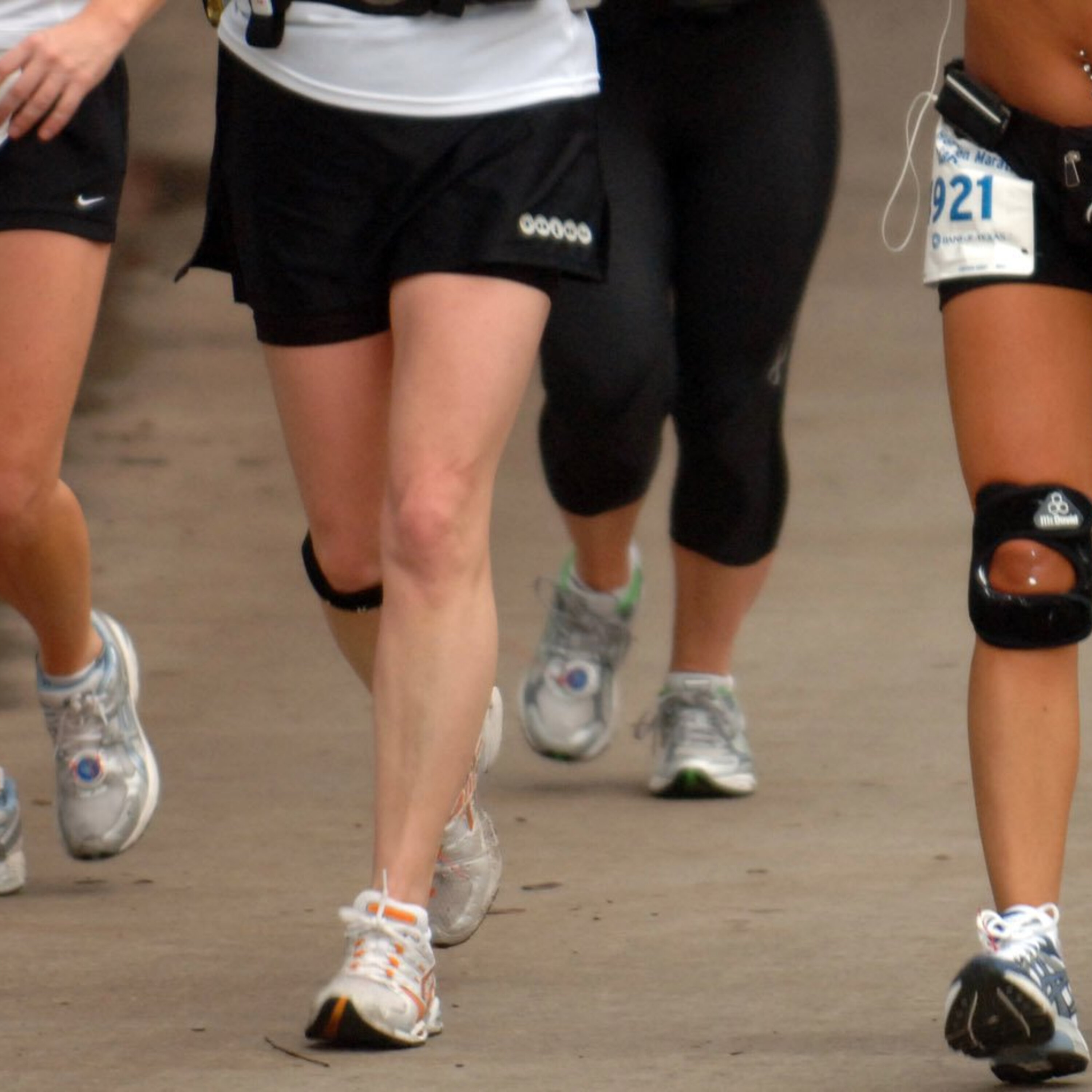
How To Keep Running From Destroying Your Body
For the past 28 days, I've been trying out a new protocol.
Each of my days starts with about 5 minutes of a mobility overhaul program I've been following.
For example, on Mondays I do something called a "Couch Stretch", followed by a "Two-Ball Smash & Floss" on my shins. On Tuesdays, I have a T-Spine Global Smash and a Global Gut Smash. Wednesdays is a Plantar Blitzkrieg.
I've grabbed all these weird, new moves from page 250 in the new book "Ready to Run", in which author Kelly Starrett lays out a month long, day-by-day Mobility Overhaul Plan. Kelly, who is also the author of The New York Times and Wall Street Journal Bestseller "Becoming A Supple Leopard", just wrote this new book for runners, and it's designed to help you cross the bridge from the injury-ridden world of the modern runner to the promised land that the new fad of barefoot running has led us to believe exists, to live a running life free from injury, to unlock all the athletic potential that may be hidden within and to allow you to run faster, more efficiently and for longer periods of time. Kelly travels the world teaching his wildly popular Crossfit Movement & Mobility Course and also works with elite Army, Navy, Air Force, Marines, and Coast Guard forces, athletes from the NFL, NBA, NHL, MLB, and national and world ranked strength and power athletes. He also consults with Olympic teams and universities and is a featured speaker at strength and conditioning conferences nationwide. Kelly believes every human being should know how to move and be able to perform basic maintenance on themselves, and in our discussion we talk about neutral feet, flip-flops, couch stretching, VooDoo flossing, Kelly's daily mobility routine and much more!
Do you have questions, comments, or feedback about how to keep running from destroying your body? Leave your thoughts at BenGreenfieldFitness.com, and be sure to grab the new book "Ready To Run". Also, you can click here for the previous "How To Crush The Beef Jerky In Your Quads & Become A Supple Leopard" mobility podcast I recorded with Kelly last year.
See omnystudio.com/listener for privacy information.
Available Results
Generated results are saved to your library for reuse and search.
Choose Template
Pick the result you want. You can review provider and model before generating.
A concise first-pass summary for understanding the episode quickly.
A comprehensive, source-grounded extraction of the reusable knowledge in an episode.
A comprehensive extraction focused on health practices, protocols, claims, and safety caveats.
A dedicated analysis of warnings, limitations, trade-offs, weak evidence, and uncertainty.
Repeatable methods, frameworks, mental models, processes, and systems.
Technologies, AI models, technical methods, capabilities, limitations, and adoption implications.
A concise first-pass summary for understanding the episode quickly.
A detailed readable summary organized by chapter or topic.
A navigable map of subjects, topic flow, and suggested chapters.
A comprehensive, source-grounded extraction of the reusable knowledge in an episode.
Reusable atomic knowledge units extracted from the episode.
A comprehensive extraction focused on health practices, protocols, claims, and safety caveats.
A comprehensive extraction focused on opportunities, strategy, markets, and company building.
Explicit actions, next steps, habits, recommendations, and things to avoid.
A dedicated inventory of concrete resources named in the episode.
A dedicated analysis of warnings, limitations, trade-offs, weak evidence, and uncertainty.
A concise first-pass summary for understanding the episode quickly.
A detailed readable summary organized by chapter or topic.
A navigable map of subjects, topic flow, and suggested chapters.
A comprehensive, source-grounded extraction of the reusable knowledge in an episode.
Reusable atomic knowledge units extracted from the episode.
A comprehensive extraction focused on health practices, protocols, claims, and safety caveats.
A comprehensive extraction focused on opportunities, strategy, markets, and company building.
Scientific findings, mechanisms, studies, hypotheses, and the limits of the evidence discussed.
Technologies, AI models, technical methods, capabilities, limitations, and adoption implications.
Investment theses, assets, catalysts, valuation reasoning, time horizons, and risks.
Chronologies, actors, causes, consequences, turning points, and competing historical interpretations.
Policies, proposals, stakeholders, arguments, implementation constraints, and predicted effects.
Career paths, skills, hiring signals, workplace decisions, transitions, and limitations of the advice.
Behavioral mechanisms, biases, motivation, habits, emotions, interventions, and evidence limitations.
Economic mechanisms, incentives, indicators, market structure, forecasts, and uncertainty.
Leadership principles, team systems, organizational design, culture, feedback, and failure modes.
Audience, positioning, messaging, acquisition, retention, experiments, metrics, and failed approaches.
Teaching methods, learning strategies, practice, feedback, assessment, and effectiveness evidence.
Theses, premises, arguments, objections, values, thought experiments, and unresolved questions.
Communication patterns, conflict, boundaries, expectations, repair methods, and contextual limitations.
Books, papers, authors, courses, and other learning resources mentioned in the episode.
Repeatable methods, frameworks, mental models, processes, and systems.
Explicit actions, next steps, habits, recommendations, and things to avoid.
Memorable statements and important claims with attribution and source context.
A dedicated inventory of concrete resources named in the episode.
A dedicated analysis of warnings, limitations, trade-offs, weak evidence, and uncertainty.