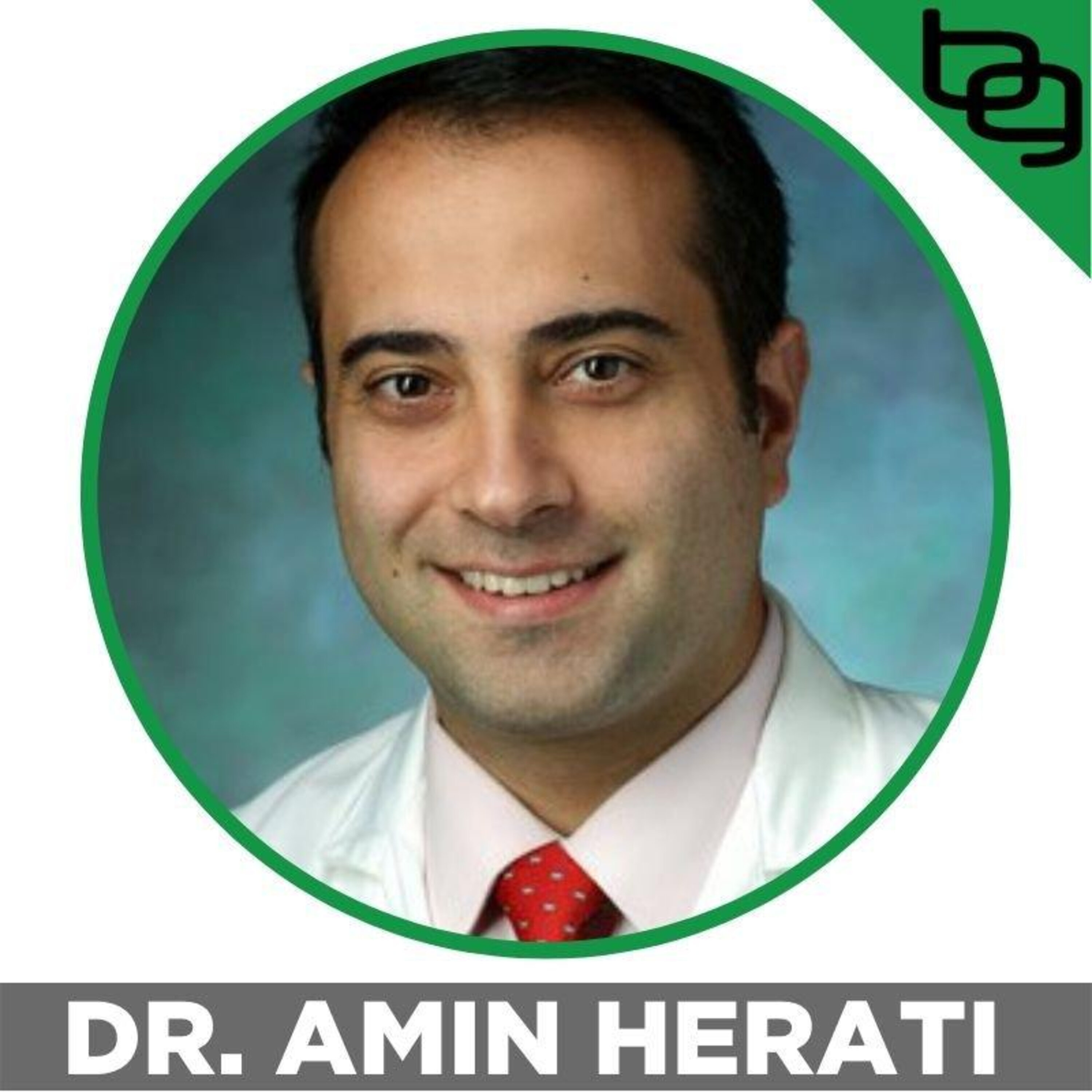
The Ultimate Guide To Increasing Fertility, Sperm Health, Semen Quality, Storing & Freezing Sperm & Much More With Dr. Amin Herati.
BenGreenfieldFitness.com/dadi
I get asked a lot of questions by both males and females about fertility (or, perhaps more accurately, infertility), including how to increase sperm count, how to store and freeze sperm, the best diets and supplements for fertility, and much more.
So I decided it was high time I recorded an episode for you fellas who want your swimmers just a bit more dialed in, and for you couples who may be wanting to conceive. Dr. Amin Herati, MD is an Assistant Professor at the James Buchanan Brady Urological Institute and works at the Johns Hopkins Hospital. He is the Director of Men's Health and Director of Male Infertility. Dr. Herati is also an advisor to Dadi, the leading at home male fertility services company for sperm testing and storage. He is active in basic and clinical research with an interest in the fertility of patients with spinal cord injury, genetic basis of male infertility, hypogonadism, and pelvic pain syndromes.
During this discussion, you'll discover: -Is infertility a genetic issue to any degree?... -Why infertility is more an issue among men in recent history than generations prior... -Environmental causes of infertility... -Testosterone replacement therapy and its effects on fertility... -Does a cool crotch affects one's fertility levels? -Strategies for enhancing fertility... -Diets or foods recommended for fertility... -How to proactively take care of business, even if you're not ready to have children... And much more! Episode sponsors: Do you have questions, thoughts, or feedback for Dr. Amin Herati or me? Leave your comments at BenGreenfieldFitness.com/dadi and one of us will reply!See omnystudio.com/listener for privacy information.
Available Results
Generated results are saved to your library for reuse and search.
Choose Template
Pick the result you want. You can review provider and model before generating.
A concise first-pass summary for understanding the episode quickly.
A comprehensive, source-grounded extraction of the reusable knowledge in an episode.
A comprehensive extraction focused on health practices, protocols, claims, and safety caveats.
A dedicated analysis of warnings, limitations, trade-offs, weak evidence, and uncertainty.
Repeatable methods, frameworks, mental models, processes, and systems.
A comprehensive extraction focused on opportunities, strategy, markets, and company building.
A concise first-pass summary for understanding the episode quickly.
A detailed readable summary organized by chapter or topic.
A navigable map of subjects, topic flow, and suggested chapters.
A comprehensive, source-grounded extraction of the reusable knowledge in an episode.
Reusable atomic knowledge units extracted from the episode.
A comprehensive extraction focused on health practices, protocols, claims, and safety caveats.
A comprehensive extraction focused on opportunities, strategy, markets, and company building.
Explicit actions, next steps, habits, recommendations, and things to avoid.
A dedicated inventory of concrete resources named in the episode.
A dedicated analysis of warnings, limitations, trade-offs, weak evidence, and uncertainty.
A concise first-pass summary for understanding the episode quickly.
A detailed readable summary organized by chapter or topic.
A navigable map of subjects, topic flow, and suggested chapters.
A comprehensive, source-grounded extraction of the reusable knowledge in an episode.
Reusable atomic knowledge units extracted from the episode.
A comprehensive extraction focused on health practices, protocols, claims, and safety caveats.
A comprehensive extraction focused on opportunities, strategy, markets, and company building.
Scientific findings, mechanisms, studies, hypotheses, and the limits of the evidence discussed.
Technologies, AI models, technical methods, capabilities, limitations, and adoption implications.
Investment theses, assets, catalysts, valuation reasoning, time horizons, and risks.
Chronologies, actors, causes, consequences, turning points, and competing historical interpretations.
Policies, proposals, stakeholders, arguments, implementation constraints, and predicted effects.
Career paths, skills, hiring signals, workplace decisions, transitions, and limitations of the advice.
Behavioral mechanisms, biases, motivation, habits, emotions, interventions, and evidence limitations.
Economic mechanisms, incentives, indicators, market structure, forecasts, and uncertainty.
Leadership principles, team systems, organizational design, culture, feedback, and failure modes.
Audience, positioning, messaging, acquisition, retention, experiments, metrics, and failed approaches.
Teaching methods, learning strategies, practice, feedback, assessment, and effectiveness evidence.
Theses, premises, arguments, objections, values, thought experiments, and unresolved questions.
Communication patterns, conflict, boundaries, expectations, repair methods, and contextual limitations.
Books, papers, authors, courses, and other learning resources mentioned in the episode.
Repeatable methods, frameworks, mental models, processes, and systems.
Explicit actions, next steps, habits, recommendations, and things to avoid.
Memorable statements and important claims with attribution and source context.
A dedicated inventory of concrete resources named in the episode.
A dedicated analysis of warnings, limitations, trade-offs, weak evidence, and uncertainty.