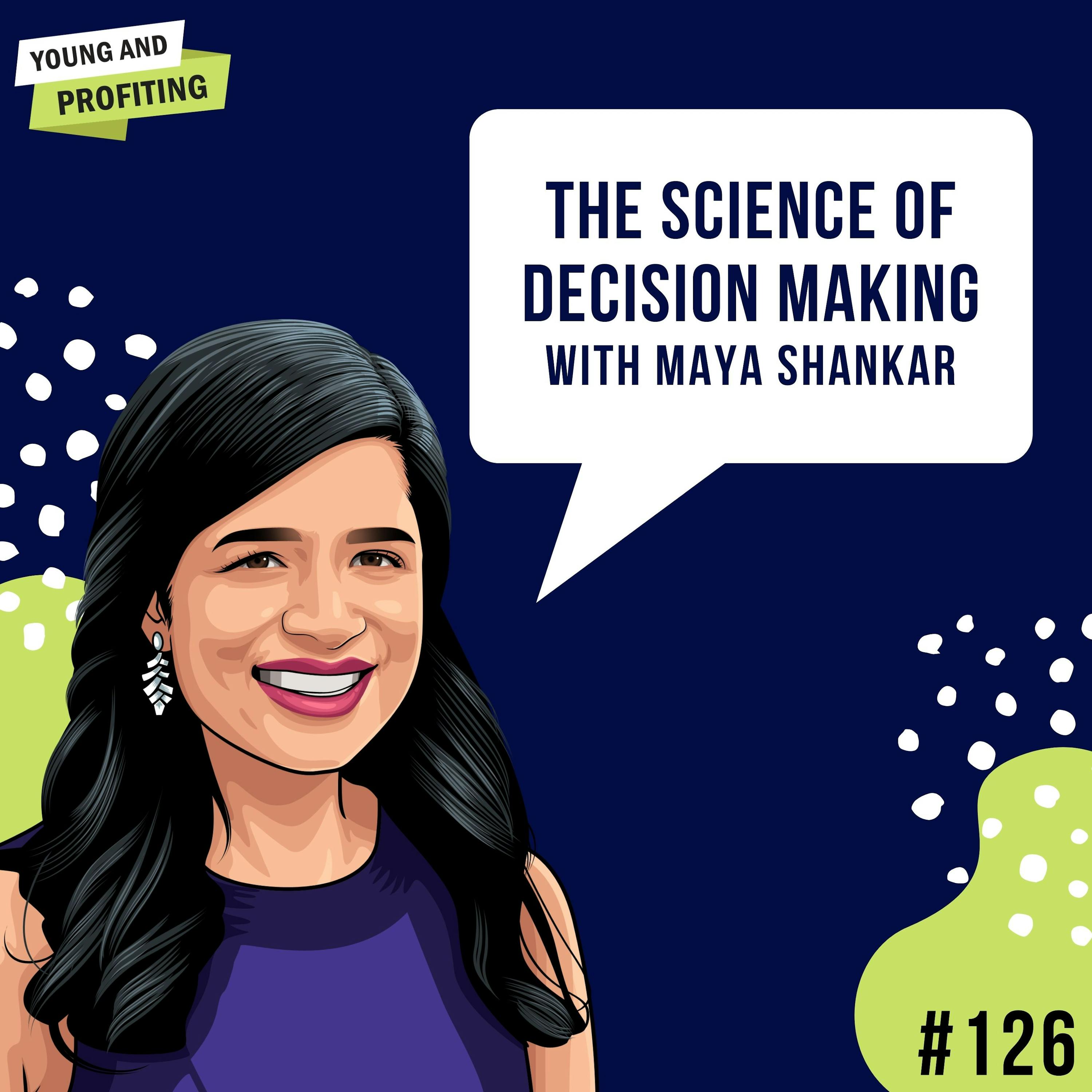
Dr. Maya Shankar: The Science of Decision Making | E126
Want to make better decisions?
In this episode, we are talking with Dr Maya Shankar, behavioural scientist and podcast host. Maya is currently the Senior Director of Behavioral Economics at Google and is the Creator, Host, and Executive Producer of “A Slight Change of Plans”, a podcast with Pushkin Industries. Maya previously served as a Senior Advisor in the Obama White House, where she founded and served as Chair of the White House's Behavioral Science Team — a team of scientists charged with improving public policy using research insights about human behaviour. In 2016, Maya served as the first Behavioral Science Advisor to the United Nations.
Maya completed a post-doctoral fellowship in cognitive neuroscience at Stanford, after receiving a PhD from Oxford on a Rhodes Scholarship and a B.A. from Yale in cognitive science. She has been profiled by the New Yorker and has been featured in the New York Times, Scientific American, Forbes, and on NPR's All Things Considered, Freakonomics, and Hidden Brain.
Today’s episode discusses Maya’s childhood as a violin prodigy, how she became a student at Juilliard’s pre-college program, and her career journey. We’ll also talk about Maya’s job at the White House, some common behavioural scientist concepts like the Sunk Cost Fallacy and Nudging, and how we, as humans, can make more realistic decisions.
Sponsored by -
Gusto. Get three months free when you run your first payroll at gusto.com/YAP
The Jordan Harbinger Show. Listen to the show here jordanharbinger.com/start
Social Media:
Follow YAP on IG: www.instagram.com/youngandprofiting
Reach out to Hala directly at Hala@YoungandProfiting.com
Follow Hala on Linkedin: www.linkedin.com/in/htaha/
Follow Hala on Instagram: www.instagram.com/yapwithhala
Follow Hala on Clubhouse: @halataha
Check out our website to meet the team, view show notes and transcripts: www.youngandprofiting.com
Timestamps:
02:44 - Maya's Childhood and Hand injury.
05:41 - How Maya got into Julliard
08;29 - Maya's lessons as a pro violinist.
11:19 - What is Behavioural and Cognitive Science.
22:35 - The Suncoast Fallacy.
25:50 - When is it time to move on?
27:21 - Maya's Journey in Obama's White House.
35:02 - Being Creative and Optimistic in every situation.
37;39 - What is Nudging?
44:02 - Why is it hard to change people's minds?
46:29 - Nudging in business and professional life.
50:27 - How to make realistic decisions?
53:30 - The Peak End Rule.
54:05 - The IKEA Effect
54:32 - Maya's Podcast.
59;48 - Maya's Secret to Profiting in Life
Mentioned In The Episode:
Maya’s Podcast, A Slight Change of Plans: https://mayashankar.com/podcast
Maya’s Website: https://mayashankar.com/
Available Results
Generated results are saved to your library for reuse and search.
Choose Template
Pick the result you want. You can review provider and model before generating.
A concise first-pass summary for understanding the episode quickly.
A comprehensive, source-grounded extraction of the reusable knowledge in an episode.
A comprehensive extraction focused on opportunities, strategy, markets, and company building.
Explicit actions, next steps, habits, recommendations, and things to avoid.
Repeatable methods, frameworks, mental models, processes, and systems.
A dedicated inventory of concrete resources named in the episode.
A concise first-pass summary for understanding the episode quickly.
A detailed readable summary organized by chapter or topic.
A navigable map of subjects, topic flow, and suggested chapters.
A comprehensive, source-grounded extraction of the reusable knowledge in an episode.
Reusable atomic knowledge units extracted from the episode.
A comprehensive extraction focused on health practices, protocols, claims, and safety caveats.
A comprehensive extraction focused on opportunities, strategy, markets, and company building.
Explicit actions, next steps, habits, recommendations, and things to avoid.
A dedicated inventory of concrete resources named in the episode.
A dedicated analysis of warnings, limitations, trade-offs, weak evidence, and uncertainty.
A concise first-pass summary for understanding the episode quickly.
A detailed readable summary organized by chapter or topic.
A navigable map of subjects, topic flow, and suggested chapters.
A comprehensive, source-grounded extraction of the reusable knowledge in an episode.
Reusable atomic knowledge units extracted from the episode.
A comprehensive extraction focused on health practices, protocols, claims, and safety caveats.
A comprehensive extraction focused on opportunities, strategy, markets, and company building.
Scientific findings, mechanisms, studies, hypotheses, and the limits of the evidence discussed.
Technologies, AI models, technical methods, capabilities, limitations, and adoption implications.
Investment theses, assets, catalysts, valuation reasoning, time horizons, and risks.
Chronologies, actors, causes, consequences, turning points, and competing historical interpretations.
Policies, proposals, stakeholders, arguments, implementation constraints, and predicted effects.
Career paths, skills, hiring signals, workplace decisions, transitions, and limitations of the advice.
Behavioral mechanisms, biases, motivation, habits, emotions, interventions, and evidence limitations.
Economic mechanisms, incentives, indicators, market structure, forecasts, and uncertainty.
Leadership principles, team systems, organizational design, culture, feedback, and failure modes.
Audience, positioning, messaging, acquisition, retention, experiments, metrics, and failed approaches.
Teaching methods, learning strategies, practice, feedback, assessment, and effectiveness evidence.
Theses, premises, arguments, objections, values, thought experiments, and unresolved questions.
Communication patterns, conflict, boundaries, expectations, repair methods, and contextual limitations.
Books, papers, authors, courses, and other learning resources mentioned in the episode.
Repeatable methods, frameworks, mental models, processes, and systems.
Explicit actions, next steps, habits, recommendations, and things to avoid.
Memorable statements and important claims with attribution and source context.
A dedicated inventory of concrete resources named in the episode.
A dedicated analysis of warnings, limitations, trade-offs, weak evidence, and uncertainty.