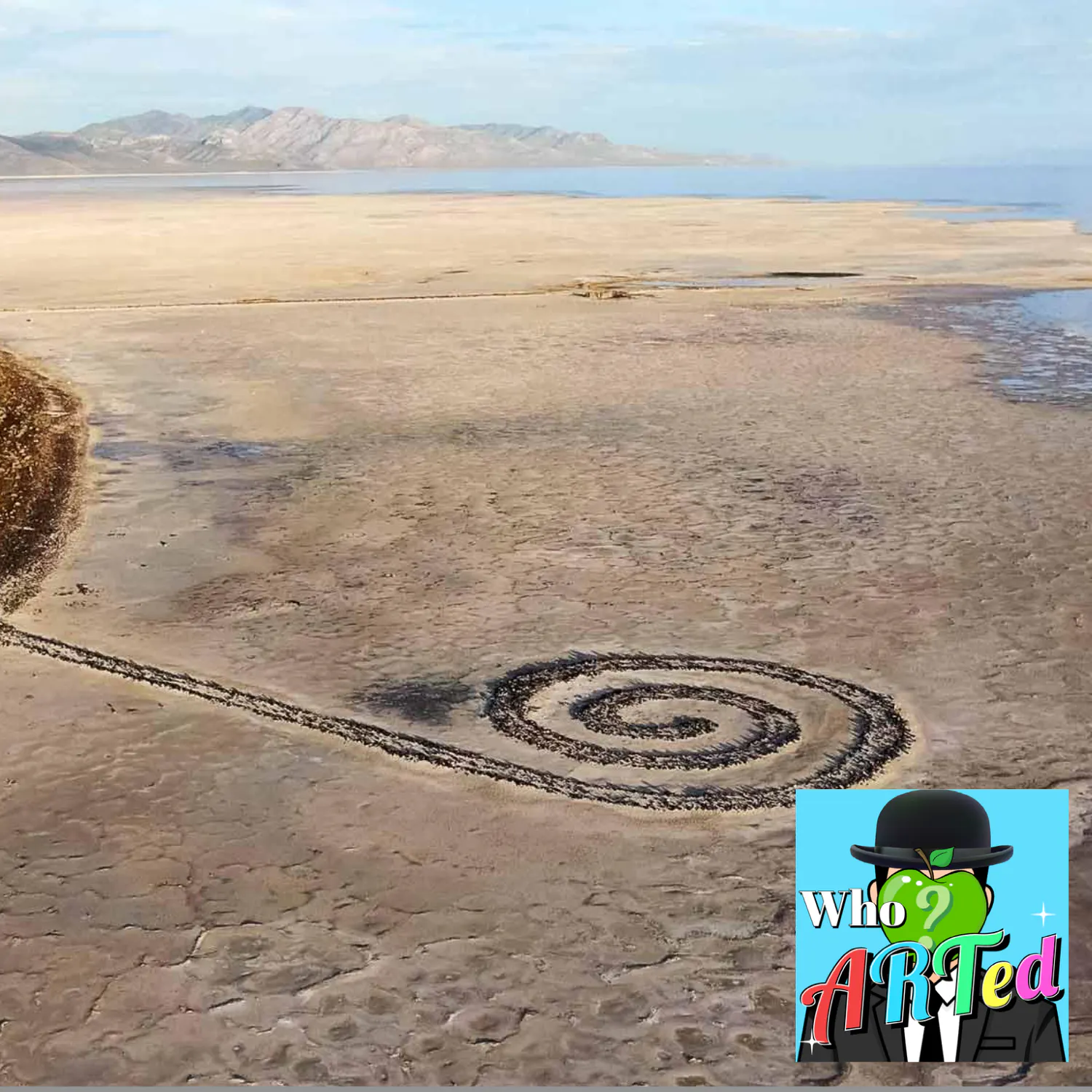
Robert Smithson | Spiral Jetty
Robert Smithson decided to make monumental sculptures using perhaps the world’s oldest material, the earth itself, but he used modern tools to shape it in a way and on a scale rarely seen. Spiral Jetty is as the name would suggest, a spiral. Part of what makes it special is the enormousness of it. On the peninsula at Rozel Point on Utah’s Great Salt Lake, Smithson created his most famous monumental sculpture using over six thousand tons of black basalt rocks and earth from the site. The spiral forms a path out onto the lake. It is intended to be not only witnessed, but experienced. Walking the spiral would be an almost meditative act similar to circumambulating or walking around a hindu temple. The spiral allows people to walk out onto the lake. A small speck on a vast lake witnessing the entropy of nature as the water erodes the foundation. The gigantic piece built from thousands of tons of stone has been decaying from the moment it was built. It was a giant monument to nature demonstrating the concept of entropy. It was born out of a time of social upheaval and changing norms leaving in which people were rethinking the ways they related to both nature and the constructed environment which now that I’m saying it out loud could just as easily be a description of pretty much any time period as the only true constant is change.
Help support the show by completing the network's survey. You can give me feedback to improve the show and get a chance to win a $500 Amazon Gift Card!
www.surveymonkey.com/r/airwave
Who ARTed is an Airwave Media Podcast.
Connect with me:
Website | Twitter | Instagram | Tiktok
Support the show:
Merch from TeePublic | Make a Donation
As always you can find images of the work being discussed at www.WhoARTedPodcast.com and of course, please leave a rating or review on your favorite podcast app. You might hear it read out on the show.
Learn more about your ad choices. Visit megaphone.fm/adchoices
Available Results
Generated results are saved to your library for reuse and search.
Choose Template
Pick the result you want. You can review provider and model before generating.
A concise first-pass summary for understanding the episode quickly.
A comprehensive, source-grounded extraction of the reusable knowledge in an episode.
Technologies, AI models, technical methods, capabilities, limitations, and adoption implications.
Repeatable methods, frameworks, mental models, processes, and systems.
A dedicated analysis of warnings, limitations, trade-offs, weak evidence, and uncertainty.
A dedicated inventory of concrete resources named in the episode.
A concise first-pass summary for understanding the episode quickly.
A detailed readable summary organized by chapter or topic.
A navigable map of subjects, topic flow, and suggested chapters.
A comprehensive, source-grounded extraction of the reusable knowledge in an episode.
Reusable atomic knowledge units extracted from the episode.
A comprehensive extraction focused on health practices, protocols, claims, and safety caveats.
A comprehensive extraction focused on opportunities, strategy, markets, and company building.
Explicit actions, next steps, habits, recommendations, and things to avoid.
A dedicated inventory of concrete resources named in the episode.
A dedicated analysis of warnings, limitations, trade-offs, weak evidence, and uncertainty.
A concise first-pass summary for understanding the episode quickly.
A detailed readable summary organized by chapter or topic.
A navigable map of subjects, topic flow, and suggested chapters.
A comprehensive, source-grounded extraction of the reusable knowledge in an episode.
Reusable atomic knowledge units extracted from the episode.
A comprehensive extraction focused on health practices, protocols, claims, and safety caveats.
A comprehensive extraction focused on opportunities, strategy, markets, and company building.
Scientific findings, mechanisms, studies, hypotheses, and the limits of the evidence discussed.
Technologies, AI models, technical methods, capabilities, limitations, and adoption implications.
Investment theses, assets, catalysts, valuation reasoning, time horizons, and risks.
Chronologies, actors, causes, consequences, turning points, and competing historical interpretations.
Policies, proposals, stakeholders, arguments, implementation constraints, and predicted effects.
Career paths, skills, hiring signals, workplace decisions, transitions, and limitations of the advice.
Behavioral mechanisms, biases, motivation, habits, emotions, interventions, and evidence limitations.
Economic mechanisms, incentives, indicators, market structure, forecasts, and uncertainty.
Leadership principles, team systems, organizational design, culture, feedback, and failure modes.
Audience, positioning, messaging, acquisition, retention, experiments, metrics, and failed approaches.
Teaching methods, learning strategies, practice, feedback, assessment, and effectiveness evidence.
Theses, premises, arguments, objections, values, thought experiments, and unresolved questions.
Communication patterns, conflict, boundaries, expectations, repair methods, and contextual limitations.
Books, papers, authors, courses, and other learning resources mentioned in the episode.
Repeatable methods, frameworks, mental models, processes, and systems.
Explicit actions, next steps, habits, recommendations, and things to avoid.
Memorable statements and important claims with attribution and source context.
A dedicated inventory of concrete resources named in the episode.
A dedicated analysis of warnings, limitations, trade-offs, weak evidence, and uncertainty.