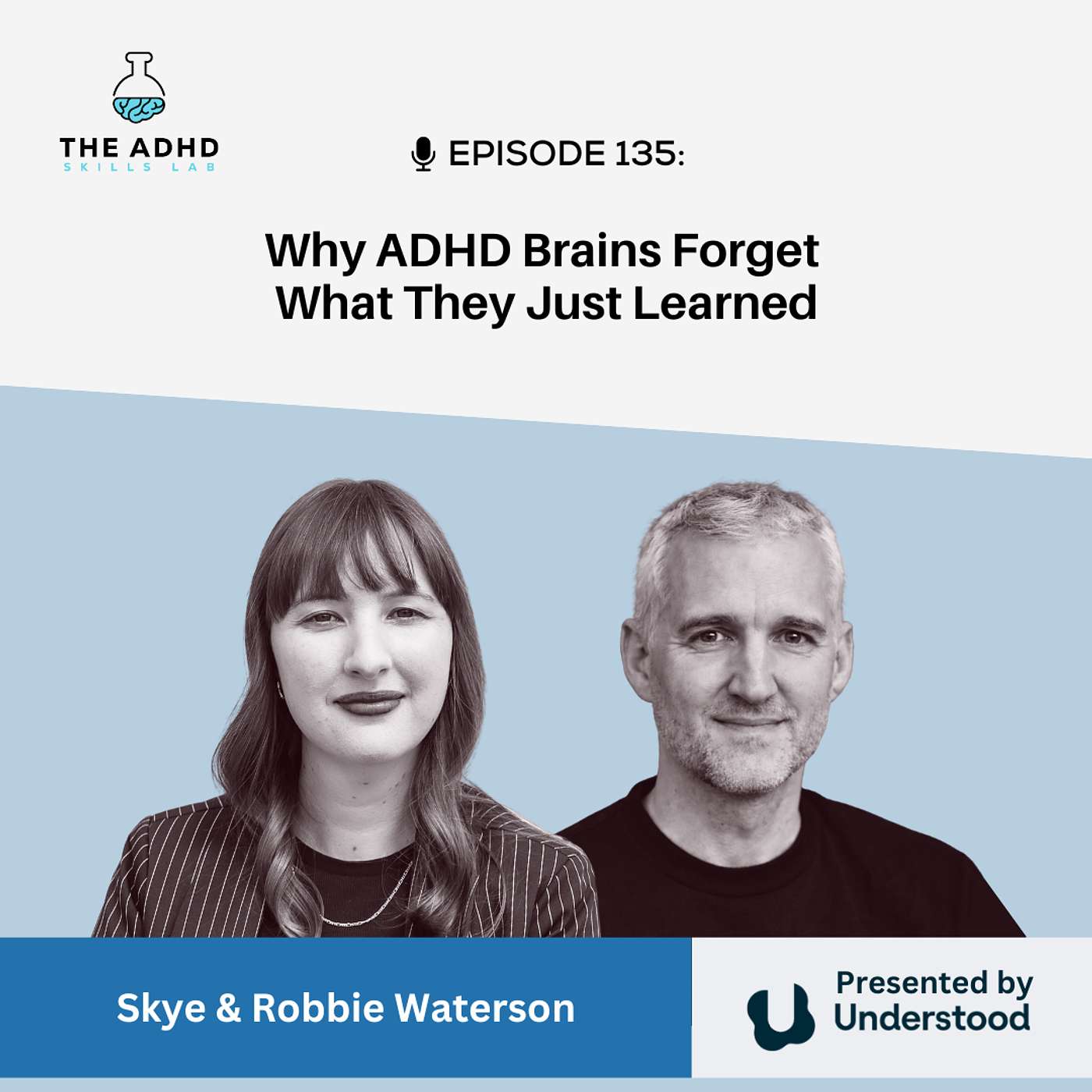
Why ADHD Brains Forget What They Just Learned
Presented by Understood.org
Many adults with ADHD feel like they have a bad memory.
You learn something in a meeting or training session, but a few days later it feels like the information has disappeared.
In this episode of ADHD Skills Lab, Skye and Robbie break down research on memory and ADHD. They explore how information gets encoded into long-term memory and why this stage of learning often breaks down for ADHD brains.
The discussion covers a major meta-analysis on effective learning techniques, research on long-term memory in adults with ADHD, and an experiment comparing retrieval practice with restudying.
In Friday’s episode they’ll explore practical systems that help ADHD professionals and business owners design training and learning systems that actually stick.
What We Cover
- The difference between encoding and retrieving information
- Why ADHD memory problems often start during the learning stage
- Research showing practice testing and spaced learning outperform rereading
- Why verbal learning can be harder for ADHD than visual learning
- What research suggests about medication and learning performance
If you're enjoying ADHD Skills Lab, you may also enjoy Understood.org’s new podcast, Everyone Gets a Juice Box: For Parents of Neurodivergent Kids.
Listen here:
https://lnk.to/everyonegetsajuiceboxPS!adhdskillslab
About ADHD founders for ADHD founders.
Interesting in working together? You can click here to receive a free bottleneck audio session and learn more about what we do. https://www.unconventionalorganisation.com/unstuckaudiosession
Diagnosed with ADHD at the start of her PhD, Skye Waterson spent years researching what actually works and writing about it for thousands of founders. The pattern she kept finding: ADHD business owners don't have a focus problem, they have an operations problem, because the whole business runs through their own head. Now she and her husband, former programmer Robert Waterson, work as fractional COOs for those founders. They find the bottleneck, hire the fix, and build the system that holds.
Subscribe to our Newsletter - https://unconventionalorganization.substack.com/
Follow us on Instagram - @unconventionalorganisation
Visit our website - https://www.unconventionalorganisation.com/
More description
Presented by Understood.org
Many adults with ADHD feel like they have a bad memory.
You learn something in a meeting or training session, but a few days later it feels like the information has disappeared.
In this episode of ADHD Skills Lab, Skye and Robbie break down research on memory and ADHD. They explore how information gets encoded into long-term memory and why this stage of learning often breaks down for ADHD brains.
The discussion covers a major meta-analysis on effective learning techniques, research on long-term memory in adults with ADHD, and an experiment comparing retrieval practice with restudying.
In Friday’s episode they’ll explore practical systems that help ADHD professionals and business owners design training and learning systems that actually stick.
What We Cover
- The difference between encoding and retrieving information
- Why ADHD memory problems often start during the learning stage
- Research showing practice testing and spaced learning outperform rereading
- Why verbal learning can be harder for ADHD than visual learning
- What research suggests about medication and learning performance
If you're enjoying ADHD Skills Lab, you may also enjoy Understood.org’s new podcast, Everyone Gets a Juice Box: For Parents of Neurodivergent Kids.
Listen here:
https://lnk.to/everyonegetsajuiceboxPS!adhdskillslab
About ADHD founders for ADHD founders.
Interesting in working together? You can click here to receive a free bottleneck audio session and learn more about what we do. https://www.unconventionalorganisation.com/unstuckaudiosession
Diagnosed with ADHD at the start of her PhD, Skye Waterson spent years researching what actually works and writing about it for thousands of founders. The pattern she kept finding: ADHD business owners don't have a focus problem, they have an operations problem, because the whole business runs through their own head. Now she and her husband, former programmer Robert Waterson, work as fractional COOs for those founders. They find the bottleneck, hire the fix, and build the system that holds.
Subscribe to our Newsletter - https://unconventionalorganization.substack.com/
Follow us on Instagram - @unconventionalorganisation
Visit our website - https://www.unconventionalorganisation.com/
Listen elsewhere
Available Results
Generated results are saved to your library for reuse and search.