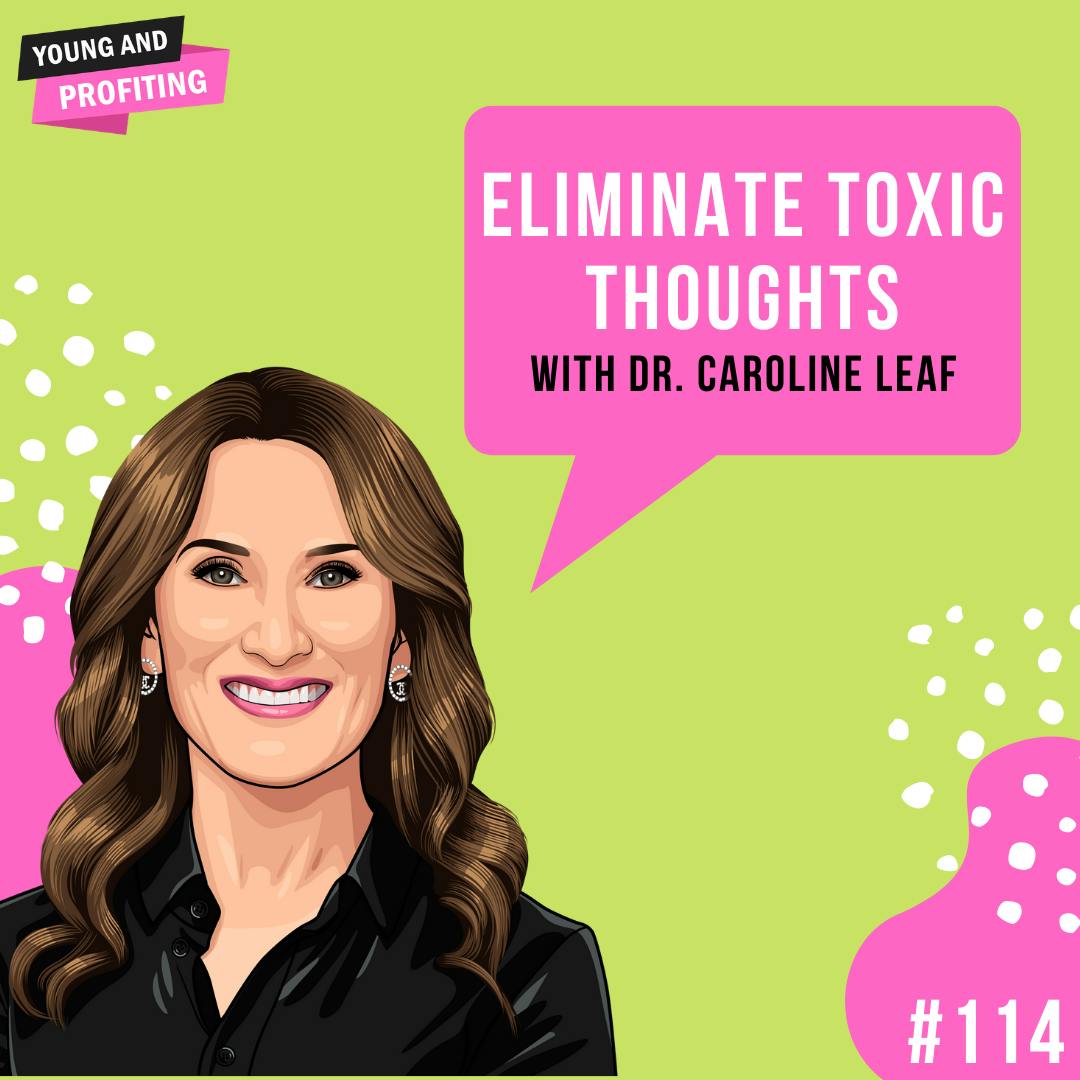
Dr. Caroline Leaf: Eliminate Toxic Thoughts | E114
Did you know that the Mind and the Brain are two separate things?!
In this episode, we are chatting with Dr. Caroline Leaf, a best-selling author and cognitive neuroscientist. Since the early 1980s, Dr. Caroline has researched the mind-brain connection, the nature of mental health, and the formation of memory. She was one of the first in her field to study how the brain can change (neuroplasticity) with directed mind input.
Dr. Leaf is also the best-selling author of Switch on Your Brain, Think Learn Succeed, Think and Eat Yourself Smart, and many more. She teaches at academic, medical and neuroscience conferences, churches, and to various audiences around the world. She is also involved in the global ECHO movement, which trains physicians worldwide on the mind-brain-body connection, mental health and how to avoid physician burnout.
In this episode, we discuss how Dr. Caroline first started working with the brain and the mind, why she chose to focus on the mind, and the unique aspects of it. We’ll also chat about the differences between the brain and the mind, how the mind and soul are connected, the physical impact toxic thoughts have on your brain, and Dr. Caroline’s advice on how it’s possible to heal with your mind instead of medication. This conversation got deep and uncovered so many things I never knew about what our minds are capable of - you definitely want to listen in!
Sponsored by Capsule. Visite capsule.com to get your prescription hand delivered today - for free!
Social Media:
Follow YAP on IG: www.instagram.com/youngandprofiting
Reach out to Hala directly at Hala@YoungandProfiting.com
Follow Hala on Linkedin: www.linkedin.com/in/htaha/
Follow Hala on Instagram: www.instagram.com/yapwithhala
Follow Hala on ClubHouse: @halataha
Check out our website to meet the team, view show notes and transcripts: www.youngandprofiting.com
Timestamps:
00:39 - How Caroline Got Fascinated with the Mind
02:53 - Why Caroline Knew the Mind Needed to Be Explored More
07:52 - Difference Between the Brain and the Mind
20:04 - Caroline’s Perspective on the Soul
31:15 - Healthy vs. Toxic Thoughts and Their Effects
39:04 - Why Are People Dying Earlier Even With Technological Advancements
57:06 - Advice To Heal With Your Mind
1:08:06 - Dr. Caroline’s Secret to Profiting in Life
Mentioned in the Episode:
Dr. Caroline’s Instagram: https://www.instagram.com/drcarolineleaf/
Dr. Caroline’s Website: https://drleaf.com/
Dr. Caroline’s Book: https://www.cleaningupyourmentalmess.com/
Dr. Caroline’s Podcast: https://drleaf.com/pages/podcasts
Available Results
Generated results are saved to your library for reuse and search.
Choose Template
Pick the result you want. You can review provider and model before generating.
A concise first-pass summary for understanding the episode quickly.
A comprehensive, source-grounded extraction of the reusable knowledge in an episode.
A comprehensive extraction focused on health practices, protocols, claims, and safety caveats.
A dedicated analysis of warnings, limitations, trade-offs, weak evidence, and uncertainty.
Repeatable methods, frameworks, mental models, processes, and systems.
Scientific findings, mechanisms, studies, hypotheses, and the limits of the evidence discussed.
A concise first-pass summary for understanding the episode quickly.
A detailed readable summary organized by chapter or topic.
A navigable map of subjects, topic flow, and suggested chapters.
A comprehensive, source-grounded extraction of the reusable knowledge in an episode.
Reusable atomic knowledge units extracted from the episode.
A comprehensive extraction focused on health practices, protocols, claims, and safety caveats.
A comprehensive extraction focused on opportunities, strategy, markets, and company building.
Explicit actions, next steps, habits, recommendations, and things to avoid.
A dedicated inventory of concrete resources named in the episode.
A dedicated analysis of warnings, limitations, trade-offs, weak evidence, and uncertainty.
A concise first-pass summary for understanding the episode quickly.
A detailed readable summary organized by chapter or topic.
A navigable map of subjects, topic flow, and suggested chapters.
A comprehensive, source-grounded extraction of the reusable knowledge in an episode.
Reusable atomic knowledge units extracted from the episode.
A comprehensive extraction focused on health practices, protocols, claims, and safety caveats.
A comprehensive extraction focused on opportunities, strategy, markets, and company building.
Scientific findings, mechanisms, studies, hypotheses, and the limits of the evidence discussed.
Technologies, AI models, technical methods, capabilities, limitations, and adoption implications.
Investment theses, assets, catalysts, valuation reasoning, time horizons, and risks.
Chronologies, actors, causes, consequences, turning points, and competing historical interpretations.
Policies, proposals, stakeholders, arguments, implementation constraints, and predicted effects.
Career paths, skills, hiring signals, workplace decisions, transitions, and limitations of the advice.
Behavioral mechanisms, biases, motivation, habits, emotions, interventions, and evidence limitations.
Economic mechanisms, incentives, indicators, market structure, forecasts, and uncertainty.
Leadership principles, team systems, organizational design, culture, feedback, and failure modes.
Audience, positioning, messaging, acquisition, retention, experiments, metrics, and failed approaches.
Teaching methods, learning strategies, practice, feedback, assessment, and effectiveness evidence.
Theses, premises, arguments, objections, values, thought experiments, and unresolved questions.
Communication patterns, conflict, boundaries, expectations, repair methods, and contextual limitations.
Books, papers, authors, courses, and other learning resources mentioned in the episode.
Repeatable methods, frameworks, mental models, processes, and systems.
Explicit actions, next steps, habits, recommendations, and things to avoid.
Memorable statements and important claims with attribution and source context.
A dedicated inventory of concrete resources named in the episode.
A dedicated analysis of warnings, limitations, trade-offs, weak evidence, and uncertainty.