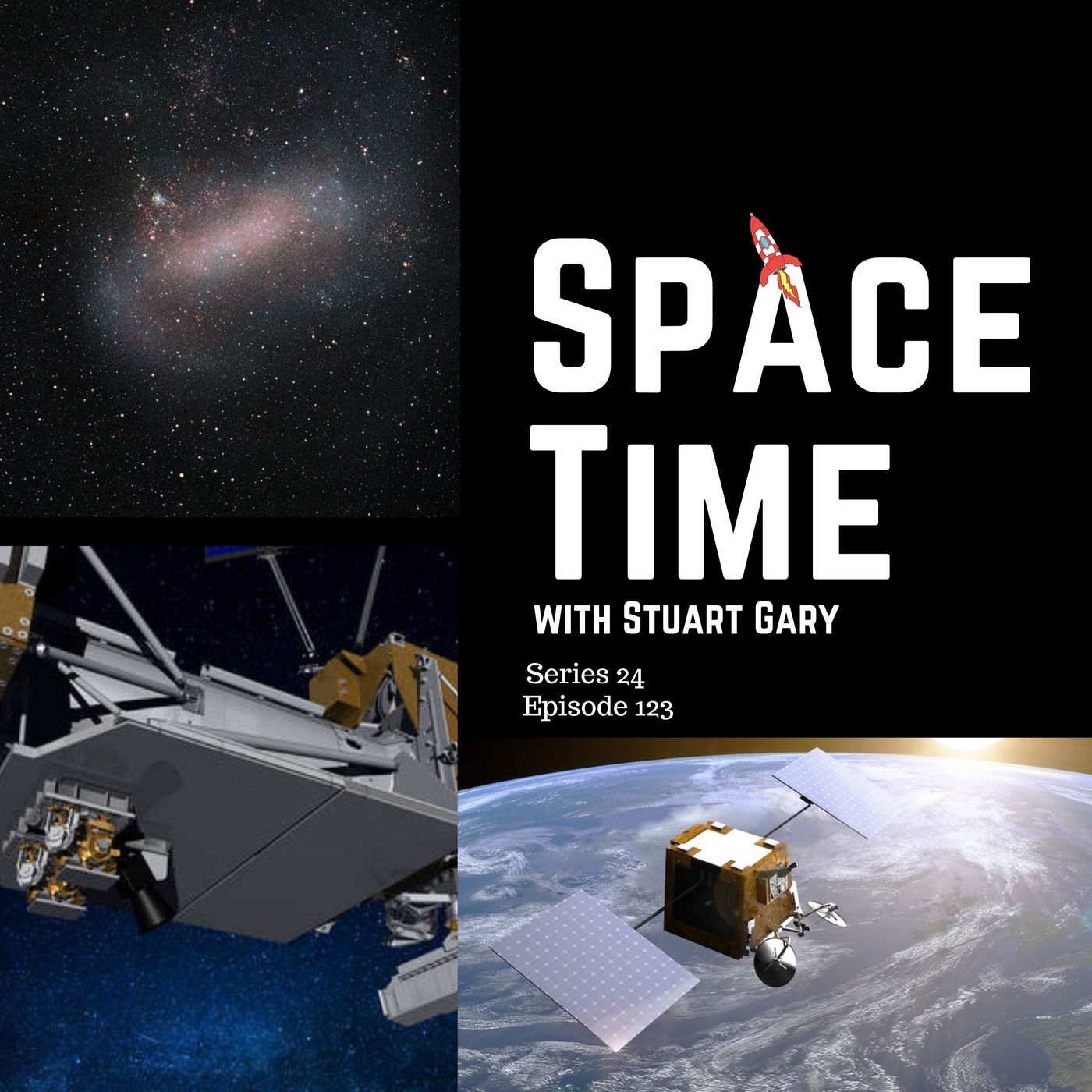
The Large Magellanic Cloud Cannibalizing Smaller Galaxies
SpaceTime Series 24 Episode 123
*The Large Magellanic Cloud cannibalizing smaller galaxies
Scientists have confirmed that the Large Magellanic Cloud has been cannibalizing smaller galaxies. Astronomers already knew that large galaxies like the Milky Way grow by merging with or cannibalizing smaller galaxies. But now a report in the journal Nature has shown that a small satellite dwarf galaxy like the Large Magellanic Cloud has in turn absorbed an even smaller galaxy in its vicinity.
*NASA’s first test of optical communications technology
NASA is about to test a new optical laser communications system in space for the first time. The Laser Communications Relay Demonstration is gearing up for launch next month with the payload now fully integrated into its host spacecraft and ready for its final testing before being lofted into orbit.
*One Web’s constellation passes the halfway mark
One Web have launched another 36 broadband internet satellites into orbit.
*The Science Report
Discovery of the first fossil evidence of modern human remains from the Pleistocene in Sulawesi.
The US State Department provides details on America’s current nuclear weapons stockpile.
A new study suggests horses were first domesticated in the Volga-Don region of Russia.
Skeptic's guide to schadenfreude over COVID deniers who get sick.
For more SpaceTime and show links: https://linktr.ee/biteszHQ
If you love this podcast, please get someone else to listen too. Thank you…
Your support is needed...
SpaceTime is an independently produced podcast (we are not funded by any government grants, big organisations or companies), and we’re working towards becoming a completely listener supported show...meaning we can do away with the commercials and sponsors. We figure the time can be much better spent on researching and producing stories for you, rather than having to chase sponsors to help us pay the bills.
That's where you come in....help us reach our first 1,000 subscribers...at that level the show becomes financially viable and bills can be paid without us breaking into a sweat every month. Every little bit helps...even if you could contribute just $1 per month. It all adds up.
By signing up and becoming a supporter at the $5 or more level, you get immediate access to over 240 commercial-free, double, and triple episode editions of SpaceTime plus extended interview bonus content. You also receive all new episodes on a Monday rather than having to wait the week out. Subscribe via Patreon or Supercast (you get a month’s free trial with Supercast to see if it’s really for you or not)....and share in the rewards. Details at Patreon www.patreon.com/spacetimewithstuartgary or Supercast - https://bitesznetwork.supercast.tech/
Details at https://spacetimewithstuartgary.com or www.bitesz.com
Sponsor Details:
This episode is brought to you with the support of NameCheap…cheap domain names is just the beginning of your own online presence. We use them and we love them. Get our special deal…just visit: https://spacetimewithstuartgary.com/namecheap and help support the show.
For more SpaceTime visit https://spacetimewithstuartgary.com (mobile friendly).
For enhanced Show Notes including photos to accompany this episode: https://www.bitesz.com/show/spacetime/blog/
Available Results
Generated results are saved to your library for reuse and search.
Choose Template
Pick the result you want. You can review provider and model before generating.
A concise first-pass summary for understanding the episode quickly.
A comprehensive, source-grounded extraction of the reusable knowledge in an episode.
A comprehensive extraction focused on opportunities, strategy, markets, and company building.
Explicit actions, next steps, habits, recommendations, and things to avoid.
Repeatable methods, frameworks, mental models, processes, and systems.
A dedicated inventory of concrete resources named in the episode.
A concise first-pass summary for understanding the episode quickly.
A detailed readable summary organized by chapter or topic.
A navigable map of subjects, topic flow, and suggested chapters.
A comprehensive, source-grounded extraction of the reusable knowledge in an episode.
Reusable atomic knowledge units extracted from the episode.
A comprehensive extraction focused on health practices, protocols, claims, and safety caveats.
A comprehensive extraction focused on opportunities, strategy, markets, and company building.
Explicit actions, next steps, habits, recommendations, and things to avoid.
A dedicated inventory of concrete resources named in the episode.
A dedicated analysis of warnings, limitations, trade-offs, weak evidence, and uncertainty.
A concise first-pass summary for understanding the episode quickly.
A detailed readable summary organized by chapter or topic.
A navigable map of subjects, topic flow, and suggested chapters.
A comprehensive, source-grounded extraction of the reusable knowledge in an episode.
Reusable atomic knowledge units extracted from the episode.
A comprehensive extraction focused on health practices, protocols, claims, and safety caveats.
A comprehensive extraction focused on opportunities, strategy, markets, and company building.
Scientific findings, mechanisms, studies, hypotheses, and the limits of the evidence discussed.
Technologies, AI models, technical methods, capabilities, limitations, and adoption implications.
Investment theses, assets, catalysts, valuation reasoning, time horizons, and risks.
Chronologies, actors, causes, consequences, turning points, and competing historical interpretations.
Policies, proposals, stakeholders, arguments, implementation constraints, and predicted effects.
Career paths, skills, hiring signals, workplace decisions, transitions, and limitations of the advice.
Behavioral mechanisms, biases, motivation, habits, emotions, interventions, and evidence limitations.
Economic mechanisms, incentives, indicators, market structure, forecasts, and uncertainty.
Leadership principles, team systems, organizational design, culture, feedback, and failure modes.
Audience, positioning, messaging, acquisition, retention, experiments, metrics, and failed approaches.
Teaching methods, learning strategies, practice, feedback, assessment, and effectiveness evidence.
Theses, premises, arguments, objections, values, thought experiments, and unresolved questions.
Communication patterns, conflict, boundaries, expectations, repair methods, and contextual limitations.
Books, papers, authors, courses, and other learning resources mentioned in the episode.
Repeatable methods, frameworks, mental models, processes, and systems.
Explicit actions, next steps, habits, recommendations, and things to avoid.
Memorable statements and important claims with attribution and source context.
A dedicated inventory of concrete resources named in the episode.
A dedicated analysis of warnings, limitations, trade-offs, weak evidence, and uncertainty.