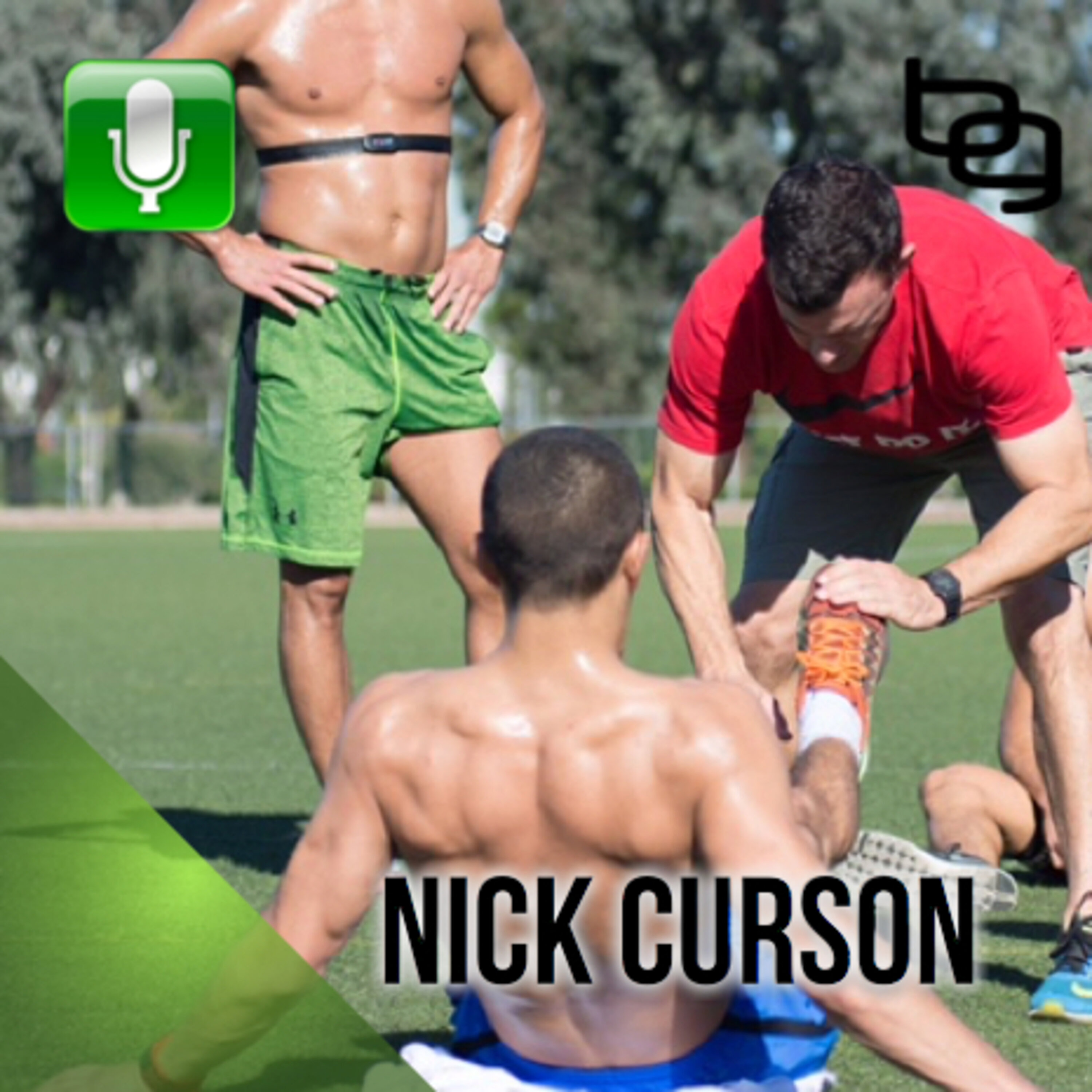
How To Get Faster Fast, The Best Shortcuts To Power, Why Conventional Speed Training Sucks & More With Nick Curson.
https://bengreenfieldfitness.com/speedofsport
My guest on today's podcast is Coach Nick Curson, owner of Speed of Sport. He has produced multiple World, National, International, and Collegiate Champions. He is the head strength and conditioning coach for the famous ALA Boxing Gym in Cebu, Philippines and his primary areas of study are Eastern Bloc Strength & Conditioning, Plyometrics, Biomechanics, Exercise Physiology, and Rehabilitative Exercise.
Speed of Sport is owned and operated by Nick Curson. With over 18 years of experience in nearly every type of strength training modality, Nick has studied extensively with top scientists, sports trainers, strength coaches, Olympic lifters, physical therapists, bio mechanical engineers, professional boxing trainers, martial artists, and more to develop the unique system of training for speed that we discuss on today's show.
During our discussion, you'll discover: -Why Nick is so into training the nervous system when it comes to full body performance (vs., say, the cardiovascular or muscular system)...[10:50]
-The training components Nick emphasizes that most other coaches and personal trainers don't...[14:40]
-Why heavy strength training is something that you shouldn't do very often vs. power and speed training...[24:30]
-How to strike a balance between muscle hypertrophy and muscle speed...[34:30]
-The best way to measure the speed of your muscles and rate of force development...[38:45]
-Why Nick always starts by training an athlete's feet and proprioception...[46:40]
-How this type of training can be used by endurance athletes like triathletes, marathoners and obstacle course racers...[54:32]
-How new "biohacking" headsets like tDCS can increase rate of force development, power and explosiveness...[58:45]
-Nick's top body weight exercises for developing speed...[61:40]
-And much more!
Resources from this episode: -SpeedOfSport.com - use coupon BEN -Halo Neuroscience headset for transcranial direct current stimulation (tDCS) -Shuttle Systems plyometric machines -My interview with Jon Bruney on Neuromass training -The Bjornsen study Ben discusses (from Paul Jaminet's website) -The mPower device for measuring rate of force development
Do you have questions, thoughts or feedback for Nick or me? Leave your comments at BenGreenfieldFitness.com and one of us will reply!
See omnystudio.com/listener for privacy information.
Available Results
Generated results are saved to your library for reuse and search.
Choose Template
Pick the result you want. You can review provider and model before generating.
A concise first-pass summary for understanding the episode quickly.
A comprehensive, source-grounded extraction of the reusable knowledge in an episode.
A comprehensive extraction focused on health practices, protocols, claims, and safety caveats.
A dedicated analysis of warnings, limitations, trade-offs, weak evidence, and uncertainty.
Repeatable methods, frameworks, mental models, processes, and systems.
Scientific findings, mechanisms, studies, hypotheses, and the limits of the evidence discussed.
A concise first-pass summary for understanding the episode quickly.
A detailed readable summary organized by chapter or topic.
A navigable map of subjects, topic flow, and suggested chapters.
A comprehensive, source-grounded extraction of the reusable knowledge in an episode.
Reusable atomic knowledge units extracted from the episode.
A comprehensive extraction focused on health practices, protocols, claims, and safety caveats.
A comprehensive extraction focused on opportunities, strategy, markets, and company building.
Explicit actions, next steps, habits, recommendations, and things to avoid.
A dedicated inventory of concrete resources named in the episode.
A dedicated analysis of warnings, limitations, trade-offs, weak evidence, and uncertainty.
A concise first-pass summary for understanding the episode quickly.
A detailed readable summary organized by chapter or topic.
A navigable map of subjects, topic flow, and suggested chapters.
A comprehensive, source-grounded extraction of the reusable knowledge in an episode.
Reusable atomic knowledge units extracted from the episode.
A comprehensive extraction focused on health practices, protocols, claims, and safety caveats.
A comprehensive extraction focused on opportunities, strategy, markets, and company building.
Scientific findings, mechanisms, studies, hypotheses, and the limits of the evidence discussed.
Technologies, AI models, technical methods, capabilities, limitations, and adoption implications.
Investment theses, assets, catalysts, valuation reasoning, time horizons, and risks.
Chronologies, actors, causes, consequences, turning points, and competing historical interpretations.
Policies, proposals, stakeholders, arguments, implementation constraints, and predicted effects.
Career paths, skills, hiring signals, workplace decisions, transitions, and limitations of the advice.
Behavioral mechanisms, biases, motivation, habits, emotions, interventions, and evidence limitations.
Economic mechanisms, incentives, indicators, market structure, forecasts, and uncertainty.
Leadership principles, team systems, organizational design, culture, feedback, and failure modes.
Audience, positioning, messaging, acquisition, retention, experiments, metrics, and failed approaches.
Teaching methods, learning strategies, practice, feedback, assessment, and effectiveness evidence.
Theses, premises, arguments, objections, values, thought experiments, and unresolved questions.
Communication patterns, conflict, boundaries, expectations, repair methods, and contextual limitations.
Books, papers, authors, courses, and other learning resources mentioned in the episode.
Repeatable methods, frameworks, mental models, processes, and systems.
Explicit actions, next steps, habits, recommendations, and things to avoid.
Memorable statements and important claims with attribution and source context.
A dedicated inventory of concrete resources named in the episode.
A dedicated analysis of warnings, limitations, trade-offs, weak evidence, and uncertainty.