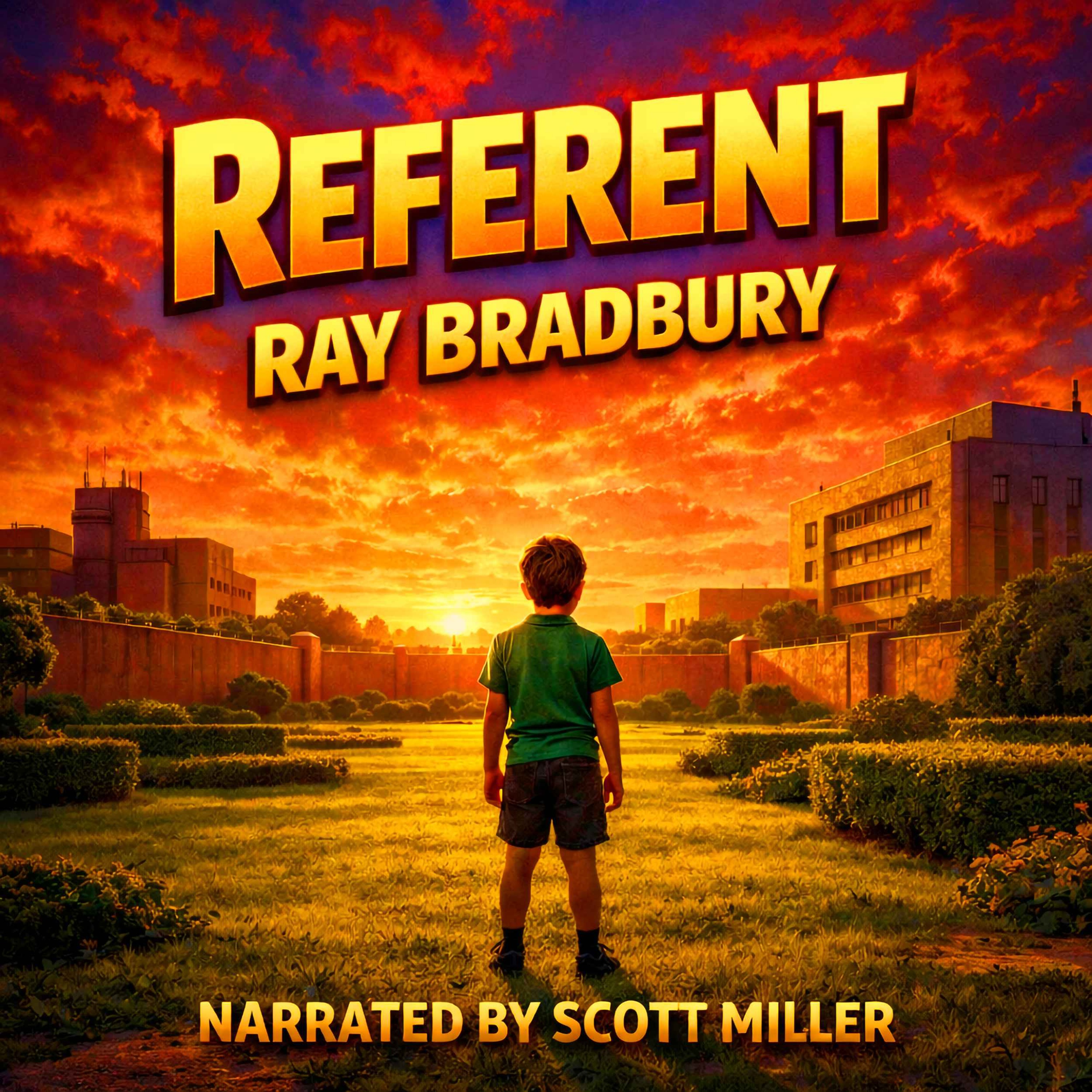
Referent by Ray Bradbury
The Life of a child genius was no fun, but Roby couldn’t escape it–until a falling star taught him how to rebel! Referent by Ray Bradbury, that’s next on The Lost Sci-Fi Podcast.
Thanks to another listener for buying us $15 worth of coffee anonymously. We appreciate all our listeners around the world. If you want to show your support by buying us a coffee there’s a link in the description.
☕ Buy Me a Coffee https://www.buymeacoffee.com/scottsV
Ray Bradbury is back on the podcast with a story that first appeared in the October 1948 issue of Thrilling Wonder Stories Magazine. Bradbury used the pen name Brett Sterling. Why did he use a pen name? Another one of his stories was in the same issue and magazines didn't like to have more than one story per author in an issue. Our story can be found on page 148, Referent by Ray Bradbury…
Next on The Lost Sci-Fi Podcast, If Joe Mulloy was perfect—and he was—then beyond his perfection here only could be… Super Joe Mulloy by Scott F. Grenville.
☕ Buy Me a Coffee - https://lostscifi.com/coffee
Newsletter - https://lostscifi.com/free/
Facebook - https://lostscifi.com/facebook
YouTube - https://lostscifi.com/youtube
Rise - http://Lostscifi.com/rise
Instagram - https://www.instagram.com/lostscifiguy
❤️ Thanks to All Our Listeners Who Bought Us a Coffee
$50
Anonymous Listener
$25
Stephen Kagan
James Van Maanenberg
Irma Stolfo
Josh Jennings
Leber8tr
Anonymous Listener
Conrad Chaffee
$15
Fressie
Anonymous Listener
$10
Anonymous Listener
$5
Anonymous Listener
https://lostscifi.com/podcast/referent-by-ray-bradbury-episode-190/
Listen without commercials and enjoy exclusive bonus episodes every month with Lost Sci-Fi Premium—start your free 7-day trial today. https://lostscifi.supercast.com/
Hosted on Acast. See acast.com/privacy for more information.
Available Results
Generated results are saved to your library for reuse and search.
Choose Template
Pick the result you want. You can review provider and model before generating.
A concise first-pass summary for understanding the episode quickly.
A comprehensive, source-grounded extraction of the reusable knowledge in an episode.
Books, papers, authors, courses, and other learning resources mentioned in the episode.
Reusable atomic knowledge units extracted from the episode.
A dedicated inventory of concrete resources named in the episode.
A detailed readable summary organized by chapter or topic.
A concise first-pass summary for understanding the episode quickly.
A detailed readable summary organized by chapter or topic.
A navigable map of subjects, topic flow, and suggested chapters.
A comprehensive, source-grounded extraction of the reusable knowledge in an episode.
Reusable atomic knowledge units extracted from the episode.
A comprehensive extraction focused on health practices, protocols, claims, and safety caveats.
A comprehensive extraction focused on opportunities, strategy, markets, and company building.
Explicit actions, next steps, habits, recommendations, and things to avoid.
A dedicated inventory of concrete resources named in the episode.
A dedicated analysis of warnings, limitations, trade-offs, weak evidence, and uncertainty.
A concise first-pass summary for understanding the episode quickly.
A detailed readable summary organized by chapter or topic.
A navigable map of subjects, topic flow, and suggested chapters.
A comprehensive, source-grounded extraction of the reusable knowledge in an episode.
Reusable atomic knowledge units extracted from the episode.
A comprehensive extraction focused on health practices, protocols, claims, and safety caveats.
A comprehensive extraction focused on opportunities, strategy, markets, and company building.
Scientific findings, mechanisms, studies, hypotheses, and the limits of the evidence discussed.
Technologies, AI models, technical methods, capabilities, limitations, and adoption implications.
Investment theses, assets, catalysts, valuation reasoning, time horizons, and risks.
Chronologies, actors, causes, consequences, turning points, and competing historical interpretations.
Policies, proposals, stakeholders, arguments, implementation constraints, and predicted effects.
Career paths, skills, hiring signals, workplace decisions, transitions, and limitations of the advice.
Behavioral mechanisms, biases, motivation, habits, emotions, interventions, and evidence limitations.
Economic mechanisms, incentives, indicators, market structure, forecasts, and uncertainty.
Leadership principles, team systems, organizational design, culture, feedback, and failure modes.
Audience, positioning, messaging, acquisition, retention, experiments, metrics, and failed approaches.
Teaching methods, learning strategies, practice, feedback, assessment, and effectiveness evidence.
Theses, premises, arguments, objections, values, thought experiments, and unresolved questions.
Communication patterns, conflict, boundaries, expectations, repair methods, and contextual limitations.
Books, papers, authors, courses, and other learning resources mentioned in the episode.
Repeatable methods, frameworks, mental models, processes, and systems.
Explicit actions, next steps, habits, recommendations, and things to avoid.
Memorable statements and important claims with attribution and source context.
A dedicated inventory of concrete resources named in the episode.
A dedicated analysis of warnings, limitations, trade-offs, weak evidence, and uncertainty.