The Ongoing Search for Dark Matter
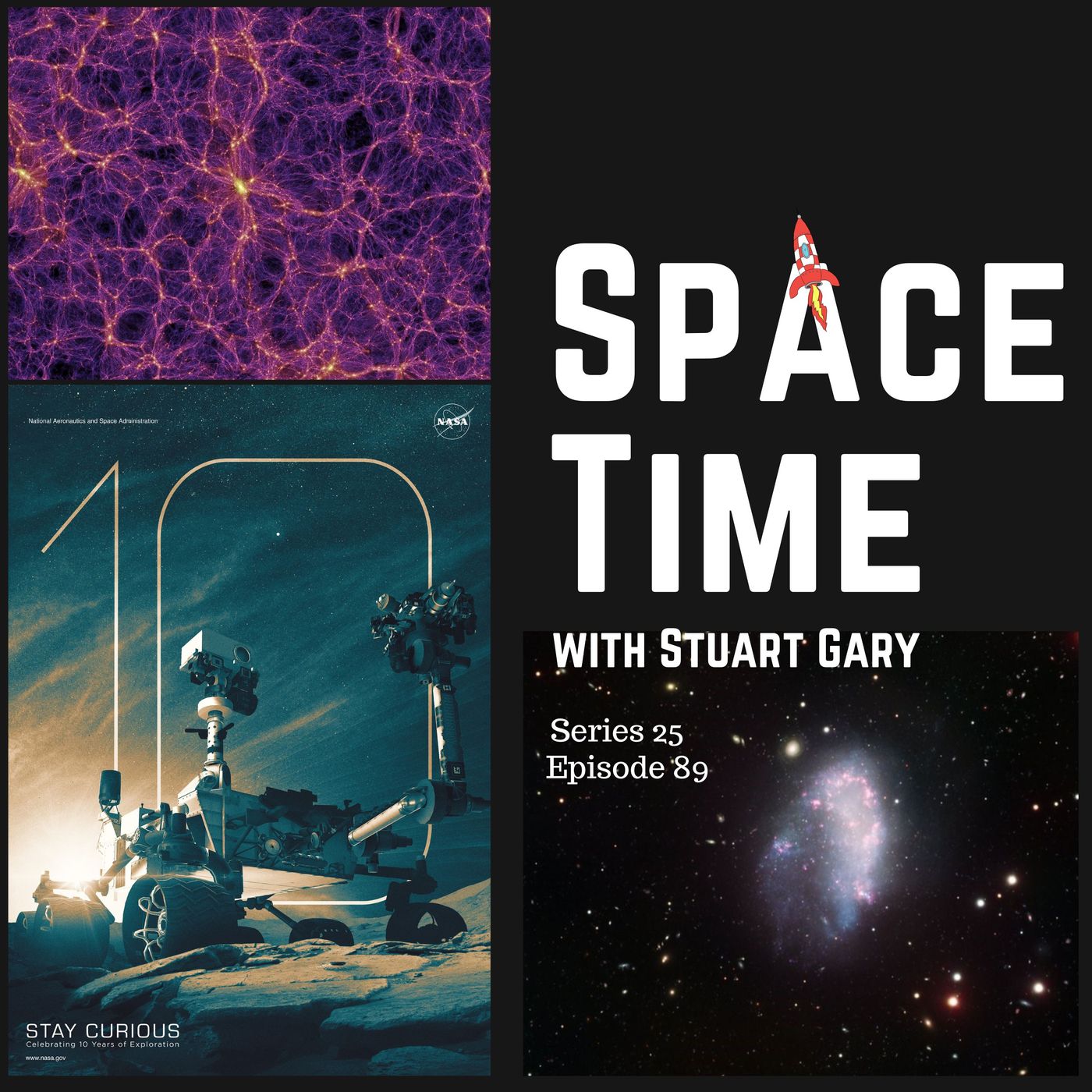
SpaceTime Series 25 Episode 89
*The ongoing search for Dark Matter
Scientists have placed new limits on where the mysterious invisible substance known as dark matter could be hiding.
*Another win for Modified Newtonian dynamics over dark matter
Astronomers have unexpectedly found strong evidence supporting Modified Newtonian dynamics or MOND rather than dark matter to best explain the observations of the gravitational tidal effects in the Fornax Cluster on a population of dwarf galaxies.
*NASA's Mars Curiosity rover marks ten years on the red planet
NASA’s car sized Mars Curiosity Rover has celebrated its first decade exploring the red planet.
*Another Blue Origin flight reaching the edge of space
Blue Origin’s New Shepard has undertaken its sixth space tourism flight to the edge of space.
*More dangerous Chinese space junk
Beijing has come in for more criticism following the de-orbit of yet another out of control spacecraft.
*Beijing tests a reusable spacecraft
China’s growing concern about the success of America’s X-37b space shuttle program has seen Beijing launch its own reusable experimental spacecraft.
*New Russian spy satellite spies on other satellites
Russia have just launched a new spy satellite designed to spy on other satellites.
*Salt could be key to life on water worlds
A new theoretical study suggests oceans on water-rich worlds could be enriched with electrolytes, including salts such as sodium chloride which is an important factor in the search for life.
*The Science Report
New evidence triggers fresh calls for an independent investigation into the origins of COVID.
A new study warns that the Arctic is warming faster than previously thought.
Finally, some good news for coral growth on the Great Barrier Reef.
Environmental damage from the 2010 BP Deepwater Horizon oil spill disaster still detectable.
The closest thing so far to a fountain of youth.
Alex on Tech new Samsung galaxy Z flip and fold 4 released
Skeptic's guide Forget the Gaia Sausage now there's a Spanish one
Listen to SpaceTime on your favorite podcast app with our universal listen link: https://spacetimewithstuartgary.com/listen
For more SpaceTime and show links: https://linktr.ee/biteszHQ
If you love this podcast, please get someone else to listen to. Thank you…
To become a SpaceTime supporter and unlock commercial free editions of the show, gain early access and bonus content, please visit https://bitesz.supercast.com/ . Premium version now available via Spotify and Apple Podcasts.
For more podcasts visit our HQ at https://biteszhq.com
Your support is needed...
SpaceTime is an independently produced podcast (we are not funded by any government grants, big organisations or companies), and we’re working towards becoming a completely listener supported show...meaning we can do away with the commercials and sponsors. We figure the time can be much better spent on researching and producing stories for you, rather than having to chase sponsors to help us pay the bills.
That's where you come in....help us reach our first 1,000 subscribers...at that level the show becomes financially viable and bills can be paid without us breaking into a sweat every month. Every little bit helps...even if you could contribute just $1 per month. It all adds up.
By signing up and becoming a supporter at the $5 or more level, you get immediate access to over 240 commercial-free, double, and triple episode editions of SpaceTime plus extended interview bonus content. You also receive...
Available Results
Generated results are saved to your library for reuse and search.
Choose Template
Pick the result you want. You can review provider and model before generating.
A concise first-pass summary for understanding the episode quickly.
A comprehensive, source-grounded extraction of the reusable knowledge in an episode.
Scientific findings, mechanisms, studies, hypotheses, and the limits of the evidence discussed.
A dedicated analysis of warnings, limitations, trade-offs, weak evidence, and uncertainty.
Memorable statements and important claims with attribution and source context.
Technologies, AI models, technical methods, capabilities, limitations, and adoption implications.
A concise first-pass summary for understanding the episode quickly.
A detailed readable summary organized by chapter or topic.
A navigable map of subjects, topic flow, and suggested chapters.
A comprehensive, source-grounded extraction of the reusable knowledge in an episode.
Reusable atomic knowledge units extracted from the episode.
A comprehensive extraction focused on health practices, protocols, claims, and safety caveats.
A comprehensive extraction focused on opportunities, strategy, markets, and company building.
Explicit actions, next steps, habits, recommendations, and things to avoid.
A dedicated inventory of concrete resources named in the episode.
A dedicated analysis of warnings, limitations, trade-offs, weak evidence, and uncertainty.
A concise first-pass summary for understanding the episode quickly.
A detailed readable summary organized by chapter or topic.
A navigable map of subjects, topic flow, and suggested chapters.
A comprehensive, source-grounded extraction of the reusable knowledge in an episode.
Reusable atomic knowledge units extracted from the episode.
A comprehensive extraction focused on health practices, protocols, claims, and safety caveats.
A comprehensive extraction focused on opportunities, strategy, markets, and company building.
Scientific findings, mechanisms, studies, hypotheses, and the limits of the evidence discussed.
Technologies, AI models, technical methods, capabilities, limitations, and adoption implications.
Investment theses, assets, catalysts, valuation reasoning, time horizons, and risks.
Chronologies, actors, causes, consequences, turning points, and competing historical interpretations.
Policies, proposals, stakeholders, arguments, implementation constraints, and predicted effects.
Career paths, skills, hiring signals, workplace decisions, transitions, and limitations of the advice.
Behavioral mechanisms, biases, motivation, habits, emotions, interventions, and evidence limitations.
Economic mechanisms, incentives, indicators, market structure, forecasts, and uncertainty.
Leadership principles, team systems, organizational design, culture, feedback, and failure modes.
Audience, positioning, messaging, acquisition, retention, experiments, metrics, and failed approaches.
Teaching methods, learning strategies, practice, feedback, assessment, and effectiveness evidence.
Theses, premises, arguments, objections, values, thought experiments, and unresolved questions.
Communication patterns, conflict, boundaries, expectations, repair methods, and contextual limitations.
Books, papers, authors, courses, and other learning resources mentioned in the episode.
Repeatable methods, frameworks, mental models, processes, and systems.
Explicit actions, next steps, habits, recommendations, and things to avoid.
Memorable statements and important claims with attribution and source context.
A dedicated inventory of concrete resources named in the episode.
A dedicated analysis of warnings, limitations, trade-offs, weak evidence, and uncertainty.