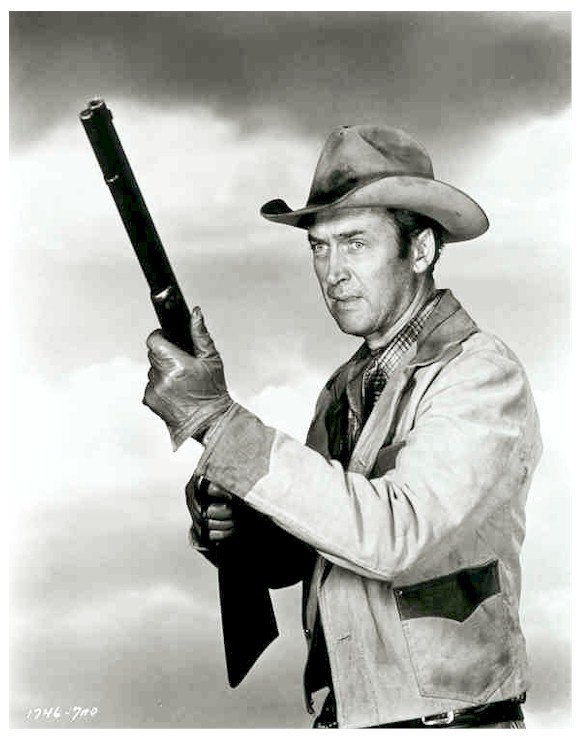
"The man in the saddle"
"The man in the saddle is angular and long-legged. His skin is sun-dyed brown. The gun in his holster is gray steel and rainbow mother-of-pearl, its handle unmarked. People call them both 'the Six Shooter.'"
Today in 1953, James Stewart rode on to the radio range as Britt Ponset, the wandering plainsman and infamous gunfighter known far and wide as The Six Shooter. In his only regular starring role in a radio dramatic series, Stewart lent his trademark screen persona to the character of Ponset, a hero who had to reluctantly live up to his reputation as he traveled the plains. With Stewart's amazing performance in the title role, engrossing scripts, and a talented troupe of supporting players, The Six Shooter stands up today as one of the finest frontier offerings from the Golden Age of Radio.
Each week, Ponset drifted into a new town and a new adventure. He encountered everything from gunslingers looking for revenge to a dangerous sibling rivalry on a cattle drive to being strong-armed into marriage. Whether the story of the week was intense and dramatic or played for laughs, Stewart was an amiable hero. His drawl was put to excellent use as the show's narrator, and he would drop his voice to a whisper as Ponset crept up on a gun-toting villain.
The series was created by Frank Burt, the writer who two years later penned Stewart's film western The Man from Laramie, and it was directed by Jack Johnstone (who later helmed the Bob Bailey era of Yours Truly, Johnny Dollar). Despite the caliber of talent on and behind the microphone, the show ended after only 39 episodes. For most of its run The Six Shooter aired without sponsorship, but it wasn't because potential sponsors weren't interested. Jack Johnstone later recalled "Chesterfield begged and begged and begged for months trying to get sponsorship, but Jim didn't feel that, because of his screen image, it would be fair for him to be sponsored by a cigarette." Without sponsorship, even the best shows fell to the rise of television in the early 1950s, and Britt Ponset rode off into the sunset on June 24, 1954.
Available Results
Generated results are saved to your library for reuse and search.
Choose Template
Pick the result you want. You can review provider and model before generating.
A concise first-pass summary for understanding the episode quickly.
A comprehensive, source-grounded extraction of the reusable knowledge in an episode.
Technologies, AI models, technical methods, capabilities, limitations, and adoption implications.
Repeatable methods, frameworks, mental models, processes, and systems.
A dedicated analysis of warnings, limitations, trade-offs, weak evidence, and uncertainty.
A dedicated inventory of concrete resources named in the episode.
A concise first-pass summary for understanding the episode quickly.
A detailed readable summary organized by chapter or topic.
A navigable map of subjects, topic flow, and suggested chapters.
A comprehensive, source-grounded extraction of the reusable knowledge in an episode.
Reusable atomic knowledge units extracted from the episode.
A comprehensive extraction focused on health practices, protocols, claims, and safety caveats.
A comprehensive extraction focused on opportunities, strategy, markets, and company building.
Explicit actions, next steps, habits, recommendations, and things to avoid.
A dedicated inventory of concrete resources named in the episode.
A dedicated analysis of warnings, limitations, trade-offs, weak evidence, and uncertainty.
A concise first-pass summary for understanding the episode quickly.
A detailed readable summary organized by chapter or topic.
A navigable map of subjects, topic flow, and suggested chapters.
A comprehensive, source-grounded extraction of the reusable knowledge in an episode.
Reusable atomic knowledge units extracted from the episode.
A comprehensive extraction focused on health practices, protocols, claims, and safety caveats.
A comprehensive extraction focused on opportunities, strategy, markets, and company building.
Scientific findings, mechanisms, studies, hypotheses, and the limits of the evidence discussed.
Technologies, AI models, technical methods, capabilities, limitations, and adoption implications.
Investment theses, assets, catalysts, valuation reasoning, time horizons, and risks.
Chronologies, actors, causes, consequences, turning points, and competing historical interpretations.
Policies, proposals, stakeholders, arguments, implementation constraints, and predicted effects.
Career paths, skills, hiring signals, workplace decisions, transitions, and limitations of the advice.
Behavioral mechanisms, biases, motivation, habits, emotions, interventions, and evidence limitations.
Economic mechanisms, incentives, indicators, market structure, forecasts, and uncertainty.
Leadership principles, team systems, organizational design, culture, feedback, and failure modes.
Audience, positioning, messaging, acquisition, retention, experiments, metrics, and failed approaches.
Teaching methods, learning strategies, practice, feedback, assessment, and effectiveness evidence.
Theses, premises, arguments, objections, values, thought experiments, and unresolved questions.
Communication patterns, conflict, boundaries, expectations, repair methods, and contextual limitations.
Books, papers, authors, courses, and other learning resources mentioned in the episode.
Repeatable methods, frameworks, mental models, processes, and systems.
Explicit actions, next steps, habits, recommendations, and things to avoid.
Memorable statements and important claims with attribution and source context.
A dedicated inventory of concrete resources named in the episode.
A dedicated analysis of warnings, limitations, trade-offs, weak evidence, and uncertainty.