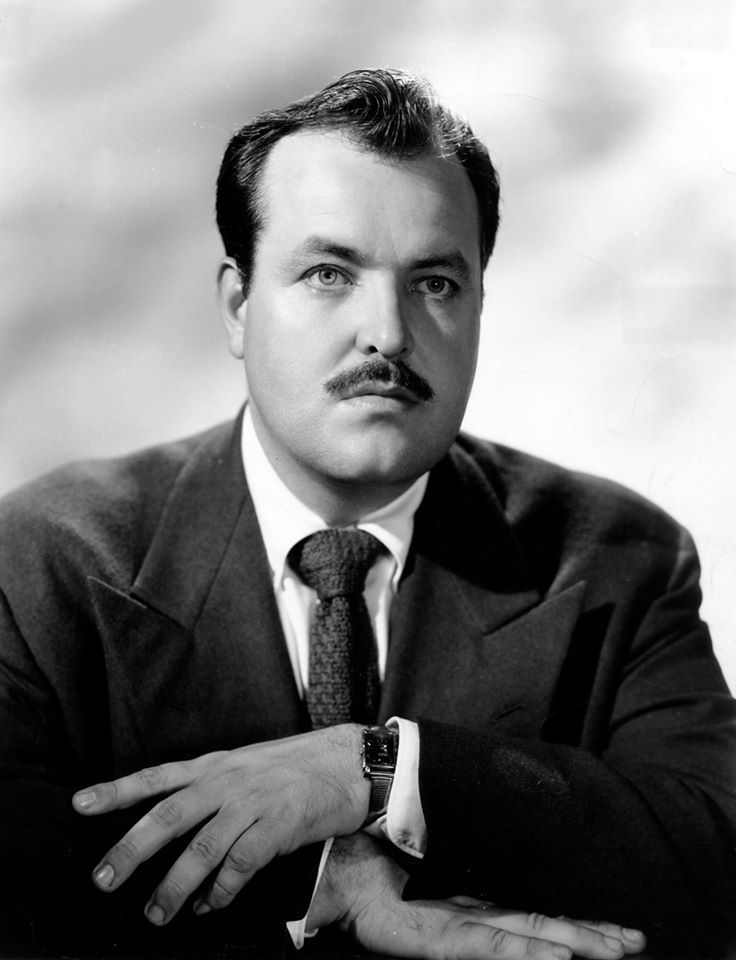
"There's just one way to handle the killers and the spoilers..."
One of radio's finest dramas rode into town on April 26, 1952 with the premiere broadcast of Gunsmoke. The series was created at the request of CBS president William Paley who wanted a "Philip Marlowe in the old West." After the idea kicked around without gaining any traction, producer/director Norman Macdonnell and writer John Meston developed their idea for a Western made for adults, without the simple "good guys vs. bad guys" feel of The Lone Ranger and other programs. Macdonnell and Meston created Gunsmoke, the story of US Marshal Matt Dillon - "the first man they look for and the last they want to meet." Dillon wasn't a white hat hero - he was a man trying to put his violent past behind him as he fought to keep the peace in Dodge City, Kansas.
John Meston's writing was hailed by producer/director Macdonnell, and Meston would go on to write 183 radio episodes and 196 television episodes of Gunsmoke. Meston was keen to avoid the traits of the stereotypical western hero in his depiction of Dillon, saying "Life and his enemies have left him looking a little beat-up. There'd have to be something wrong with him or he wouldn't have been hired on as a United States marshal in the heyday of Dodge City, Kansas."
William Conrad won the role of Dillon, and he gave the character a weary humor but an absolute fury when needed. Supporting Conrad was one of radio's greatest supporting casts. Parley Baer was Chester Proudfoot, Dillon's amiable deputy. Howard McNear was "Doc" Adams, the town physician with a ghoulish demeanor (and, as one episode revealed, a past in Richmond, Virginia involving a duel with a romantic rival). Georgia Ellis was Kitty Russell, proprietor of Dodge's Long Branch Saloon, as well as a friend, confidant, and lover of Matt Dillon. The relationship between Kitty and William Conrad's Matt Dillon was a key component of the show. Though her true profession was never explicitly stated on the show, in a 1953 interview, producer/director Norman Madconnell said "Kitty is just someone Matt has to visit every once in a while. We never say it, but Kitty is a prostitute, plain and simple." But their relationship was more than what it appeared to be. As Ellis herself said "There was no forgiveness to be given because I don't think Kitty was available to anybody but Matt."
Supporting roles were filled out by some of the best actors in Hollywood radio, many of whom had worked with Macdonnell in other shows like Escape and Philip Marlowe - John Dehner, Larry Dobkin, Harry Bartell, Vivi Janiss, Jeanette Nolan, and more. The landscape of Dodge City and its saloons and jail cells was created by Ray Kemper. Kemper's sounds were as essential a part of that program's success as the acting and the writing. Dodge City came to life with the sounds generated by Kemper and his effects team. To create the sound of a beer being poured at the Long Branch Saloon, a warm can of soda was used. Old microphone cable was twisted together to make the sound of a man mounting his saddle. The sound men are often the unsung heroes of old time radio, and Ray Kemper was one of the finest.
The series presented the grim realities of the west - sickness, death, loneliness - more than any program that came before. Matt Dillon wasn't an infallible hero; he struggled with doubt and disillusionment, and he didn't always get his man. the series paved the way for the new genre of mature Westerns on radio, and it spawned a television adaptation that ran for twenty seasons on CBS. The radio cast lobbied to reprise their roles, but the core characters were recast; even Norman Macdonnell was initially passed over for the TV show; he eventually came on board in 1956, and he guided the program to the number one rating from 1957 until 1961. Today, the radio Gunsmoke (which ran from 1952 to 1961) stands as one of the finest dramatic programs from the Golden Age of Radio.
Available Results
Generated results are saved to your library for reuse and search.
Choose Template
Pick the result you want. You can review provider and model before generating.
A concise first-pass summary for understanding the episode quickly.
A comprehensive, source-grounded extraction of the reusable knowledge in an episode.
Technologies, AI models, technical methods, capabilities, limitations, and adoption implications.
Repeatable methods, frameworks, mental models, processes, and systems.
A dedicated analysis of warnings, limitations, trade-offs, weak evidence, and uncertainty.
A dedicated inventory of concrete resources named in the episode.
A concise first-pass summary for understanding the episode quickly.
A detailed readable summary organized by chapter or topic.
A navigable map of subjects, topic flow, and suggested chapters.
A comprehensive, source-grounded extraction of the reusable knowledge in an episode.
Reusable atomic knowledge units extracted from the episode.
A comprehensive extraction focused on health practices, protocols, claims, and safety caveats.
A comprehensive extraction focused on opportunities, strategy, markets, and company building.
Explicit actions, next steps, habits, recommendations, and things to avoid.
A dedicated inventory of concrete resources named in the episode.
A dedicated analysis of warnings, limitations, trade-offs, weak evidence, and uncertainty.
A concise first-pass summary for understanding the episode quickly.
A detailed readable summary organized by chapter or topic.
A navigable map of subjects, topic flow, and suggested chapters.
A comprehensive, source-grounded extraction of the reusable knowledge in an episode.
Reusable atomic knowledge units extracted from the episode.
A comprehensive extraction focused on health practices, protocols, claims, and safety caveats.
A comprehensive extraction focused on opportunities, strategy, markets, and company building.
Scientific findings, mechanisms, studies, hypotheses, and the limits of the evidence discussed.
Technologies, AI models, technical methods, capabilities, limitations, and adoption implications.
Investment theses, assets, catalysts, valuation reasoning, time horizons, and risks.
Chronologies, actors, causes, consequences, turning points, and competing historical interpretations.
Policies, proposals, stakeholders, arguments, implementation constraints, and predicted effects.
Career paths, skills, hiring signals, workplace decisions, transitions, and limitations of the advice.
Behavioral mechanisms, biases, motivation, habits, emotions, interventions, and evidence limitations.
Economic mechanisms, incentives, indicators, market structure, forecasts, and uncertainty.
Leadership principles, team systems, organizational design, culture, feedback, and failure modes.
Audience, positioning, messaging, acquisition, retention, experiments, metrics, and failed approaches.
Teaching methods, learning strategies, practice, feedback, assessment, and effectiveness evidence.
Theses, premises, arguments, objections, values, thought experiments, and unresolved questions.
Communication patterns, conflict, boundaries, expectations, repair methods, and contextual limitations.
Books, papers, authors, courses, and other learning resources mentioned in the episode.
Repeatable methods, frameworks, mental models, processes, and systems.
Explicit actions, next steps, habits, recommendations, and things to avoid.
Memorable statements and important claims with attribution and source context.
A dedicated inventory of concrete resources named in the episode.
A dedicated analysis of warnings, limitations, trade-offs, weak evidence, and uncertainty.