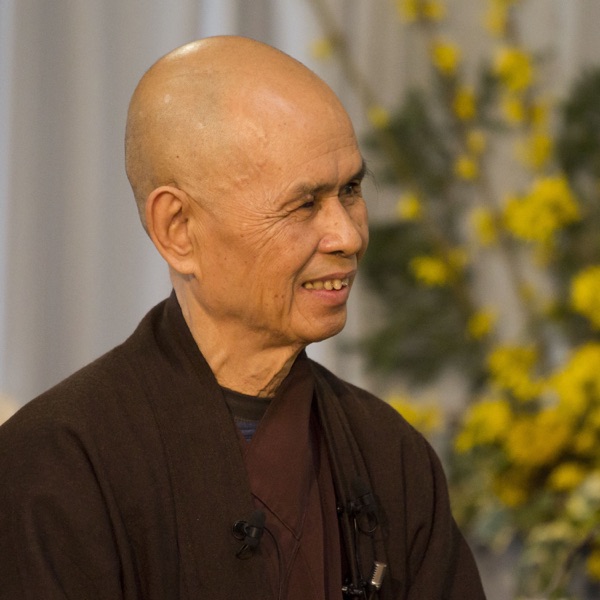
What has Buddha-Nature?
December 1, 2013. 93-minute dharma talk given by Thich Nhat Hanh from Upper Hamlet of Plum Village. This is the fifth talk of the 2013-2014 Winter Retreat. We begin with two chants from the monastics. The talk was given in Vietnamese and this is an English translation by Sr. Tue Nghiem.
An issue in Christianity has been the question whether God a human or not a human. Theologians have said, though God is not a person but God is not less than a person. In Buddhism, there is the idea of sentient beings that suffer and Buddha’s who have enlightenment. But when we become a Buddha, we continue to be a sentient being. I’m Mahayana Buddhism, these two are not separate. Sentient beings and Buddha’s are not different but two pairs of opposite. One cannot be without the other. Humans are composed of non-human elements. This is a non-dualistic insight. Interdependent co-arising.
Everything is impermanent, including enlightenment and Buddha. We must continue to cultivate happiness and insight. Can the Buddha be recognized in another form than a human? Consider what is written in the Diamond Sutra. We also need to remove the dualistic thinking regarding inanimate objects. Even a rock has Buddha-nature. We have to transcend the idea that Buddha must be a human.
Applying this teaching using sitting and breathing. Thay provides instructions.
At 58-minutes, we continue with the winter retreat teachings from the 30-verses of Vasubandhu with the 3rd verse.
Its appropriations and its manifestation of locality
cannot be known intellectually. It is always
associated with contact, mental attention, feeling,
perception, and volition.
Seeds. Form. Signs. Consciousness. Names.
More description
December 1, 2013. 93-minute dharma talk given by Thich Nhat Hanh from Upper Hamlet of Plum Village. This is the fifth talk of the 2013-2014 Winter Retreat. We begin with two chants from the monastics. The talk was given in Vietnamese and this is an English translation by Sr. Tue Nghiem.
An issue in Christianity has been the question whether God a human or not a human. Theologians have said, though God is not a person but God is not less than a person. In Buddhism, there is the idea of sentient beings that suffer and Buddha’s who have enlightenment. But when we become a Buddha, we continue to be a sentient being. I’m Mahayana Buddhism, these two are not separate. Sentient beings and Buddha’s are not different but two pairs of opposite. One cannot be without the other. Humans are composed of non-human elements. This is a non-dualistic insight. Interdependent co-arising.
Everything is impermanent, including enlightenment and Buddha. We must continue to cultivate happiness and insight. Can the Buddha be recognized in another form than a human? Consider what is written in the Diamond Sutra. We also need to remove the dualistic thinking regarding inanimate objects. Even a rock has Buddha-nature. We have to transcend the idea that Buddha must be a human.
Applying this teaching using sitting and breathing. Thay provides instructions.
At 58-minutes, we continue with the winter retreat teachings from the 30-verses of Vasubandhu with the 3rd verse.
Its appropriations and its manifestation of locality
cannot be known intellectually. It is always
associated with contact, mental attention, feeling,
perception, and volition.
Seeds. Form. Signs. Consciousness. Names.
Listen elsewhere
Available Results
Generated results are saved to your library for reuse and search.