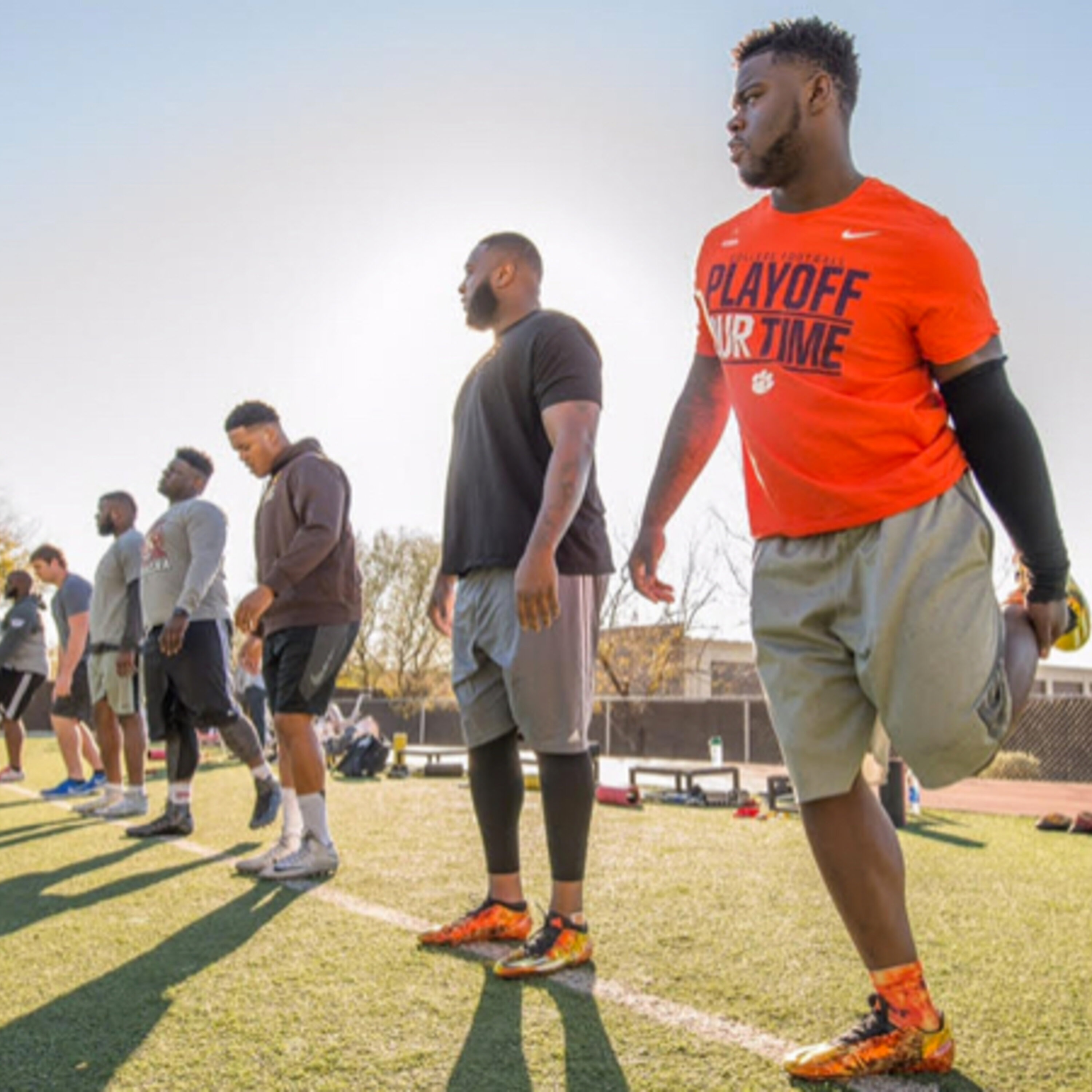
A Day In The Life Of Some Of The Top Athletes On The Face Of The Planet: How To Train For The NFL Combine.
This is a special Premium audio episode. Click here to activate a Premium subscription to the BenGreenfieldFitness show and access this and over 300 additional hidden audios, videos, pdf's and more!
Back in college, I interned at Duke University and worked with an NFL football player named Willie Roaf. I remember being completely flabbergasted at how this enormous man who was over 6'5" and weighed over 325 pounds could move like a cat, with extreme speed and precision and power while simultaneously generating enormous amounts of strength.
Today, I interview two experts who fill me in on some of the secrets that collegiate athletes are using to prepare for the NFL combine, the same underground tactics used by athletes in the NFL who are complete physical specimens. I wanted to pick these experts' brains about to learn how these NFL athletes train, how they recover, how they sleep and more…and in this episode you're going to get a sneak peek. My guests are two specialists that train and fuel these elite football athletes: Michelle Riccardi and Denis Logan.
Michelle Riccardi, MS, RD, CSSD, Sports Performance Dietitian has 18 years of experience providing sports nutrition services to professional and elite athletes in the NFL, NHL, MLB, NBA, PGA, NFLPA, and NCAA as well as International and Olympic athletes, tactical athletes and fire fighters. She also serves on the EXOS Mentorship Education Team.
Denis Logan, Performance Specialist, joined the EXOS Athletes’ Performance team in January 2008. A 2007 graduate of the Athletes’ Performance Intern Program, Denis serves as a performance specialists in the education department. Prior to joining Athletes’ Performance, he was a strength coach at Aviator Sports Performance in New York. Denis most recently completed his M.S. in Fitness and Health Management from the US Sports Academy. Both Michelle and Denis just returned from the NFL Combine, a week-long showcase occurring every February at Lucas Oil Stadium in Indianapolis, where college football players perform a big battery of physical and mental tests in front of National Football League coaches, general managers, and scouts. Implications of an athlete's performance during the combine can affect their draft status and salary, and ultimately their career, and an athlete's "draft stock" is increased based on superior measurable qualities such as size, speed, and strength. Michelle and Denis are real experts when it comes to maximizing these qualities, and during this episode, you'll discover:
-What the NFL Combine is...
-What kind of blood testing athletes have done in the NFL Combine...
-How personalized and individualized meals are created for each athlete...
-What kind of supplements the athletes take...
-A typical a ‘day in the life of an athlete’...
-Why dry needling and acupuncture is used...
-The concept of VooDoo bands and how they are used in the athletes...
-How an athlete's sleep is enhanced at the Combine...
-And much more!
Resources from this episode: -EXOS Sports Performance -The NFL Combine website -WellnessFX Blood Testing Do you have questions, comments or feedback about how to train for the NFL Combine, or anything else from this episode? Leave your thoughts at BenGreenfieldFitness.com.
See omnystudio.com/listener for privacy information.
Available Results
Generated results are saved to your library for reuse and search.
Choose Template
Pick the result you want. You can review provider and model before generating.
A concise first-pass summary for understanding the episode quickly.
A comprehensive, source-grounded extraction of the reusable knowledge in an episode.
A comprehensive extraction focused on health practices, protocols, claims, and safety caveats.
A dedicated analysis of warnings, limitations, trade-offs, weak evidence, and uncertainty.
Repeatable methods, frameworks, mental models, processes, and systems.
Technologies, AI models, technical methods, capabilities, limitations, and adoption implications.
A concise first-pass summary for understanding the episode quickly.
A detailed readable summary organized by chapter or topic.
A navigable map of subjects, topic flow, and suggested chapters.
A comprehensive, source-grounded extraction of the reusable knowledge in an episode.
Reusable atomic knowledge units extracted from the episode.
A comprehensive extraction focused on health practices, protocols, claims, and safety caveats.
A comprehensive extraction focused on opportunities, strategy, markets, and company building.
Explicit actions, next steps, habits, recommendations, and things to avoid.
A dedicated inventory of concrete resources named in the episode.
A dedicated analysis of warnings, limitations, trade-offs, weak evidence, and uncertainty.
A concise first-pass summary for understanding the episode quickly.
A detailed readable summary organized by chapter or topic.
A navigable map of subjects, topic flow, and suggested chapters.
A comprehensive, source-grounded extraction of the reusable knowledge in an episode.
Reusable atomic knowledge units extracted from the episode.
A comprehensive extraction focused on health practices, protocols, claims, and safety caveats.
A comprehensive extraction focused on opportunities, strategy, markets, and company building.
Scientific findings, mechanisms, studies, hypotheses, and the limits of the evidence discussed.
Technologies, AI models, technical methods, capabilities, limitations, and adoption implications.
Investment theses, assets, catalysts, valuation reasoning, time horizons, and risks.
Chronologies, actors, causes, consequences, turning points, and competing historical interpretations.
Policies, proposals, stakeholders, arguments, implementation constraints, and predicted effects.
Career paths, skills, hiring signals, workplace decisions, transitions, and limitations of the advice.
Behavioral mechanisms, biases, motivation, habits, emotions, interventions, and evidence limitations.
Economic mechanisms, incentives, indicators, market structure, forecasts, and uncertainty.
Leadership principles, team systems, organizational design, culture, feedback, and failure modes.
Audience, positioning, messaging, acquisition, retention, experiments, metrics, and failed approaches.
Teaching methods, learning strategies, practice, feedback, assessment, and effectiveness evidence.
Theses, premises, arguments, objections, values, thought experiments, and unresolved questions.
Communication patterns, conflict, boundaries, expectations, repair methods, and contextual limitations.
Books, papers, authors, courses, and other learning resources mentioned in the episode.
Repeatable methods, frameworks, mental models, processes, and systems.
Explicit actions, next steps, habits, recommendations, and things to avoid.
Memorable statements and important claims with attribution and source context.
A dedicated inventory of concrete resources named in the episode.
A dedicated analysis of warnings, limitations, trade-offs, weak evidence, and uncertainty.