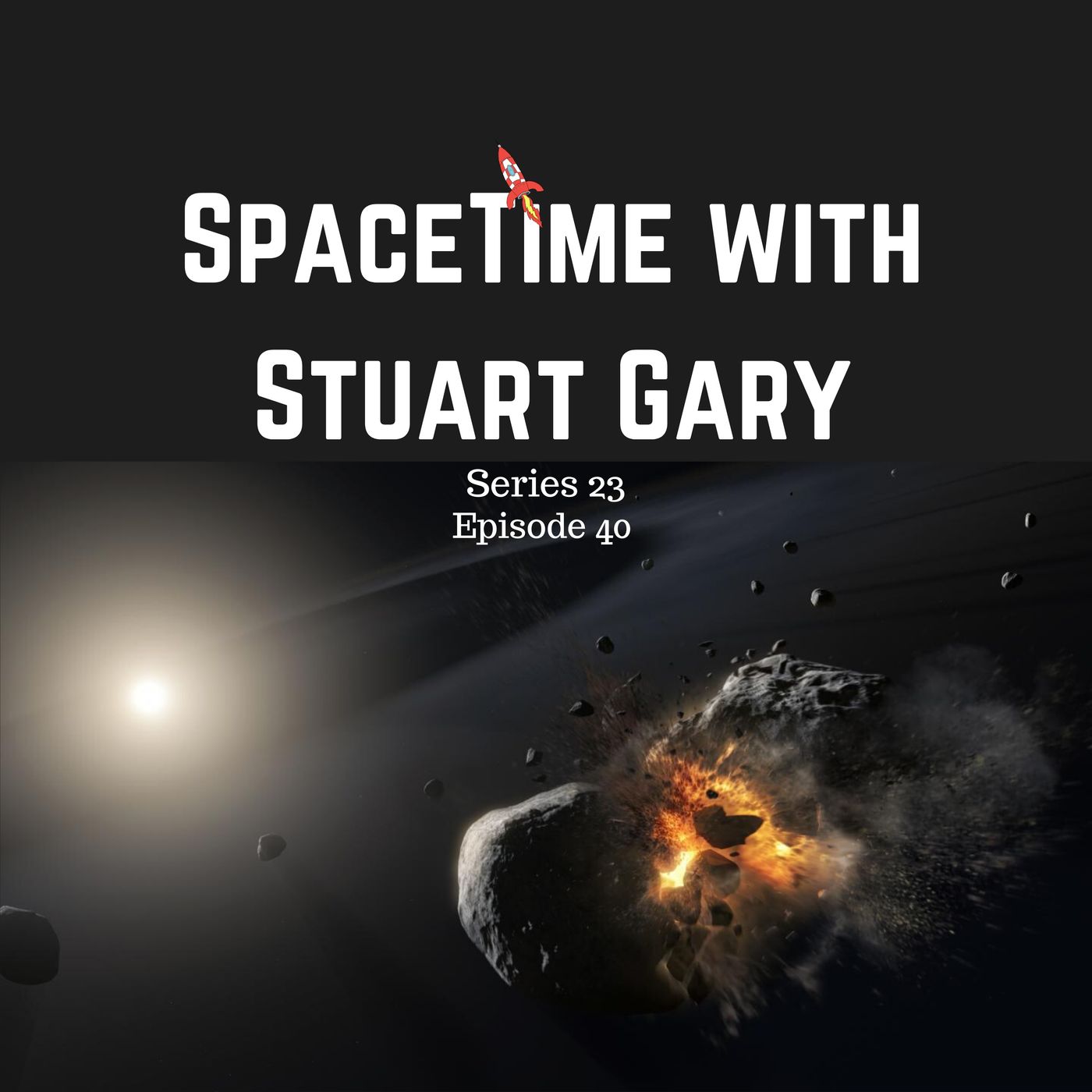
When Worlds Collide – the titanic collision of two asteroids
*When worlds collide – the titanic collision of two asteroids
Astronomers have observed an expanding cloud of icy debris caused by the catastrophic collision of two asteroids in a distant star system.
https://spacetimewithstuartgary.tumblr.com/post/616007736900108288
https://spacetimewithstuartgary.tumblr.com/post/616002631330152448
*Why NASA chose Jezero Crater for the Mars 2020 Perseverance rover
Preparations are continuing at the Cape Canaveral air force base for July’s planned launch of the Mars 2020 Perseverance rover. The mission will study the local geology and search for signs of past life on the red planet – which is why Jezero Crater was chosen from more than 60 candidate locations.
*Belief in UFOs and alien abductions is falling because people have more things to worry about.
Belief in extra-terrestrial life and aliens visiting the Earth in flying saucers to engage in some late-night probing has been a mainstay of science fiction for well over a hundred years but belief in UFOs and alien abductions is falling because people have more important things to worry about.
*The Science Report
Growing concerns that COVID-19 is spreading simply through breathing and talking.
Paper towels are better at removing viruses that hot air hand dryers.
Amphibians including frogs and salamanders on the front line of extinction due to global warming.
Summer Arctic sea-ice is predicted to disappear before 2050 due to climate change.
COVID-19 bringing out all the usual con-artists, shonks, and woo merchants.
Sponsor Link:
This episode of SpaceTime is brought to you with the support of Express VPN...rated No.1 by TechRadar. To take up our special offer, visit www.tryexpressvpn.com/space and help support the show.
For enhanced Show Notes including photos to accompany this episode, visit: http://www.bitesz.com/spacetimeshownotes
Get immediate access to over 180 commercial-free, double episode editions of SpaceTime plus extended interview bonus content. Subscribe via Patreon or Supercast....and share in the rewards. Details at www.patreon.com/spacetimewithstuartgary or if you’re not a fan of
Patreon, go to Supercast - https://bitesznetwork.supercast.tech/
RSS feed: https://rss.acast.com/spacetime
Email: SpaceTime@bitesz.com
To receive the Astronomy Daily Newsletter free, direct to your inbox...just join our mailing list at www.bitesz.com/mailinglist or visit https://www.bitesz.com/astronomy-daily
Help support SpaceTime: The SpaceTime with Stuart Gary merchandise shop. Get your T-Shirts, Coffee Cups, badges, tote bag + more and help support the show. Check out the range: http://www.cafepress.com/spacetime Thank you.
See acast.com/privacy for privacy and opt-out information.
Become a supporter of this podcast: https://www.spreaker.com/podcast/spacetime-with-stuart-gary--2458531/support.
Available Results
Generated results are saved to your library for reuse and search.
Choose Template
Pick the result you want. You can review provider and model before generating.
A concise first-pass summary for understanding the episode quickly.
A comprehensive, source-grounded extraction of the reusable knowledge in an episode.
A comprehensive extraction focused on opportunities, strategy, markets, and company building.
Explicit actions, next steps, habits, recommendations, and things to avoid.
Repeatable methods, frameworks, mental models, processes, and systems.
A dedicated inventory of concrete resources named in the episode.
A concise first-pass summary for understanding the episode quickly.
A detailed readable summary organized by chapter or topic.
A navigable map of subjects, topic flow, and suggested chapters.
A comprehensive, source-grounded extraction of the reusable knowledge in an episode.
Reusable atomic knowledge units extracted from the episode.
A comprehensive extraction focused on health practices, protocols, claims, and safety caveats.
A comprehensive extraction focused on opportunities, strategy, markets, and company building.
Explicit actions, next steps, habits, recommendations, and things to avoid.
A dedicated inventory of concrete resources named in the episode.
A dedicated analysis of warnings, limitations, trade-offs, weak evidence, and uncertainty.
A concise first-pass summary for understanding the episode quickly.
A detailed readable summary organized by chapter or topic.
A navigable map of subjects, topic flow, and suggested chapters.
A comprehensive, source-grounded extraction of the reusable knowledge in an episode.
Reusable atomic knowledge units extracted from the episode.
A comprehensive extraction focused on health practices, protocols, claims, and safety caveats.
A comprehensive extraction focused on opportunities, strategy, markets, and company building.
Scientific findings, mechanisms, studies, hypotheses, and the limits of the evidence discussed.
Technologies, AI models, technical methods, capabilities, limitations, and adoption implications.
Investment theses, assets, catalysts, valuation reasoning, time horizons, and risks.
Chronologies, actors, causes, consequences, turning points, and competing historical interpretations.
Policies, proposals, stakeholders, arguments, implementation constraints, and predicted effects.
Career paths, skills, hiring signals, workplace decisions, transitions, and limitations of the advice.
Behavioral mechanisms, biases, motivation, habits, emotions, interventions, and evidence limitations.
Economic mechanisms, incentives, indicators, market structure, forecasts, and uncertainty.
Leadership principles, team systems, organizational design, culture, feedback, and failure modes.
Audience, positioning, messaging, acquisition, retention, experiments, metrics, and failed approaches.
Teaching methods, learning strategies, practice, feedback, assessment, and effectiveness evidence.
Theses, premises, arguments, objections, values, thought experiments, and unresolved questions.
Communication patterns, conflict, boundaries, expectations, repair methods, and contextual limitations.
Books, papers, authors, courses, and other learning resources mentioned in the episode.
Repeatable methods, frameworks, mental models, processes, and systems.
Explicit actions, next steps, habits, recommendations, and things to avoid.
Memorable statements and important claims with attribution and source context.
A dedicated inventory of concrete resources named in the episode.
A dedicated analysis of warnings, limitations, trade-offs, weak evidence, and uncertainty.