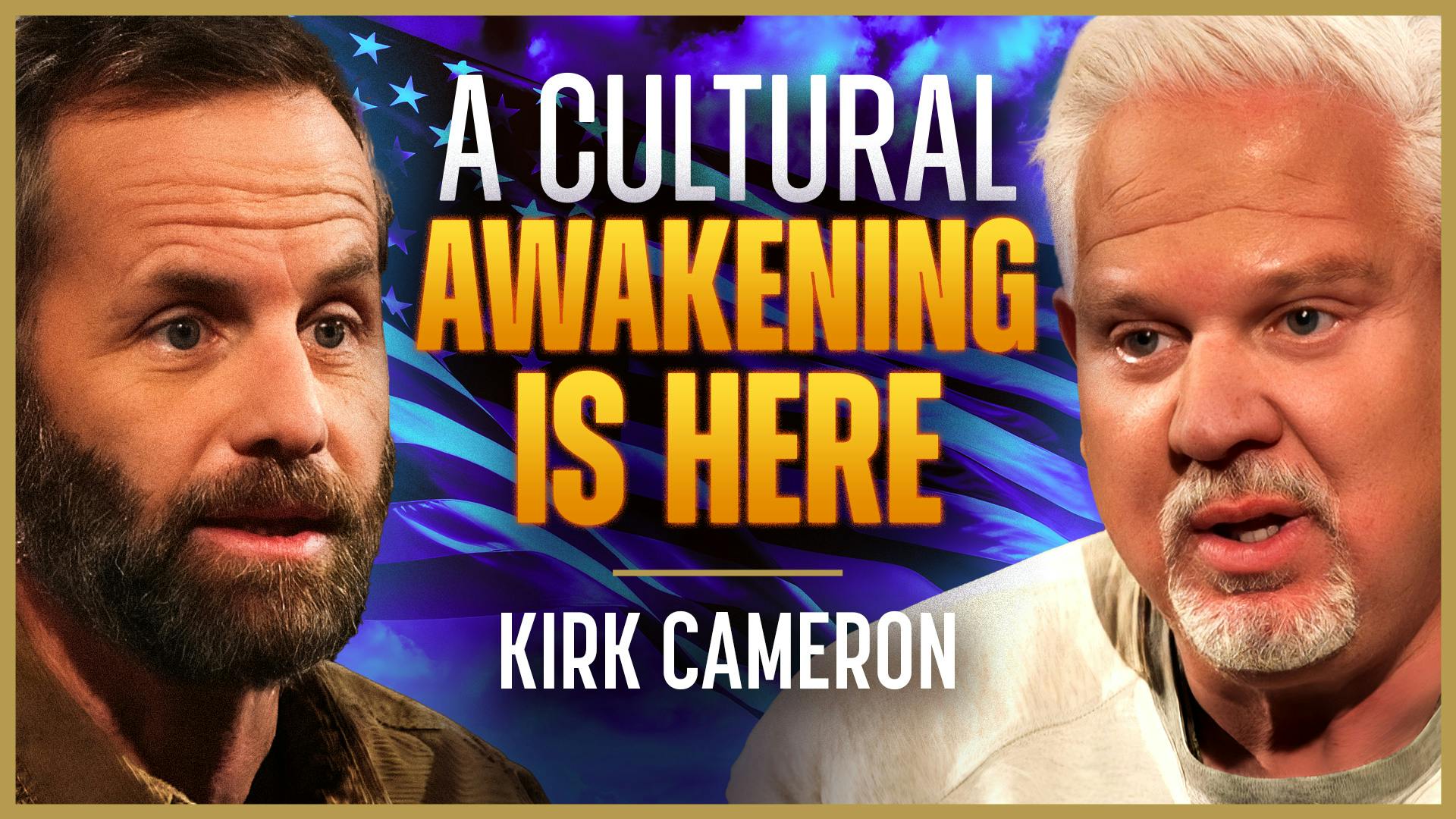
Ep 231 | Kirk Cameron: Christians CAN Save This Country | The Glenn Beck Podcast
Jesus isn’t on the ballot, so how should Christians engage in the 2024 election? For that matter, how should Christians engage in politics in general? Kirk Cameron explains that “Christian Nationalism” is a “slur thrown at people who love God, love their family, and love their country.” Now is no time for Christians to “tuck our heads in our knees, pray for the rapture, and cry into our Chick-fil-A soup.” In an age of “murdering babies in the name of reproductive care,” the mutilation of children for the sake of gender identity, and when too many Americans are being seduced by the “comfort of communism,” it’s time for Christians to get to work. Kirk and Glenn agree, the government shouldn’t be the first responder — not FEMA, not the Department of Education, and not our public schools, which Kirk describes as the “new secular church.” As we’ve seen during Hurricane Helene and Hurricane Milton, we — the American people — are the real first responders. If Kamala Harris is inaugurated in January or Donald Trump, if Jesus returns tomorrow or in a thousand years, these are the “hard times that make strong men” and just could be “our finest hour.”
Sponsors
PreBorn
Will you help save babies’ lives? To donate securely, dial #250 and say the keyword “Baby,” or visit https://Preborn.com/Glenn.
Better Spectacles
Go to https://BetterSpectacles.com/BECK and get your Rodenstock biometric intelligence glasses for 61% off.
Learn more about your ad choices. Visit megaphone.fm/adchoices
Available Results
Generated results are saved to your library for reuse and search.
Choose Template
Pick the result you want. You can review provider and model before generating.
A concise first-pass summary for understanding the episode quickly.
A comprehensive, source-grounded extraction of the reusable knowledge in an episode.
Technologies, AI models, technical methods, capabilities, limitations, and adoption implications.
Repeatable methods, frameworks, mental models, processes, and systems.
A dedicated analysis of warnings, limitations, trade-offs, weak evidence, and uncertainty.
A dedicated inventory of concrete resources named in the episode.
A concise first-pass summary for understanding the episode quickly.
A detailed readable summary organized by chapter or topic.
A navigable map of subjects, topic flow, and suggested chapters.
A comprehensive, source-grounded extraction of the reusable knowledge in an episode.
Reusable atomic knowledge units extracted from the episode.
A comprehensive extraction focused on health practices, protocols, claims, and safety caveats.
A comprehensive extraction focused on opportunities, strategy, markets, and company building.
Explicit actions, next steps, habits, recommendations, and things to avoid.
A dedicated inventory of concrete resources named in the episode.
A dedicated analysis of warnings, limitations, trade-offs, weak evidence, and uncertainty.
A concise first-pass summary for understanding the episode quickly.
A detailed readable summary organized by chapter or topic.
A navigable map of subjects, topic flow, and suggested chapters.
A comprehensive, source-grounded extraction of the reusable knowledge in an episode.
Reusable atomic knowledge units extracted from the episode.
A comprehensive extraction focused on health practices, protocols, claims, and safety caveats.
A comprehensive extraction focused on opportunities, strategy, markets, and company building.
Scientific findings, mechanisms, studies, hypotheses, and the limits of the evidence discussed.
Technologies, AI models, technical methods, capabilities, limitations, and adoption implications.
Investment theses, assets, catalysts, valuation reasoning, time horizons, and risks.
Chronologies, actors, causes, consequences, turning points, and competing historical interpretations.
Policies, proposals, stakeholders, arguments, implementation constraints, and predicted effects.
Career paths, skills, hiring signals, workplace decisions, transitions, and limitations of the advice.
Behavioral mechanisms, biases, motivation, habits, emotions, interventions, and evidence limitations.
Economic mechanisms, incentives, indicators, market structure, forecasts, and uncertainty.
Leadership principles, team systems, organizational design, culture, feedback, and failure modes.
Audience, positioning, messaging, acquisition, retention, experiments, metrics, and failed approaches.
Teaching methods, learning strategies, practice, feedback, assessment, and effectiveness evidence.
Theses, premises, arguments, objections, values, thought experiments, and unresolved questions.
Communication patterns, conflict, boundaries, expectations, repair methods, and contextual limitations.
Books, papers, authors, courses, and other learning resources mentioned in the episode.
Repeatable methods, frameworks, mental models, processes, and systems.
Explicit actions, next steps, habits, recommendations, and things to avoid.
Memorable statements and important claims with attribution and source context.
A dedicated inventory of concrete resources named in the episode.
A dedicated analysis of warnings, limitations, trade-offs, weak evidence, and uncertainty.