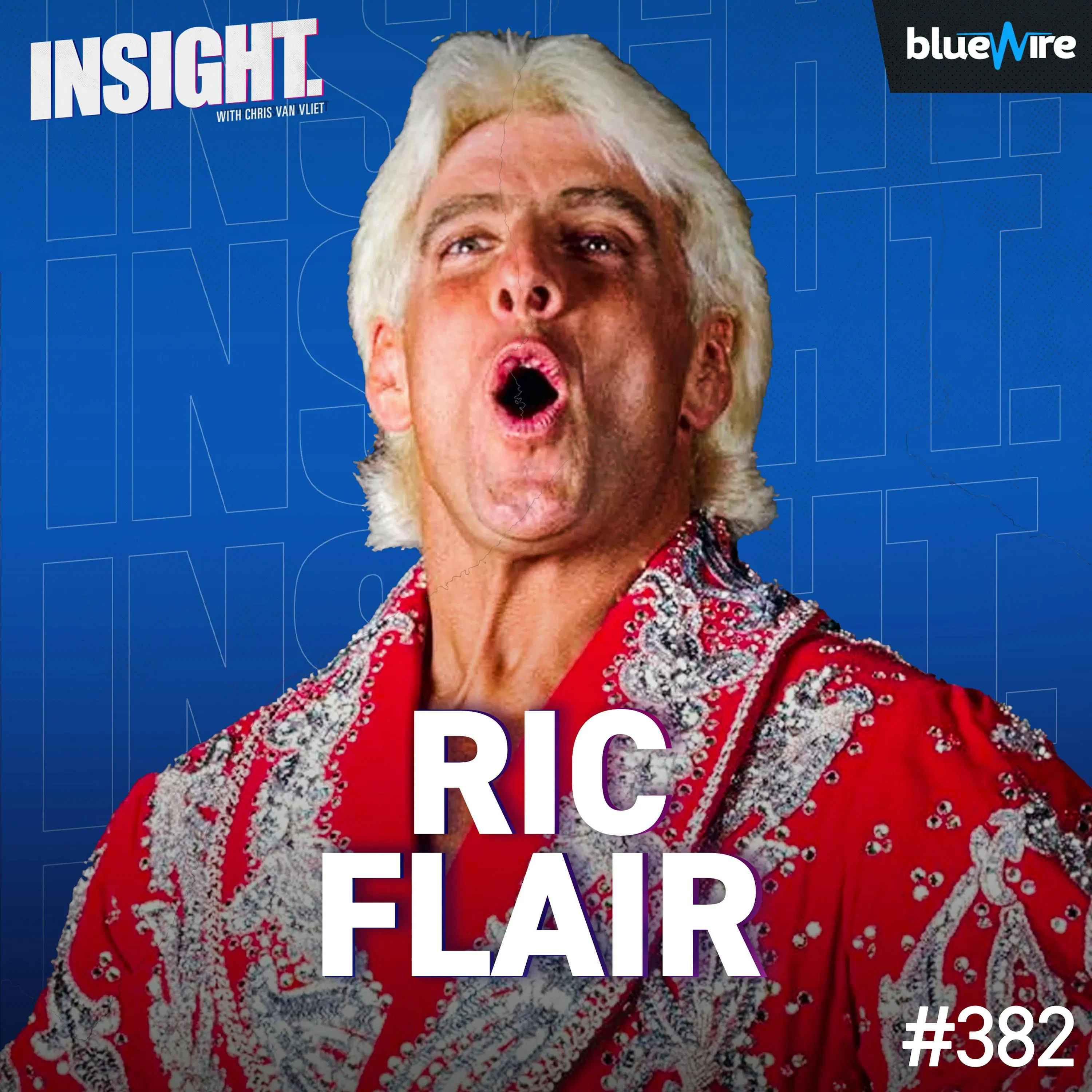
Ric Flair On His Legendary Career And Why He Wants One Last Match
"The Nature Boy" Ric Flair (@ricflairnatureboy) is an iconic professional wrestler and 2-time WWE Hall of Famer. He joins Chris Van Vliet to talk about his last match that is taking place on Sunday, July 31 at the Nashville Municipal Auditorium, why he decided to wrestle again after his retirement match at WrestleMania 24 against Shawn Michaels, his thoughts on Vince McMahon's recent retirement from WWE, who is on his pro wrestling Mount Rushmore, the catch phrase he is most proud of, his goals when he first entered the wrestling business in 1972, his thoughts on whether John Cena or Randy Orton will break record as the 16-time World Champion, the story behind his famous WOOOOO Off with Jay Lethal in TNA Wrestling and much more!
For more information about Chris and INSIGHT go to: https://podcast.chrisvanvliet.com
If you enjoyed this episode, could I ask you to please consider leaving a short review on Apple Podcast/iTunes? It takes less than a minute and makes a huge difference in helping to spread the word about the show and also to convince some hard-to-get guests.
Create a beautiful website for your podcast is just 5 minutes: https://www.podpage.com/?via=cvv
Follow CVV on social media:
Instagram: instagram.com/ChrisVanVliet
Twitter: twitter.com/ChrisVanVliet
Facebook: facebook.com/ChrisVanVliet
YouTube: youtube.com/ChrisVanVliet
TikTok: tiktok.com/@Chris.VanVliet
Learn more about your ad choices. Visit podcastchoices.com/adchoices
Learn more about your ad choices. Visit podcastchoices.com/adchoices
Available Results
Generated results are saved to your library for reuse and search.
Choose Template
Pick the result you want. You can review provider and model before generating.
A concise first-pass summary for understanding the episode quickly.
A comprehensive, source-grounded extraction of the reusable knowledge in an episode.
A comprehensive extraction focused on opportunities, strategy, markets, and company building.
Explicit actions, next steps, habits, recommendations, and things to avoid.
Repeatable methods, frameworks, mental models, processes, and systems.
A dedicated inventory of concrete resources named in the episode.
A concise first-pass summary for understanding the episode quickly.
A detailed readable summary organized by chapter or topic.
A navigable map of subjects, topic flow, and suggested chapters.
A comprehensive, source-grounded extraction of the reusable knowledge in an episode.
Reusable atomic knowledge units extracted from the episode.
A comprehensive extraction focused on health practices, protocols, claims, and safety caveats.
A comprehensive extraction focused on opportunities, strategy, markets, and company building.
Explicit actions, next steps, habits, recommendations, and things to avoid.
A dedicated inventory of concrete resources named in the episode.
A dedicated analysis of warnings, limitations, trade-offs, weak evidence, and uncertainty.
A concise first-pass summary for understanding the episode quickly.
A detailed readable summary organized by chapter or topic.
A navigable map of subjects, topic flow, and suggested chapters.
A comprehensive, source-grounded extraction of the reusable knowledge in an episode.
Reusable atomic knowledge units extracted from the episode.
A comprehensive extraction focused on health practices, protocols, claims, and safety caveats.
A comprehensive extraction focused on opportunities, strategy, markets, and company building.
Scientific findings, mechanisms, studies, hypotheses, and the limits of the evidence discussed.
Technologies, AI models, technical methods, capabilities, limitations, and adoption implications.
Investment theses, assets, catalysts, valuation reasoning, time horizons, and risks.
Chronologies, actors, causes, consequences, turning points, and competing historical interpretations.
Policies, proposals, stakeholders, arguments, implementation constraints, and predicted effects.
Career paths, skills, hiring signals, workplace decisions, transitions, and limitations of the advice.
Behavioral mechanisms, biases, motivation, habits, emotions, interventions, and evidence limitations.
Economic mechanisms, incentives, indicators, market structure, forecasts, and uncertainty.
Leadership principles, team systems, organizational design, culture, feedback, and failure modes.
Audience, positioning, messaging, acquisition, retention, experiments, metrics, and failed approaches.
Teaching methods, learning strategies, practice, feedback, assessment, and effectiveness evidence.
Theses, premises, arguments, objections, values, thought experiments, and unresolved questions.
Communication patterns, conflict, boundaries, expectations, repair methods, and contextual limitations.
Books, papers, authors, courses, and other learning resources mentioned in the episode.
Repeatable methods, frameworks, mental models, processes, and systems.
Explicit actions, next steps, habits, recommendations, and things to avoid.
Memorable statements and important claims with attribution and source context.
A dedicated inventory of concrete resources named in the episode.
A dedicated analysis of warnings, limitations, trade-offs, weak evidence, and uncertainty.