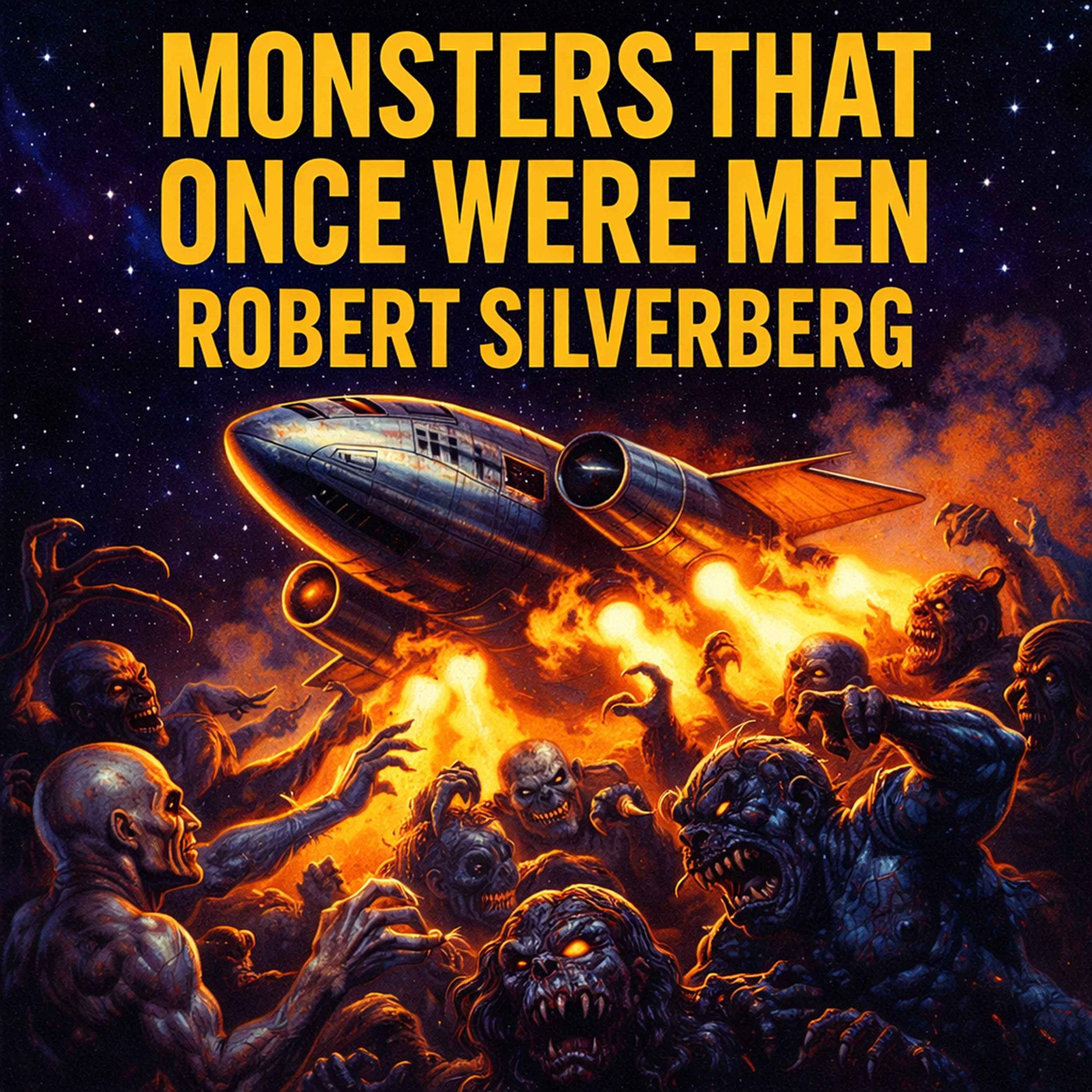
Monsters That Once Were Men by Robert Silverberg
They were like creatures painted by a drunken artist, ghastly, utterly repulsive caricatures of humanity! Yet, twisted though they were, they were still human... Monsters That Once Were Men by Robert Silverberg, that’s next on The Lost Sci-Fi Podcast, with at least one lost vintage sci-fi short story in every episode.
Our 1st Anniversary week comes to an end with a superb story Silverberg scribbled softly. Okay maybe I went a bit too far looking for words that started with S. So sorry. In the early 1950s, Robert Silverberg was a young science fiction fan who was eager to break into the field as a writer. He started submitting stories to various magazines but was repeatedly rejected.
Undeterred, Silverberg wrote a story called "Gorgon Planet" and it appeared in “Nebula”, Scotland's first science fiction magazine under the name Bob Silverberg in 1954. It was the first of more than 600 paid short stories. As was the case with many sci-fi stories back then, "Gorgon Planet" appeared again. It was published in “Super-Science Fiction” magazine 4 ½ years later with the title “The Fight With The Gorgon.” Same story, different title.
Silverberg’s career took off in 1956 when he sold more than 50 short stories.
Today’s story comes from Super-Science Fiction Magazine in August 1959. The story is credited to one of Silverberg’s pen names, Eric Rodman. Our story can be found on page 18, Monsters That Once Were Men by Robert Silverberg…
Next week on The Lost Sci-Fi Podcast… The men of the Norgan System had a tough decision to make concerning the planet in A93. Yet there was no hesitation. Can you blame them? Day of Wrath by Bjarne Kirchhoff. That’s next week on The Lost Sci-Fi Podcast, with at least one lost vintage sci-fi short story in every episode.
Listen without commercials and enjoy exclusive bonus episodes every month with Lost Sci-Fi Premium—start your free 7-day trial today. https://lostscifi.supercast.com/
Hosted by Simplecast, an AdsWizz company. See pcm.adswizz.com for information about our collection and use of personal data for advertising.
Available Results
Generated results are saved to your library for reuse and search.
Choose Template
Pick the result you want. You can review provider and model before generating.
A concise first-pass summary for understanding the episode quickly.
A comprehensive, source-grounded extraction of the reusable knowledge in an episode.
A comprehensive extraction focused on opportunities, strategy, markets, and company building.
Explicit actions, next steps, habits, recommendations, and things to avoid.
Repeatable methods, frameworks, mental models, processes, and systems.
A dedicated inventory of concrete resources named in the episode.
A concise first-pass summary for understanding the episode quickly.
A detailed readable summary organized by chapter or topic.
A navigable map of subjects, topic flow, and suggested chapters.
A comprehensive, source-grounded extraction of the reusable knowledge in an episode.
Reusable atomic knowledge units extracted from the episode.
A comprehensive extraction focused on health practices, protocols, claims, and safety caveats.
A comprehensive extraction focused on opportunities, strategy, markets, and company building.
Explicit actions, next steps, habits, recommendations, and things to avoid.
A dedicated inventory of concrete resources named in the episode.
A dedicated analysis of warnings, limitations, trade-offs, weak evidence, and uncertainty.
A concise first-pass summary for understanding the episode quickly.
A detailed readable summary organized by chapter or topic.
A navigable map of subjects, topic flow, and suggested chapters.
A comprehensive, source-grounded extraction of the reusable knowledge in an episode.
Reusable atomic knowledge units extracted from the episode.
A comprehensive extraction focused on health practices, protocols, claims, and safety caveats.
A comprehensive extraction focused on opportunities, strategy, markets, and company building.
Scientific findings, mechanisms, studies, hypotheses, and the limits of the evidence discussed.
Technologies, AI models, technical methods, capabilities, limitations, and adoption implications.
Investment theses, assets, catalysts, valuation reasoning, time horizons, and risks.
Chronologies, actors, causes, consequences, turning points, and competing historical interpretations.
Policies, proposals, stakeholders, arguments, implementation constraints, and predicted effects.
Career paths, skills, hiring signals, workplace decisions, transitions, and limitations of the advice.
Behavioral mechanisms, biases, motivation, habits, emotions, interventions, and evidence limitations.
Economic mechanisms, incentives, indicators, market structure, forecasts, and uncertainty.
Leadership principles, team systems, organizational design, culture, feedback, and failure modes.
Audience, positioning, messaging, acquisition, retention, experiments, metrics, and failed approaches.
Teaching methods, learning strategies, practice, feedback, assessment, and effectiveness evidence.
Theses, premises, arguments, objections, values, thought experiments, and unresolved questions.
Communication patterns, conflict, boundaries, expectations, repair methods, and contextual limitations.
Books, papers, authors, courses, and other learning resources mentioned in the episode.
Repeatable methods, frameworks, mental models, processes, and systems.
Explicit actions, next steps, habits, recommendations, and things to avoid.
Memorable statements and important claims with attribution and source context.
A dedicated inventory of concrete resources named in the episode.
A dedicated analysis of warnings, limitations, trade-offs, weak evidence, and uncertainty.