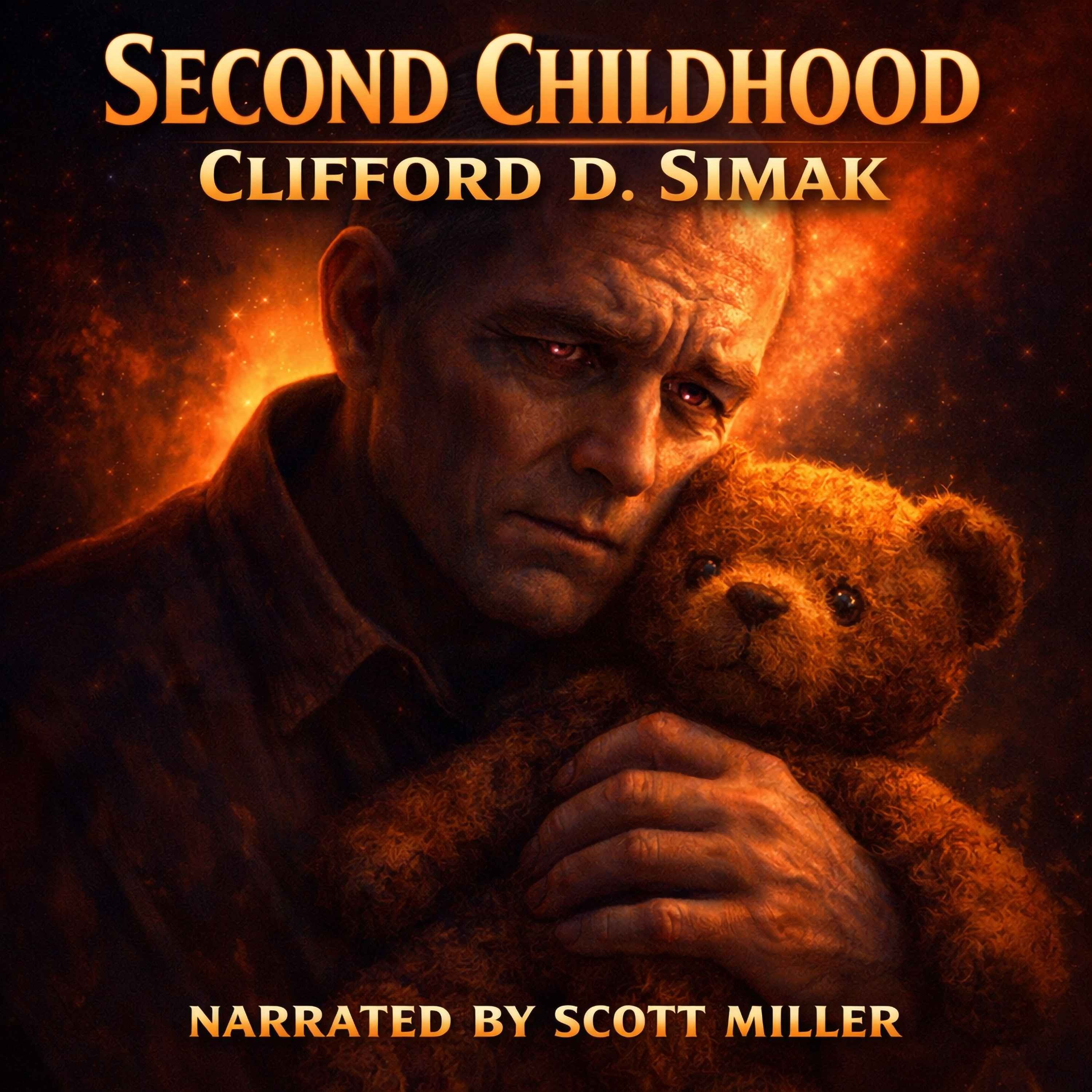
Second Childhood by Clifford D. Simak
Achieving immortality is only half of the problem. The other half is knowing how to live with it once it's been made possible—and inescapable!. Second Childhood by Clifford D. Simak, that’s next on The Lost Sci-Fi Podcast, with at least one lost vintage sci-fi short story in every episode.
Clifford D. Simak worked as a newspaperman for most of his life and only became a full-time science fiction author after his retirement. However, what he accomplished part time was more than most. He won 3 Hugo Awards and a Nebula and The Science Fiction Writers of America made him its third Grand Master.
Simak was born in Millville, Wisconsin in 1904. He was a public school teacher until leaving to work at the Minneapolis Star and Tribune until he retired at 72. He became interested in sci-fi after reading H. G. Wells.
His first short story, “The World of the Red Sun” appeared in the December 1931 issue of Wonder Stories magazine. He would go on to write more than 120 short stories.
Let’s turn to the pages of Galaxy Science Fiction in February 1951. We’ll find our story on page 81, Second Childhood by Clifford D. Simak…
Next week on The Lost Sci-Fi Podcast, The climate was perfect, the sky was always blue, and–best of all–nobody had to work. What more could anyone want? Planet of Dreams by James McKimmey Jr. That’s next week with at least one lost vintage sci-fi short story in every episode.
===========================
Buy Me a Coffee - https://lostscifi.com/coffee
Newsletter - https://lostscifi.com/free/
Facebook - https://lostscifi.com/facebook
YouTube - https://lostscifi.com/youtube
Instagram - https://www.instagram.com/lostscifiguy
Bluesky - https://bsky.app/profile/lostscifipodcast.bsky.social
Merchandise - https://lostscifi.creator-spring.com/
===========================️ ️
Thanks to Our Listeners Who Bought Us a Coffee
$200 Someone
$100 Tony from the Future
$75 James Van Maanenberg
$50 MizzBassie, Anonymous Listener
$25 Someone, Someone, Eaten by a Grue, Jeff Lussenden, Fred Sieber, Anne, Craig Hamilton, Dave Wiseman, Bromite Thrip, Marwin de Haan, Future Space Engineer, Fressie, Kevin Eckert, Stephen Kagan, James Van Maanenberg, Irma Stolfo, Josh Jennings, Leber8tr, Conrad Chaffee, Anonymous Listener
$15 Every Month Someone
$15 SueTheLibrarian, Joannie West, Amy Özkan, Someone, Carolyn Guthleben, Patrick McLendon, Curious Jon, Buz C., Fressie, Anonymous Listener
$10 Anonymous Listener
$5 Every Month Eaten by a Grue
$5 TLD, David, Denis Kalinin, Timothy Buckley, Andre'a, Martin Brown, Ron McFarlan, Tif Love, Chrystene, Richard Hoffman, Anonymous Listener
https://lostscifi.com/podcast/second-childhood-by-clifford-d-simak-episode-86/
Listen without commercials and enjoy exclusive bonus episodes every month with Lost Sci-Fi Premium—start your free 7-day trial today. https://lostscifi.supercast.com/
Hosted by Simplecast, an AdsWizz company. See pcm.adswizz.com for information about our collection and use of personal data for advertising.
Available Results
Generated results are saved to your library for reuse and search.
Choose Template
Pick the result you want. You can review provider and model before generating.
A concise first-pass summary for understanding the episode quickly.
A comprehensive, source-grounded extraction of the reusable knowledge in an episode.
A comprehensive extraction focused on opportunities, strategy, markets, and company building.
Explicit actions, next steps, habits, recommendations, and things to avoid.
Repeatable methods, frameworks, mental models, processes, and systems.
A dedicated inventory of concrete resources named in the episode.
A concise first-pass summary for understanding the episode quickly.
A detailed readable summary organized by chapter or topic.
A navigable map of subjects, topic flow, and suggested chapters.
A comprehensive, source-grounded extraction of the reusable knowledge in an episode.
Reusable atomic knowledge units extracted from the episode.
A comprehensive extraction focused on health practices, protocols, claims, and safety caveats.
A comprehensive extraction focused on opportunities, strategy, markets, and company building.
Explicit actions, next steps, habits, recommendations, and things to avoid.
A dedicated inventory of concrete resources named in the episode.
A dedicated analysis of warnings, limitations, trade-offs, weak evidence, and uncertainty.
A concise first-pass summary for understanding the episode quickly.
A detailed readable summary organized by chapter or topic.
A navigable map of subjects, topic flow, and suggested chapters.
A comprehensive, source-grounded extraction of the reusable knowledge in an episode.
Reusable atomic knowledge units extracted from the episode.
A comprehensive extraction focused on health practices, protocols, claims, and safety caveats.
A comprehensive extraction focused on opportunities, strategy, markets, and company building.
Scientific findings, mechanisms, studies, hypotheses, and the limits of the evidence discussed.
Technologies, AI models, technical methods, capabilities, limitations, and adoption implications.
Investment theses, assets, catalysts, valuation reasoning, time horizons, and risks.
Chronologies, actors, causes, consequences, turning points, and competing historical interpretations.
Policies, proposals, stakeholders, arguments, implementation constraints, and predicted effects.
Career paths, skills, hiring signals, workplace decisions, transitions, and limitations of the advice.
Behavioral mechanisms, biases, motivation, habits, emotions, interventions, and evidence limitations.
Economic mechanisms, incentives, indicators, market structure, forecasts, and uncertainty.
Leadership principles, team systems, organizational design, culture, feedback, and failure modes.
Audience, positioning, messaging, acquisition, retention, experiments, metrics, and failed approaches.
Teaching methods, learning strategies, practice, feedback, assessment, and effectiveness evidence.
Theses, premises, arguments, objections, values, thought experiments, and unresolved questions.
Communication patterns, conflict, boundaries, expectations, repair methods, and contextual limitations.
Books, papers, authors, courses, and other learning resources mentioned in the episode.
Repeatable methods, frameworks, mental models, processes, and systems.
Explicit actions, next steps, habits, recommendations, and things to avoid.
Memorable statements and important claims with attribution and source context.
A dedicated inventory of concrete resources named in the episode.
A dedicated analysis of warnings, limitations, trade-offs, weak evidence, and uncertainty.