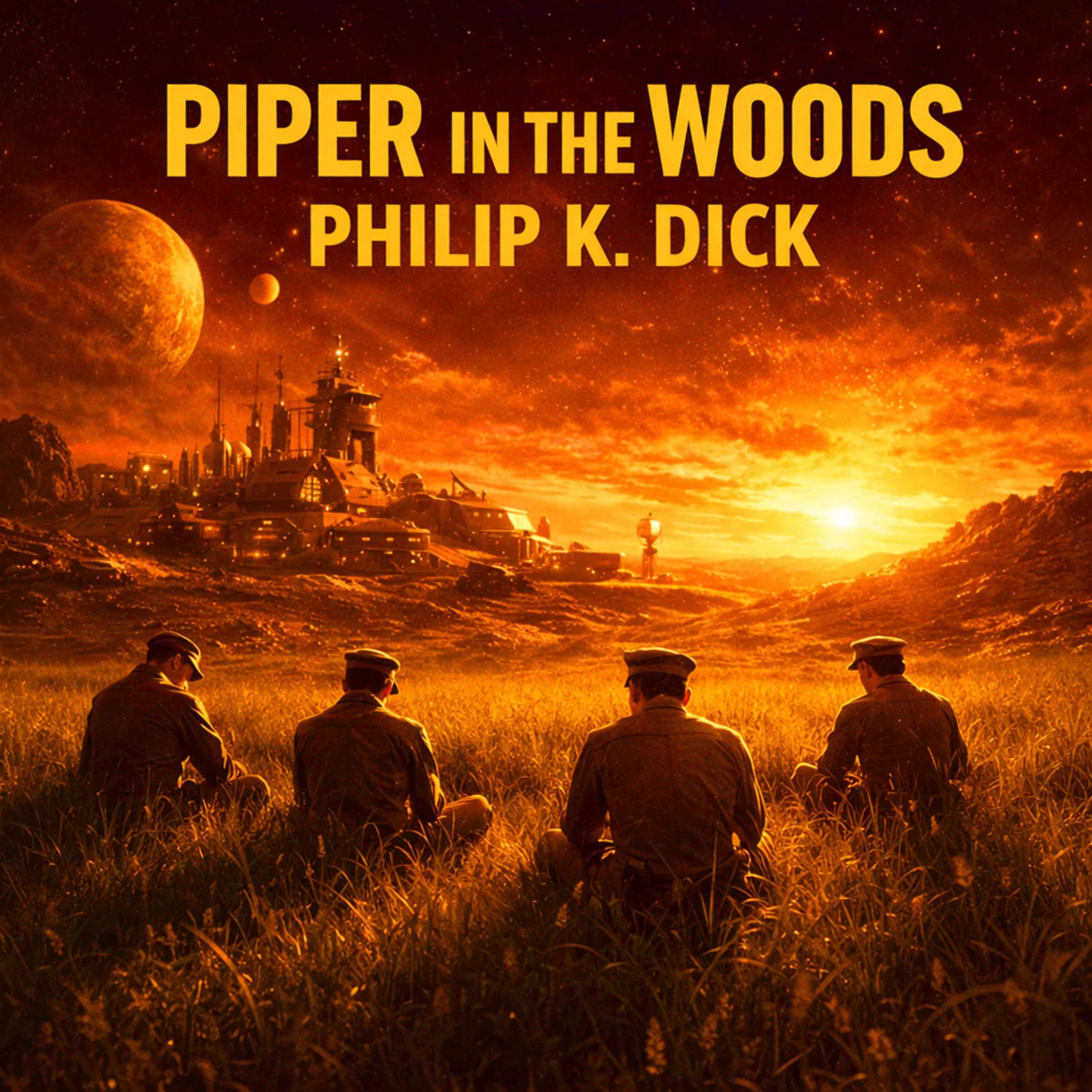
Piper in the Woods by Philip K. Dick
Earth maintained an important garrison on Asteroid Y-3. Now suddenly it was imperiled with a biological impossibility—men becoming plants! Piper in the woods written by Philip K. Dick… that’s next on The Lost Sci-Fi Podcast, with at least one lost vintage sci-fi short story in every episode.
Piper in the Woods is the 10th Philip K. Dick story here on The Lost Sci-Fi Podcast. While it won’t be the last story by Philip K. Dick, in the coming weeks were going to bring you stories by several authors who haven’t been heard from so far on The Lost Sci-Fi Podcast, H. G. Wells, Arthur C. Clarke, Jack Vance and Ross Rocklynne to name a few.
Special thanks to Lifeonmarz via Apple Podcasts Canada on February 16th 2023. Lifeonmarz gave us a 5 star rating and a glorious review. “Scott Millers readings of these science fiction stories by well known and not so well know authors is fantastic. So glad I found this podcast.”
Thank you Lifeonmarz. Your ratings and reviews, comments and compliments encourage others to listen to The Lost Sci-Fi Podcast, so if you think we deserve it please rate, review, and share our podcast. As always, your emails matter to us, scott@lostscifi.com
We’ve got a rare treat for you today, from the inside cover of Imagination Stories of Science and Fantasy in February 1953, just over 70 years ago, Philip K. Dick in his own words… “Once, when I was very young, I came across a magazine directly below the comic books called STIRRING SCIENCE STORIES. I bought it, finally, and carried it home, reading it along the way. Here were ideas, vital and imaginative. Men moving across the universe, down into sub-atomic particles, into time; there was no limit. One society, one given environment was transcended. It was Faustian; it carried a person up and beyond.
I was twelve years old, then. But I saw in it the same thing I see now: a medium in which the full play of human imagination can operate, ordered, of course, by reason and consistent development. Over the years science fiction has grown, matured toward greater social awareness and responsibility.
I became interested in writing science fiction when I saw it emerge from the ray gun stage into studies of man in various types and complexities of society.
I enjoy writing science fiction; it is essentially communication between myself, and others as interested as I in knowing where present forces are taking us. My wife and my cat Magnificat are a little worried about my preoccupation with science fiction. Like most science fiction readers, I have files and stacks of magazines, boxes of notes and data, parts of unfinished stories, a huge desk full of related material in various stages. The neighbors say I seem to “read and write a lot”. But I think we will see our devotion pay off. We may yet live to be present when the public libraries begin to carry the science fiction magazines, and someday, perhaps, even the school libraries.”
Philip K. Dick in his own words.
Let’s turn to page 88 for Piper In The Woods…
Next week on The Lost Sci-Fi Podcast, Whether the story of Gottfried Plattner is to be credited or not, is a pretty question in the value of evidence. On the one hand, we have seven witnesses—to be perfectly exact, we have six and a half pairs of eyes, and one undeniable fact; and on the other we have—what is it?—prejudice, common sense, the inertia of opinion. The Plattner Story by H. G. Wells...
That’s next week on The Lost Sci-Fi Podcast, with at least one lost vintage sci-fi short story in every episode.
https://lostscifi.com/podcast/piper-in-the-woods-by-philip-k-dick-episode-64/
Listen without commercials and enjoy exclusive bonus episodes every month with Lost Sci-Fi Premium—start your free 7-day trial today. https://lostscifi.supercast.com/
Hosted by Simplecast, an AdsWizz company. See pcm.adswizz.com for information about our collection and use of personal data for advertising.
Available Results
Generated results are saved to your library for reuse and search.
Choose Template
Pick the result you want. You can review provider and model before generating.
A concise first-pass summary for understanding the episode quickly.
A comprehensive, source-grounded extraction of the reusable knowledge in an episode.
A comprehensive extraction focused on opportunities, strategy, markets, and company building.
Explicit actions, next steps, habits, recommendations, and things to avoid.
Repeatable methods, frameworks, mental models, processes, and systems.
A dedicated inventory of concrete resources named in the episode.
A concise first-pass summary for understanding the episode quickly.
A detailed readable summary organized by chapter or topic.
A navigable map of subjects, topic flow, and suggested chapters.
A comprehensive, source-grounded extraction of the reusable knowledge in an episode.
Reusable atomic knowledge units extracted from the episode.
A comprehensive extraction focused on health practices, protocols, claims, and safety caveats.
A comprehensive extraction focused on opportunities, strategy, markets, and company building.
Explicit actions, next steps, habits, recommendations, and things to avoid.
A dedicated inventory of concrete resources named in the episode.
A dedicated analysis of warnings, limitations, trade-offs, weak evidence, and uncertainty.
A concise first-pass summary for understanding the episode quickly.
A detailed readable summary organized by chapter or topic.
A navigable map of subjects, topic flow, and suggested chapters.
A comprehensive, source-grounded extraction of the reusable knowledge in an episode.
Reusable atomic knowledge units extracted from the episode.
A comprehensive extraction focused on health practices, protocols, claims, and safety caveats.
A comprehensive extraction focused on opportunities, strategy, markets, and company building.
Scientific findings, mechanisms, studies, hypotheses, and the limits of the evidence discussed.
Technologies, AI models, technical methods, capabilities, limitations, and adoption implications.
Investment theses, assets, catalysts, valuation reasoning, time horizons, and risks.
Chronologies, actors, causes, consequences, turning points, and competing historical interpretations.
Policies, proposals, stakeholders, arguments, implementation constraints, and predicted effects.
Career paths, skills, hiring signals, workplace decisions, transitions, and limitations of the advice.
Behavioral mechanisms, biases, motivation, habits, emotions, interventions, and evidence limitations.
Economic mechanisms, incentives, indicators, market structure, forecasts, and uncertainty.
Leadership principles, team systems, organizational design, culture, feedback, and failure modes.
Audience, positioning, messaging, acquisition, retention, experiments, metrics, and failed approaches.
Teaching methods, learning strategies, practice, feedback, assessment, and effectiveness evidence.
Theses, premises, arguments, objections, values, thought experiments, and unresolved questions.
Communication patterns, conflict, boundaries, expectations, repair methods, and contextual limitations.
Books, papers, authors, courses, and other learning resources mentioned in the episode.
Repeatable methods, frameworks, mental models, processes, and systems.
Explicit actions, next steps, habits, recommendations, and things to avoid.
Memorable statements and important claims with attribution and source context.
A dedicated inventory of concrete resources named in the episode.
A dedicated analysis of warnings, limitations, trade-offs, weak evidence, and uncertainty.