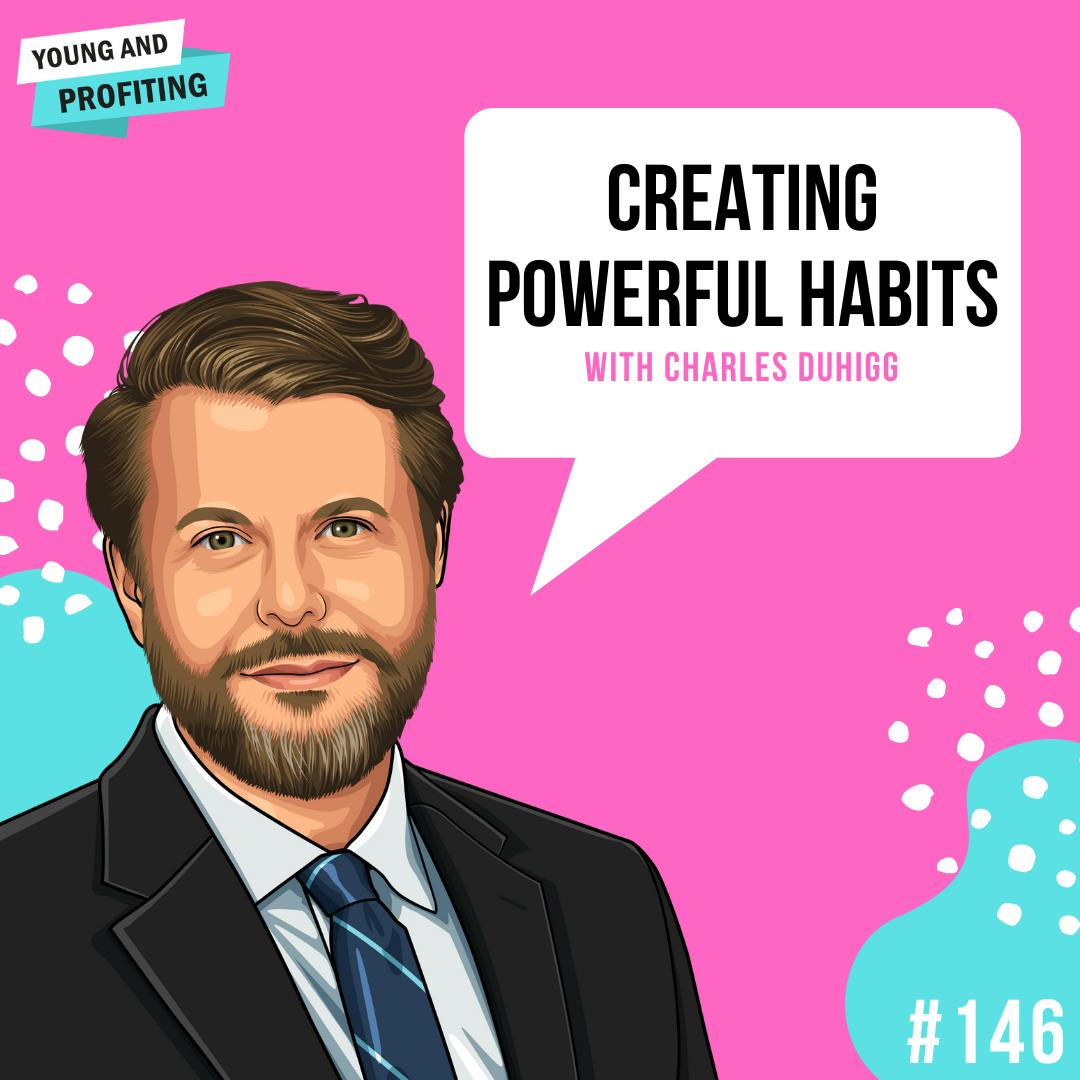
Charles Duhigg: Creating Powerful Habits | E146
Ever wonder how our brain creates habits?
Today, we are talking with the Habit master, Charles Duhigg! Charles is a Pulitzer Prize-winning writer, a best-selling author, a former New York Times Reporter, and current a writer for the New Yorker Magazine. His book The Power of Habit, was on the NYT Bestseller list for over 3 years and has inspired a generation to create stronger habits in their lives. He is also the host of the How To! Podcast. His other book, Smarter Better Faster is also a NYT bestseller.
He is the founding host of the How To! podcast with Slate and the recipient of the George Polk award, the Investigative Reporters and Editors Medal, the Robert F. Kennedy Journalism Award, and other honors. Charles speaks to a wide variety of audiences on topics ranging from how habits emerge and change within lives and companies to how idea brokers generate creativity.
In this episode, we hear about Charles’s childhood and his journey to becoming a writer. We’ll discuss Charles’ time as a reporter in Iraq and how his time there put him on the path to studying habits. We’ll also hear break down the key components to creating habits, and how a place like McDonalds can unknowingly affect our habits! If you want to learn critical skills to create meaningful habits, keep listening!
Sponsored by -
Jordan Harbinger - Check out jordanharbinger.com/start for some episode recommendations
Prose - Go to Prose.com/yap for your FREE in-depth hair consultation and 15% off.
AthleticGreens - Visit athleticgreens.com/YAP and get FREE 1 year supply of immune-supporting Vitamin D AND 5 FREE travel packs with your first purchase.
Shopify - Go to shopify.com/profiting, for a FREE fourteen-day trial and get full access to Shopify’s entire suite of features
Social Media:
Follow YAP on IG: www.instagram.com/youngandprofiting
Reach out to Hala directly at Hala@YoungandProfiting.com
Follow Hala on Linkedin: www.linkedin.com/in/htaha/
Follow Hala on Instagram: www.instagram.com/yapwithhala
Follow Hala on Clubhouse: @halataha
Check out our website to meet the team, view show notes and transcripts: www.youngandprofiting.com
Timestamps:
00:47- Charles’ Childhood and Journey Into Writing
01:26 - The Power of Habit Origin
01:57 - Working in Iraq
5:39 - Habits in the Military
6:05 - What is A Habit
7:05 - Anatomy of the Brain
9:00 - Difference Between Memory and Habit
9:30 - Components of A Habit
16:30 - Cravings and How They Relate to Habits
18:00 - Mcdonalds And Cravings
21:20 - Supermarkets and Habits
24:24 - Social Media and Habit Loops
27:51 - How To Change A Habit
32:03 - Keystone Habits
35:51 - Charles’ Secret to Profiting in Life
Mentioned In The Episode:
The Power of Habit- https://charlesduhigg.com/the-power-of-habit/
Available Results
Generated results are saved to your library for reuse and search.
Choose Template
Pick the result you want. You can review provider and model before generating.
A concise first-pass summary for understanding the episode quickly.
A comprehensive, source-grounded extraction of the reusable knowledge in an episode.
Scientific findings, mechanisms, studies, hypotheses, and the limits of the evidence discussed.
A dedicated analysis of warnings, limitations, trade-offs, weak evidence, and uncertainty.
Memorable statements and important claims with attribution and source context.
Technologies, AI models, technical methods, capabilities, limitations, and adoption implications.
A concise first-pass summary for understanding the episode quickly.
A detailed readable summary organized by chapter or topic.
A navigable map of subjects, topic flow, and suggested chapters.
A comprehensive, source-grounded extraction of the reusable knowledge in an episode.
Reusable atomic knowledge units extracted from the episode.
A comprehensive extraction focused on health practices, protocols, claims, and safety caveats.
A comprehensive extraction focused on opportunities, strategy, markets, and company building.
Explicit actions, next steps, habits, recommendations, and things to avoid.
A dedicated inventory of concrete resources named in the episode.
A dedicated analysis of warnings, limitations, trade-offs, weak evidence, and uncertainty.
A concise first-pass summary for understanding the episode quickly.
A detailed readable summary organized by chapter or topic.
A navigable map of subjects, topic flow, and suggested chapters.
A comprehensive, source-grounded extraction of the reusable knowledge in an episode.
Reusable atomic knowledge units extracted from the episode.
A comprehensive extraction focused on health practices, protocols, claims, and safety caveats.
A comprehensive extraction focused on opportunities, strategy, markets, and company building.
Scientific findings, mechanisms, studies, hypotheses, and the limits of the evidence discussed.
Technologies, AI models, technical methods, capabilities, limitations, and adoption implications.
Investment theses, assets, catalysts, valuation reasoning, time horizons, and risks.
Chronologies, actors, causes, consequences, turning points, and competing historical interpretations.
Policies, proposals, stakeholders, arguments, implementation constraints, and predicted effects.
Career paths, skills, hiring signals, workplace decisions, transitions, and limitations of the advice.
Behavioral mechanisms, biases, motivation, habits, emotions, interventions, and evidence limitations.
Economic mechanisms, incentives, indicators, market structure, forecasts, and uncertainty.
Leadership principles, team systems, organizational design, culture, feedback, and failure modes.
Audience, positioning, messaging, acquisition, retention, experiments, metrics, and failed approaches.
Teaching methods, learning strategies, practice, feedback, assessment, and effectiveness evidence.
Theses, premises, arguments, objections, values, thought experiments, and unresolved questions.
Communication patterns, conflict, boundaries, expectations, repair methods, and contextual limitations.
Books, papers, authors, courses, and other learning resources mentioned in the episode.
Repeatable methods, frameworks, mental models, processes, and systems.
Explicit actions, next steps, habits, recommendations, and things to avoid.
Memorable statements and important claims with attribution and source context.
A dedicated inventory of concrete resources named in the episode.
A dedicated analysis of warnings, limitations, trade-offs, weak evidence, and uncertainty.