The Magellanic Stream Closer than Previously Thought
SpaceTime Series 24 Episode 137
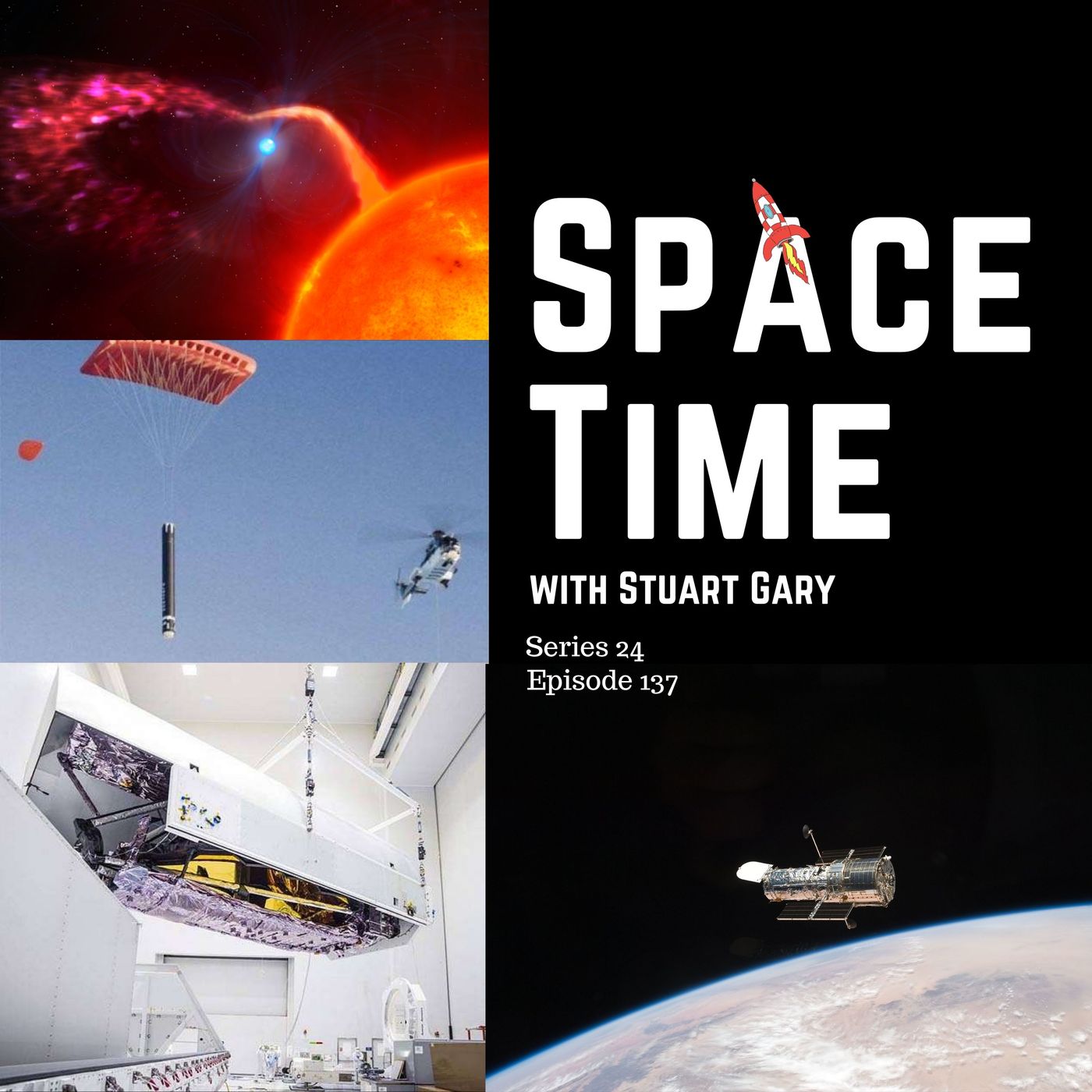
*The Magellanic stream closer than previously thought
A new study suggests the Magellanic stream is five times closer to the Milky Way galaxy than previously thought. The discovery means it will start colliding with the Milky Way far sooner than expected.
*New Zealand’s Rocket Lab launches its 22nd Electron mission
Rocket Lab has successfully launched another two satellites into orbit aboard its Electron rocket.
*There’s been an incident involving the James Webb space telescope
Oops is not something you want to hear when moving a ten-billion-dollar space telescope. But that’s what’s just happened at the European Space Agency’s Kourou Space Port in French Guyana as technicians were attempting to attach the new James Webb Space Telescope to its launch vehicle adapter on the upper stage of the Ariane 5 rocket.
*NASA continues work to retore the Hubble Space Telescope
NASA has brought the Wide Field Camera 3 instrument back on line as it continues efforts to fix the Hubble Space Telescope after it suddenly went into safe mode in October.
*Another Chinese spy satellite launched
Another week and the launch of another Chinese Earth reconnaissance satellite bringing Beijing’s total to over 148 surveillance spacecraft.
*The Science Report
Deforestation in the Amazon rainforest has increased by a devastating 22 percent.
A new study finds some Pacific Ocean rock fishes can live for more than 200 years.
How does coffee affect your heart?
Alex on Tech: stupid passwords.
For more SpaceTime and show links: https://linktr.ee/biteszHQ
If you love this podcast, please get someone else to listen to. Thank you…
To become a SpaceTime supporter and unlock commercial free editions of the show, gain early access and bonus content, please visit https://bitesz.supercast.com/ . Premium version now available via Spotify and Apple Podcasts.
To listen to SpaceTime on your favorite App automatically: https://link.chtbl.com/spacetime
https://spacetimewithstuartgary.com
https://bitesz.com
Become a supporter of this podcast: https://www.spreaker.com/podcast/spacetime-with-stuart-gary--2458531/support.
Available Results
Generated results are saved to your library for reuse and search.
Choose Template
Pick the result you want. You can review provider and model before generating.
A concise first-pass summary for understanding the episode quickly.
A comprehensive, source-grounded extraction of the reusable knowledge in an episode.
Scientific findings, mechanisms, studies, hypotheses, and the limits of the evidence discussed.
A dedicated analysis of warnings, limitations, trade-offs, weak evidence, and uncertainty.
Memorable statements and important claims with attribution and source context.
Technologies, AI models, technical methods, capabilities, limitations, and adoption implications.
A concise first-pass summary for understanding the episode quickly.
A detailed readable summary organized by chapter or topic.
A navigable map of subjects, topic flow, and suggested chapters.
A comprehensive, source-grounded extraction of the reusable knowledge in an episode.
Reusable atomic knowledge units extracted from the episode.
A comprehensive extraction focused on health practices, protocols, claims, and safety caveats.
A comprehensive extraction focused on opportunities, strategy, markets, and company building.
Explicit actions, next steps, habits, recommendations, and things to avoid.
A dedicated inventory of concrete resources named in the episode.
A dedicated analysis of warnings, limitations, trade-offs, weak evidence, and uncertainty.
A concise first-pass summary for understanding the episode quickly.
A detailed readable summary organized by chapter or topic.
A navigable map of subjects, topic flow, and suggested chapters.
A comprehensive, source-grounded extraction of the reusable knowledge in an episode.
Reusable atomic knowledge units extracted from the episode.
A comprehensive extraction focused on health practices, protocols, claims, and safety caveats.
A comprehensive extraction focused on opportunities, strategy, markets, and company building.
Scientific findings, mechanisms, studies, hypotheses, and the limits of the evidence discussed.
Technologies, AI models, technical methods, capabilities, limitations, and adoption implications.
Investment theses, assets, catalysts, valuation reasoning, time horizons, and risks.
Chronologies, actors, causes, consequences, turning points, and competing historical interpretations.
Policies, proposals, stakeholders, arguments, implementation constraints, and predicted effects.
Career paths, skills, hiring signals, workplace decisions, transitions, and limitations of the advice.
Behavioral mechanisms, biases, motivation, habits, emotions, interventions, and evidence limitations.
Economic mechanisms, incentives, indicators, market structure, forecasts, and uncertainty.
Leadership principles, team systems, organizational design, culture, feedback, and failure modes.
Audience, positioning, messaging, acquisition, retention, experiments, metrics, and failed approaches.
Teaching methods, learning strategies, practice, feedback, assessment, and effectiveness evidence.
Theses, premises, arguments, objections, values, thought experiments, and unresolved questions.
Communication patterns, conflict, boundaries, expectations, repair methods, and contextual limitations.
Books, papers, authors, courses, and other learning resources mentioned in the episode.
Repeatable methods, frameworks, mental models, processes, and systems.
Explicit actions, next steps, habits, recommendations, and things to avoid.
Memorable statements and important claims with attribution and source context.
A dedicated inventory of concrete resources named in the episode.
A dedicated analysis of warnings, limitations, trade-offs, weak evidence, and uncertainty.