Linking silicon T centres with light offers a route to fault-tolerant quantum computing
Today’s noisy quantum processors are prone to errors that can quickly knock a quantum calculation off course. As a result, quantum error correction schemes are used to make some nascent quantum computers more tolerant to such faults.
This involves using a large number of qubits – called “physical” qubits – to create one fault-tolerant “logical” qubit. A useful fault-tolerant quantum computer would have thousands of logical qubits and this would require the integration of millions of physical qubits, which remains a formidable challenge.
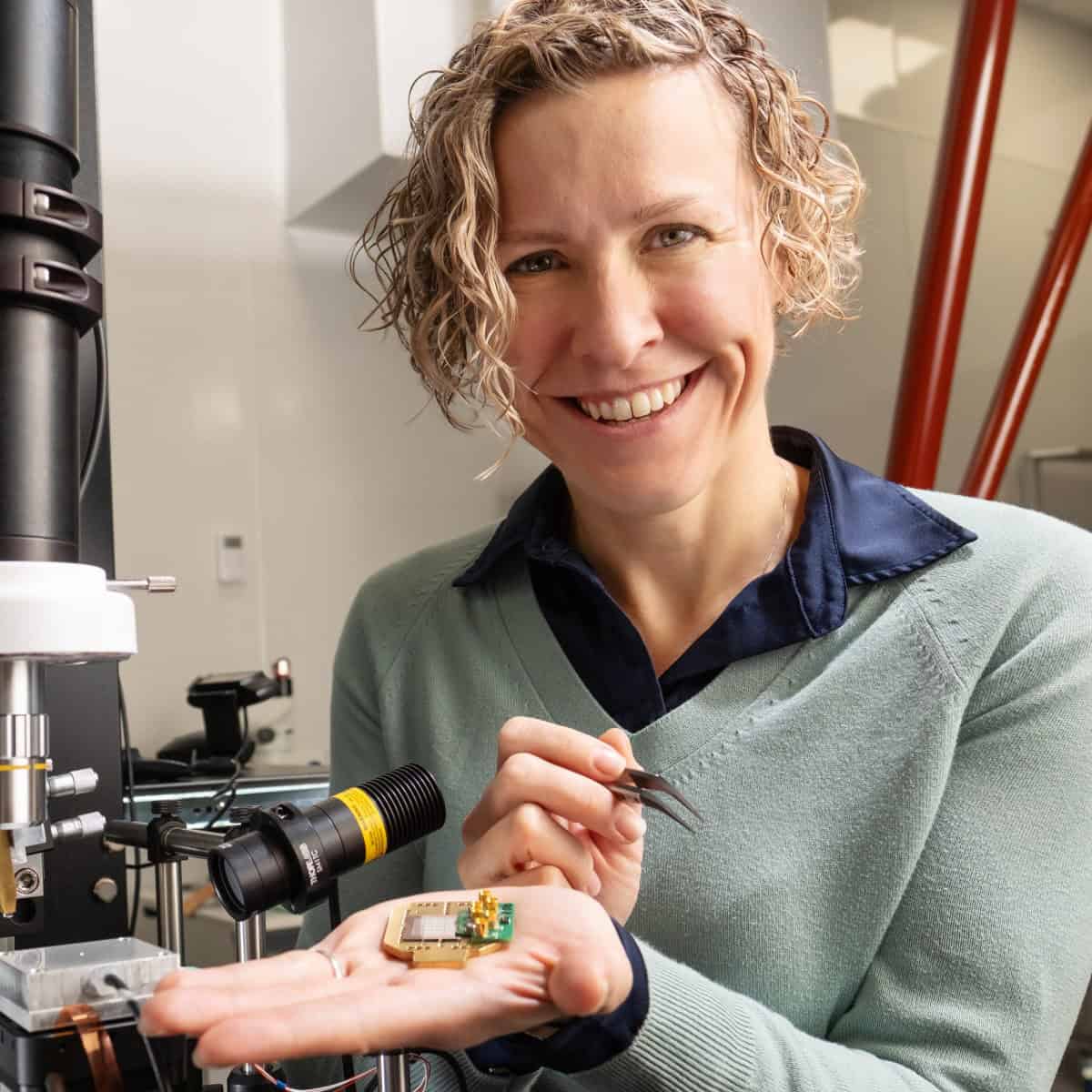
In this episode of the Physics World Weekly podcast, I am in conversation with Stephanie Simmons, who is founder and chief quantum officer at Photonic Inc. The Vancouver-based company is developing optically-linked silicon spin qubits – and it has recently announced that it has distributed quantum entanglement between two of its modules.
I spoke with Simmons earlier this month in London at Commercialising Quantum Global 2024, which was organized by Economist Impact. She explains how the company’s qubits – based on T-centre spins in silicon – are connected using telecoms-band photons. Simmons makes the case that the technology can be integrated and scaled to create fault-tolerant computers. We also chat about the company’s manufacturing programme and career opportunities for physicists at the firm.
More description
Today’s noisy quantum processors are prone to errors that can quickly knock a quantum calculation off course. As a result, quantum error correction schemes are used to make some nascent quantum computers more tolerant to such faults.
This involves using a large number of qubits – called “physical” qubits – to create one fault-tolerant “logical” qubit. A useful fault-tolerant quantum computer would have thousands of logical qubits and this would require the integration of millions of physical qubits, which remains a formidable challenge.
In this episode of the Physics World Weekly podcast, I am in conversation with Stephanie Simmons, who is founder and chief quantum officer at Photonic Inc. The Vancouver-based company is developing optically-linked silicon spin qubits – and it has recently announced that it has distributed quantum entanglement between two of its modules.
I spoke with Simmons earlier this month in London at Commercialising Quantum Global 2024, which was organized by Economist Impact. She explains how the company’s qubits – based on T-centre spins in silicon – are connected using telecoms-band photons. Simmons makes the case that the technology can be integrated and scaled to create fault-tolerant computers. We also chat about the company’s manufacturing programme and career opportunities for physicists at the firm.
Listen elsewhere
Available Results
Generated results are saved to your library for reuse and search.