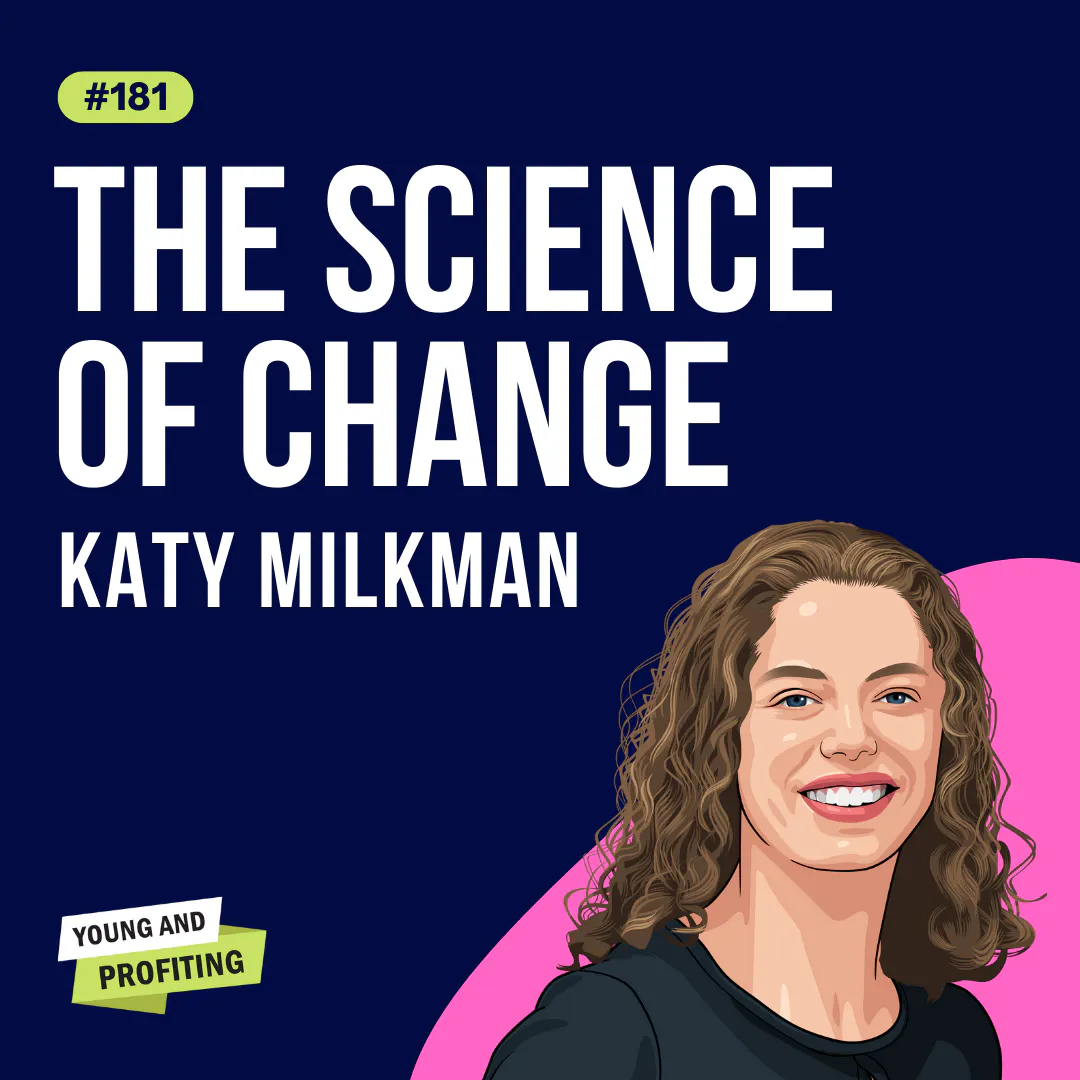
Katy Milkman: The Science of Change | Human Behavior | E181
Do you want to create lasting behavioral change but can’t seem to make it stick? Katy Milkman, Wharton School Professor, bestselling author, and podcast host has dedicated her life to studying behavior change, and in this episode, she gives a science-backed blueprint of how to create lasting change and achieve your goals. In this episode, Hala and Katy chat about barriers to change and why humans are so impulsive. Katy shares science-backed strategies to help you create lasting change like temptation bundling, gamification, and the fresh start effect. Katy also dives deep into what she’s learned about encouraging others to adopt a behavior through nudging, and the powerful effect giving advice can have.
Topics Include:
- What first got Katy interested in human behavior
- Relationship between engineering and human behavior
- What makes it so hard for us to change?
- Why are humans impulsive?
- Temptation bundling and gamification
- Commitment Devices
- The Fresh Start Effect
- Rigidity versus variability for habits
- Counteracting the “What the Hell Effect”
- Perspective on the power of negative thinking
- Why acting like a mentor can help you succeed
- How can we become advice-givers?
- COVID-19 Vaccine Adoption Research
- Nudging
- Katy’s actionable advice
- Katy’s secret to profiting
- And other topics…
Katy Milkman is a James G. Dinan Professor at The Wharton School of the University of Pennsylvania and the host of Charles Schwab’s popular behavioral economics podcast Choiceology. She is also the co-founder and co-director of the Behavior Change for Good Initiative, a research center with the mission of advancing the science of lasting behavior change whose work is being chronicled by Freakonomics Radio. She is also the author of the best-selling book, How to Change.
She received her undergraduate degree from Princeton University (summa cum laude) in Operations Research and Financial Engineering and her Ph.D. from Harvard University's joint program in Computer Science and Business.
Sponsored By:
Indeed - Claim your $75 credit now at Indeed.com/yap (Terms and conditions apply)
Shopify - Go to shopify.com/profiting, for a FREE fourteen-day trial and get full access to Shopify’s entire suite of features
The Jordan Harbinger Show - Check out jordanharbinger.com/start for some episode recommendations
Resources Mentioned:
Katy’s Book: https://www.katymilkman.com/book
Katy’s Website: https://www.katymilkman.com/
Katy’s Newsletter: https://www.katymilkman.com/newsletter-milkman-delivers
Katy’s Linkedin: https://www.linkedin.com/in/katy-milkman/
Katy’s Twitter: https://twitter.com/katy_milkman
Katy’s Instagram: https://www.instagram.com/katymilkman/
Katy’s Facebook: https://www.facebook.com/katymilkmanphd/
Katy’s Podcast, Choiceology:
https://www.katymilkman.com/podcast
Connect with Young and Profiting:
Hala’s LinkedIn: https://www.linkedin.com/in/htaha/
Hala’s Instagram:https://www.instagram.com/yapwithhala/
Hala’s Twitter: https://twitter.com/yapwithhala
Clubhouse: https://www.clubhouse.com/@halataha
Website: https://www.youngandprofiting.com/
Text Hala: https://youngandprofiting.co/TextHala or text “YAP” to 28046
Available Results
Generated results are saved to your library for reuse and search.
Choose Template
Pick the result you want. You can review provider and model before generating.
A concise first-pass summary for understanding the episode quickly.
A comprehensive, source-grounded extraction of the reusable knowledge in an episode.
A comprehensive extraction focused on opportunities, strategy, markets, and company building.
Explicit actions, next steps, habits, recommendations, and things to avoid.
Repeatable methods, frameworks, mental models, processes, and systems.
A dedicated inventory of concrete resources named in the episode.
A concise first-pass summary for understanding the episode quickly.
A detailed readable summary organized by chapter or topic.
A navigable map of subjects, topic flow, and suggested chapters.
A comprehensive, source-grounded extraction of the reusable knowledge in an episode.
Reusable atomic knowledge units extracted from the episode.
A comprehensive extraction focused on health practices, protocols, claims, and safety caveats.
A comprehensive extraction focused on opportunities, strategy, markets, and company building.
Explicit actions, next steps, habits, recommendations, and things to avoid.
A dedicated inventory of concrete resources named in the episode.
A dedicated analysis of warnings, limitations, trade-offs, weak evidence, and uncertainty.
A concise first-pass summary for understanding the episode quickly.
A detailed readable summary organized by chapter or topic.
A navigable map of subjects, topic flow, and suggested chapters.
A comprehensive, source-grounded extraction of the reusable knowledge in an episode.
Reusable atomic knowledge units extracted from the episode.
A comprehensive extraction focused on health practices, protocols, claims, and safety caveats.
A comprehensive extraction focused on opportunities, strategy, markets, and company building.
Scientific findings, mechanisms, studies, hypotheses, and the limits of the evidence discussed.
Technologies, AI models, technical methods, capabilities, limitations, and adoption implications.
Investment theses, assets, catalysts, valuation reasoning, time horizons, and risks.
Chronologies, actors, causes, consequences, turning points, and competing historical interpretations.
Policies, proposals, stakeholders, arguments, implementation constraints, and predicted effects.
Career paths, skills, hiring signals, workplace decisions, transitions, and limitations of the advice.
Behavioral mechanisms, biases, motivation, habits, emotions, interventions, and evidence limitations.
Economic mechanisms, incentives, indicators, market structure, forecasts, and uncertainty.
Leadership principles, team systems, organizational design, culture, feedback, and failure modes.
Audience, positioning, messaging, acquisition, retention, experiments, metrics, and failed approaches.
Teaching methods, learning strategies, practice, feedback, assessment, and effectiveness evidence.
Theses, premises, arguments, objections, values, thought experiments, and unresolved questions.
Communication patterns, conflict, boundaries, expectations, repair methods, and contextual limitations.
Books, papers, authors, courses, and other learning resources mentioned in the episode.
Repeatable methods, frameworks, mental models, processes, and systems.
Explicit actions, next steps, habits, recommendations, and things to avoid.
Memorable statements and important claims with attribution and source context.
A dedicated inventory of concrete resources named in the episode.
A dedicated analysis of warnings, limitations, trade-offs, weak evidence, and uncertainty.