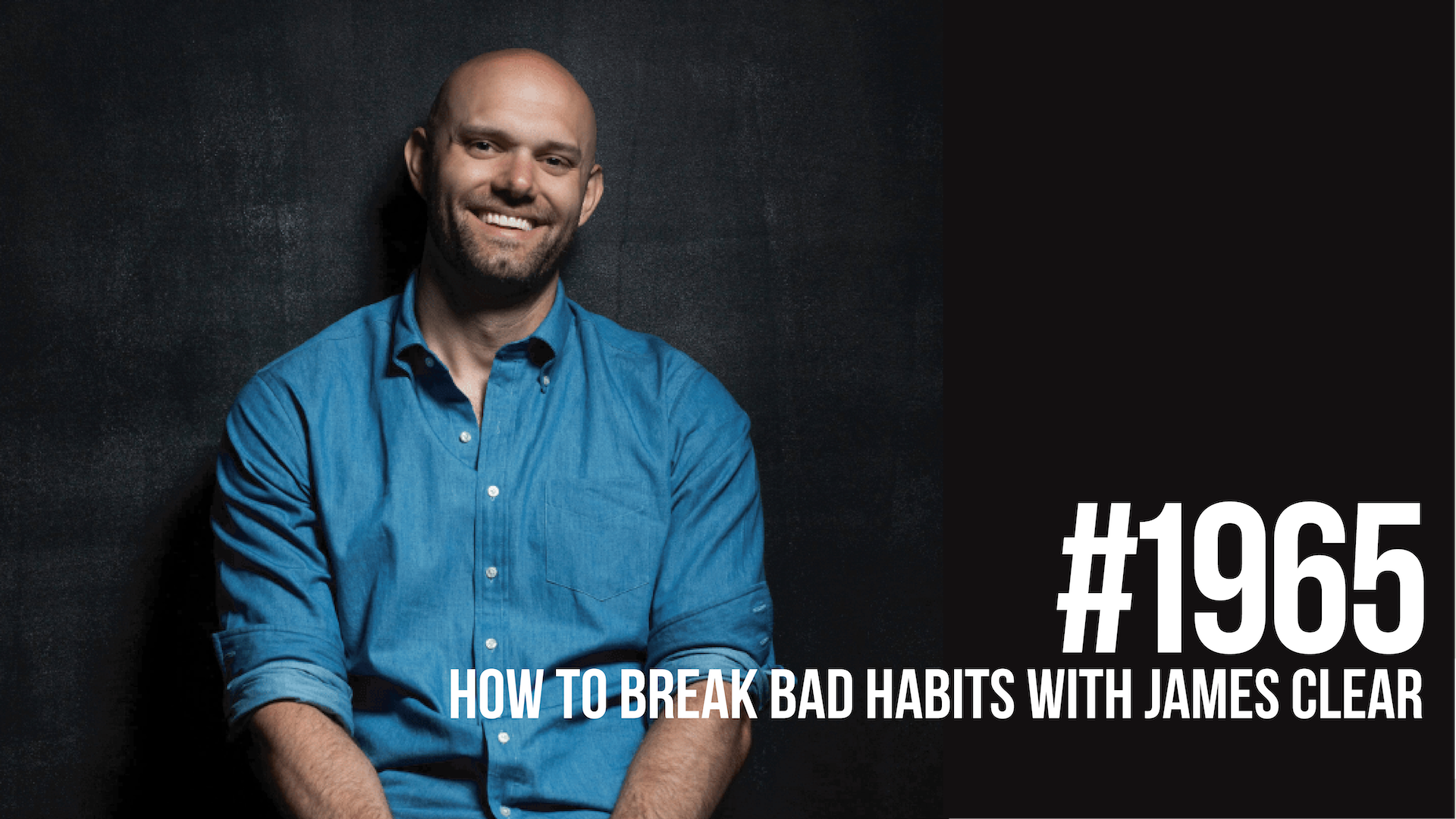
1965: How to Break Bad Habits with James Clear
In this episode Sal, Adam & Justin speak with New York Times bestselling author of Atomic Habits, James Clear.
- The insights behind writing Atomic Habits. (1:59)
- Overvaluing the results and undervaluing the process. (4:34)
- Habits don't restrict freedom, they CREATE it. (8:14)
- What is more difficult, starting or maintaining a good habit? (14:01)
- Three applicable steps to stay consistent. (15:12)
- The two-minute rule for success. (19:05)
- The Four Laws of Behavior Change. (24:15)
- At what point is a bad habit an addiction? (27:32)
- Align your tribe and align your habits. (29:56)
- Strategies for making bad habits unattractive. (34:06)
- The importance of positive self-talk. (38:27)
- What epiphanies did he come across writing the book? (44:49)
- What bad habit does he struggle with the most, and how did he address it? (49:03)
- Be patient with yourself and make things work for YOU. (57:05)
- When your season changes, your habits need to change. (1:02:38)
- Have good questions. (1:07:07)
Related Links/Products Mentioned
- For Mind Pump Listeners, visit Integrative Health Practitioner Certification Courses for $100 off IHP L1 and $250 off L2. **Code MINDPUMP at checkout**
- December Promotion: At-Home Holiday Bundle (MAPS Anywhere, MAPS Suspension, MAPS PRIME, and The No BS 6-Pack Formula all for the low price of $99.99!)
- Atomic Habits: An Easy and Proven Way to Build Good Habits and Break Bad Ones
- Mind Pump #1925: How To Build A Great Physique In 15 Minutes A Day
- Commitment Devices for behavior change
- 3-2-1 Thursday newsletter - James Clear
- Mind Pump Podcast – YouTube
- Mind Pump Free Resources
Featured Guest
- James Clear (@JamesClear) Twitter
- Website
Available Results
Generated results are saved to your library for reuse and search.
Choose Template
Pick the result you want. You can review provider and model before generating.
A concise first-pass summary for understanding the episode quickly.
A comprehensive, source-grounded extraction of the reusable knowledge in an episode.
A comprehensive extraction focused on health practices, protocols, claims, and safety caveats.
A dedicated analysis of warnings, limitations, trade-offs, weak evidence, and uncertainty.
Repeatable methods, frameworks, mental models, processes, and systems.
Technologies, AI models, technical methods, capabilities, limitations, and adoption implications.
A concise first-pass summary for understanding the episode quickly.
A detailed readable summary organized by chapter or topic.
A navigable map of subjects, topic flow, and suggested chapters.
A comprehensive, source-grounded extraction of the reusable knowledge in an episode.
Reusable atomic knowledge units extracted from the episode.
A comprehensive extraction focused on health practices, protocols, claims, and safety caveats.
A comprehensive extraction focused on opportunities, strategy, markets, and company building.
Explicit actions, next steps, habits, recommendations, and things to avoid.
A dedicated inventory of concrete resources named in the episode.
A dedicated analysis of warnings, limitations, trade-offs, weak evidence, and uncertainty.
A concise first-pass summary for understanding the episode quickly.
A detailed readable summary organized by chapter or topic.
A navigable map of subjects, topic flow, and suggested chapters.
A comprehensive, source-grounded extraction of the reusable knowledge in an episode.
Reusable atomic knowledge units extracted from the episode.
A comprehensive extraction focused on health practices, protocols, claims, and safety caveats.
A comprehensive extraction focused on opportunities, strategy, markets, and company building.
Scientific findings, mechanisms, studies, hypotheses, and the limits of the evidence discussed.
Technologies, AI models, technical methods, capabilities, limitations, and adoption implications.
Investment theses, assets, catalysts, valuation reasoning, time horizons, and risks.
Chronologies, actors, causes, consequences, turning points, and competing historical interpretations.
Policies, proposals, stakeholders, arguments, implementation constraints, and predicted effects.
Career paths, skills, hiring signals, workplace decisions, transitions, and limitations of the advice.
Behavioral mechanisms, biases, motivation, habits, emotions, interventions, and evidence limitations.
Economic mechanisms, incentives, indicators, market structure, forecasts, and uncertainty.
Leadership principles, team systems, organizational design, culture, feedback, and failure modes.
Audience, positioning, messaging, acquisition, retention, experiments, metrics, and failed approaches.
Teaching methods, learning strategies, practice, feedback, assessment, and effectiveness evidence.
Theses, premises, arguments, objections, values, thought experiments, and unresolved questions.
Communication patterns, conflict, boundaries, expectations, repair methods, and contextual limitations.
Books, papers, authors, courses, and other learning resources mentioned in the episode.
Repeatable methods, frameworks, mental models, processes, and systems.
Explicit actions, next steps, habits, recommendations, and things to avoid.
Memorable statements and important claims with attribution and source context.
A dedicated inventory of concrete resources named in the episode.
A dedicated analysis of warnings, limitations, trade-offs, weak evidence, and uncertainty.