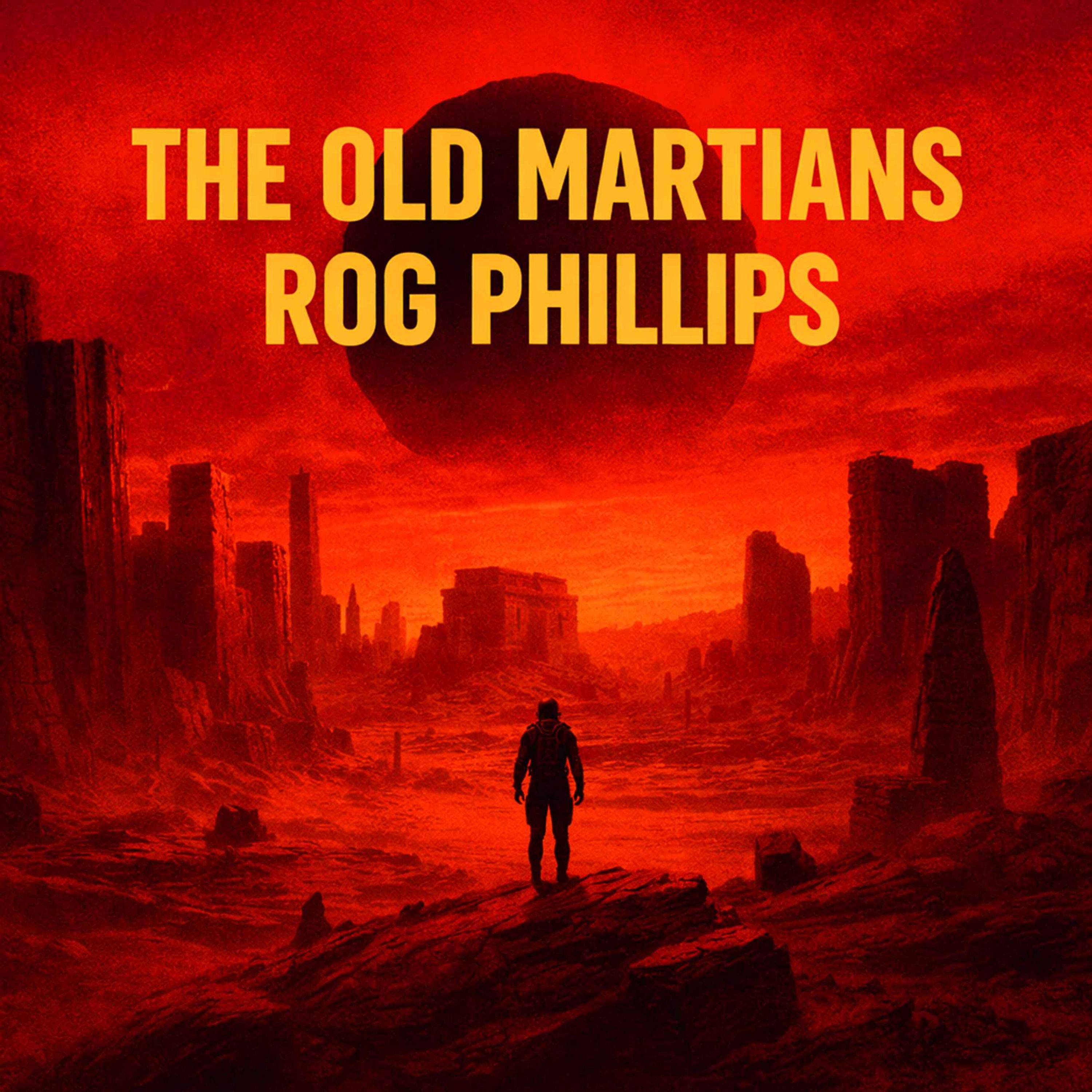
The Old Martians by Rog Phillips
How does a plumber, construction worker, carpenter, power plant engineer, shipyard welder and longshoreman become a science fiction writer? Rog Phillips seems like the kind of guy you’d want to sit down and have a beer with, a hard-working blue-collar guy. Born in 1909 in Spokane Washington, Roger Phillip Graham wasn’t only a man with many different jobs, he was also a man of many names. In fact, Phillips had more pseudonyms than any sci-fi writer that we’ve discovered so far. Twenty of them!
Support the show - https://www.buymeacoffee.com/scottsV
Merch - https://lostscifi.creator-spring.com/
Sign up for our newsletter
He wrote more than 160 short sci-fi stories published in the 1940s and 50s, and 3 more in the early 60s. His first published work was a detective story, "Murder Note," credited to Charles Mann. “Murder Note” appeared in the Winter 1943 issue ofThe Masked Detective. Raymond Palmer, the editor of Amazing Stories started Rog on his science fiction career with a $500 advance in 1945 for his first story, "Let Freedom Ring! That was a hefty sum in 1945, worth more than $7,000 today.
Today’s story can be found in the March 1952 edition of If Worlds of Science Fiction, you can find it on ebay for $12.99. The Old Martians by Rog Phillips.
Phillips, the blue-collar guy, turned sci-fi writer once taught a writing course to prisoners at San Quentin.
He died of heart failure in California in 1966 days after his 57th birthday.
Next week on The Lost Sci-Fi Podcast It was a nice little world; everything about it reminded Steve of Earth—except for the people. They looked as human—as steel could make them!... Thanks for listening and we hope you’ll join us next week onThe Lost Sci-Fi Podcast, with at least one lost vintage sci-fi short story in every episode.
https://lostscifi.com/podcast/the-old-martians-by-rog-phillips-episode-21/
Listen without commercials and enjoy exclusive bonus episodes every month with Lost Sci-Fi Premium—start your free 7-day trial today. https://lostscifi.supercast.com/
Hosted by Simplecast, an AdsWizz company. See pcm.adswizz.com for information about our collection and use of personal data for advertising.
Available Results
Generated results are saved to your library for reuse and search.
Choose Template
Pick the result you want. You can review provider and model before generating.
A concise first-pass summary for understanding the episode quickly.
A comprehensive, source-grounded extraction of the reusable knowledge in an episode.
A comprehensive extraction focused on opportunities, strategy, markets, and company building.
Explicit actions, next steps, habits, recommendations, and things to avoid.
Repeatable methods, frameworks, mental models, processes, and systems.
A dedicated inventory of concrete resources named in the episode.
A concise first-pass summary for understanding the episode quickly.
A detailed readable summary organized by chapter or topic.
A navigable map of subjects, topic flow, and suggested chapters.
A comprehensive, source-grounded extraction of the reusable knowledge in an episode.
Reusable atomic knowledge units extracted from the episode.
A comprehensive extraction focused on health practices, protocols, claims, and safety caveats.
A comprehensive extraction focused on opportunities, strategy, markets, and company building.
Explicit actions, next steps, habits, recommendations, and things to avoid.
A dedicated inventory of concrete resources named in the episode.
A dedicated analysis of warnings, limitations, trade-offs, weak evidence, and uncertainty.
A concise first-pass summary for understanding the episode quickly.
A detailed readable summary organized by chapter or topic.
A navigable map of subjects, topic flow, and suggested chapters.
A comprehensive, source-grounded extraction of the reusable knowledge in an episode.
Reusable atomic knowledge units extracted from the episode.
A comprehensive extraction focused on health practices, protocols, claims, and safety caveats.
A comprehensive extraction focused on opportunities, strategy, markets, and company building.
Scientific findings, mechanisms, studies, hypotheses, and the limits of the evidence discussed.
Technologies, AI models, technical methods, capabilities, limitations, and adoption implications.
Investment theses, assets, catalysts, valuation reasoning, time horizons, and risks.
Chronologies, actors, causes, consequences, turning points, and competing historical interpretations.
Policies, proposals, stakeholders, arguments, implementation constraints, and predicted effects.
Career paths, skills, hiring signals, workplace decisions, transitions, and limitations of the advice.
Behavioral mechanisms, biases, motivation, habits, emotions, interventions, and evidence limitations.
Economic mechanisms, incentives, indicators, market structure, forecasts, and uncertainty.
Leadership principles, team systems, organizational design, culture, feedback, and failure modes.
Audience, positioning, messaging, acquisition, retention, experiments, metrics, and failed approaches.
Teaching methods, learning strategies, practice, feedback, assessment, and effectiveness evidence.
Theses, premises, arguments, objections, values, thought experiments, and unresolved questions.
Communication patterns, conflict, boundaries, expectations, repair methods, and contextual limitations.
Books, papers, authors, courses, and other learning resources mentioned in the episode.
Repeatable methods, frameworks, mental models, processes, and systems.
Explicit actions, next steps, habits, recommendations, and things to avoid.
Memorable statements and important claims with attribution and source context.
A dedicated inventory of concrete resources named in the episode.
A dedicated analysis of warnings, limitations, trade-offs, weak evidence, and uncertainty.