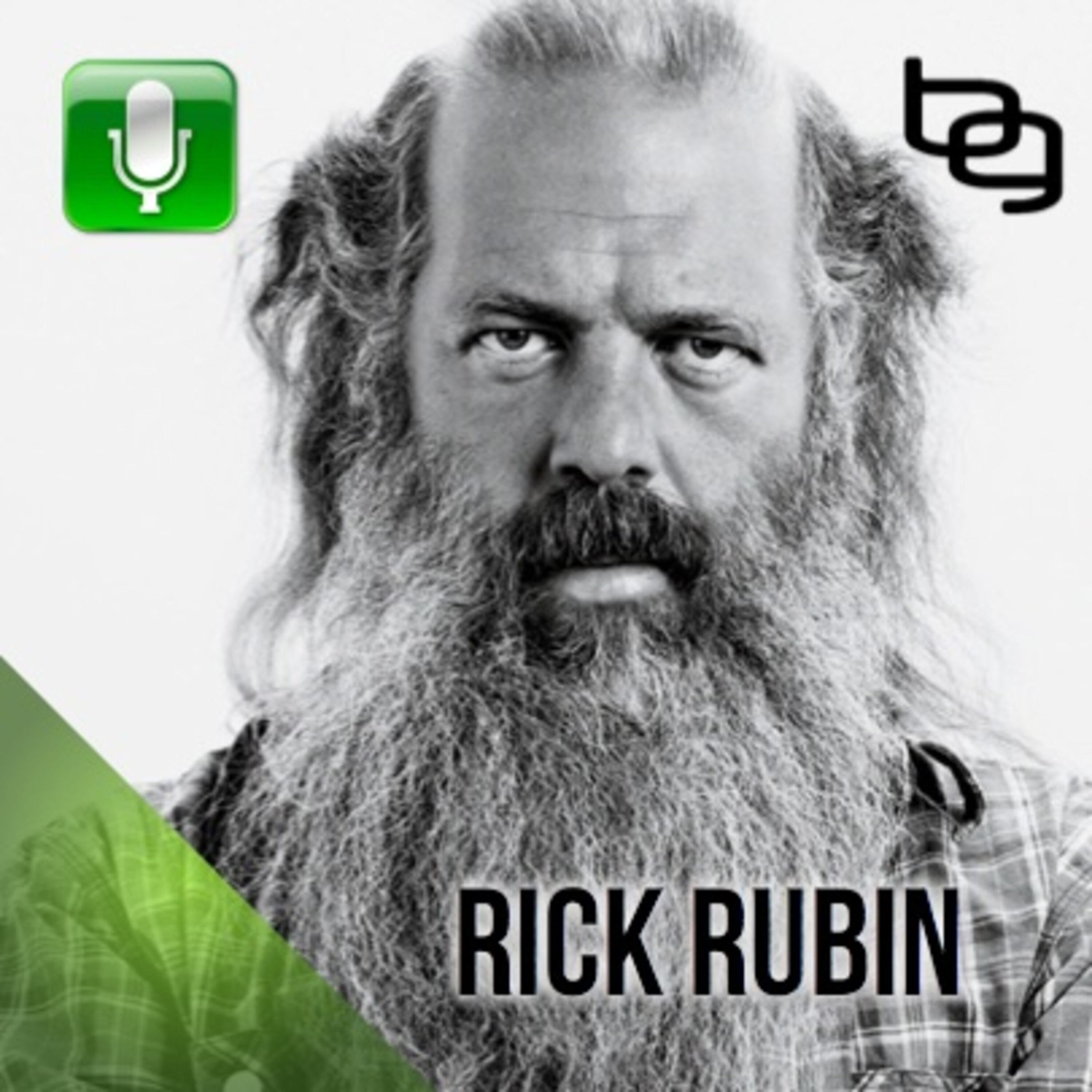
How To Lose 131 Pounds By Eating Meat: The Rick Rubin Podcast
What do the Red Hot Chili Peppers, Kanye West, Johnny Cash, The Black Crowes, Slayer, Jay Z, James Blake, Dixie Chicks, Tom Petty and the Heartbreakers, Black Sabbath, Slipknot, Metallica, AC/DC, Aerosmith, Weezer, Linkin Park, The Cult, Neil Diamond, The Avett Brothers, Adele, Mick Jagger, System of a Down, Rage Against the Machine, Audioslave, Sheryl Crow, ZZ Top, Lady Gaga, Shakira, Ed Sheeran, Damien Rice, Eminem, and just about every other world-famous band or musician you've ever heard of have in common?
They were all produced by today's podcast guest: Rick Rubin, the American record producer and former co-president of Columbia Records. In 2007, MTV called Rick "the most important producer of the last 20 years", and the same year he appeared on Time's 100 Most Influential People in the World list. Rapper Dr. Dre has stated that Rubin is, "hands down, the dopest producer ever that anyone would ever want to be, ever." But Rick has a personal passion outside of music that many people don't know about... ...health, nutrition, fitness and biohacking.
And in this episode, in which Rick and I sit on his back porch, watching a relaxing sunset after a hard morning of Laird Hamilton's pool workout, we have an intense discussion about veganism vs. Paleo, Rick's weight loss journey, and much more. During our discussion, you'll discover:
-The little-known Ayurvedic pulse taking technique Rick used to find out he need to "drink more bone broth"...[16:10] -
Why Rick thinks an ice bath is very much like eating meat...[26:25]
-How Rick lost 131 pounds by eating animal protein...[29:45]
-Why Rick took an entire week to eat one steak...[28:56]
-What legendary Ironman coach and physician Dr. Phil Maffetone told Rick to do for diet and exercise, and how Rick modified it...[37:35 & 41:05]
-What a typical day is like for Rick...[54:25]
-How Rick uses "transcendental meditation", and his insight into neurofeedback for the brain...[57:20]
-Rick's unique dietary and supplementation routine he uses each day...[60:35]
-The one herb Rick uses each day to decrease hunger and sugar cravings...[68:00]
-Rick's standing workstation setup...[68:55]
-Why Rick uses a projector instead of a television or computer to watch movies at night...[73:45 ]
-The audio track that Rick falls asleep to each night...[76:30]
-What is it that drives Rick to live the life he lives...[79:30]
-And much more!
Resources from this episode: -My article on "hacking" an infrared sauna -The Ayurvedic pulse taking technique Rick refers to -Don Wildman's "Hardest Workout In The World" article from Esquire magazine -Phil Maffetone's "Big Book of Health and Fitness: A Practical Guide to Diet, Exercise, Healthy Aging, Illness Prevention, and Sexual Well-Being" -My podcast on Transcendental Meditation -My neurofeedback EEG training experience -The full recipe for Rick's Stim-Stem Shake
- Espresso
- Chocolate whey protein
- Bulletproof Collogelatin
- Glutamine
- Chocolate Stevia
- Bulletproof Brain Octane
- Organic Cocoa Nibs
- Organic Cocoa Powder
- Organic Aloe Vera Juice
- Ocean's Alive Marine Phytoplankton
- Ice to desired texture
-NatureAminos amino acids -The herb Rick uses to decrease hunger and sugar cravings -The Kybounder Mat Rick uses under his standing workstation -Sleeping Monk tea -Natural Calm Magnesium powder -The alternative to Natural Calm Magnesium powder that Ben uses -Below is the Natural Calm Magnesium reply that Ben mentioned regarding heavy metals:
In regards to the Arsenic levels that Labdoor has decided to use, it is from a proposed limit over 10 years that was NEVER approved or accepted. The current established level for Arsenic is 10mcg/day. Why Labdoor decided to use a never approved or accepted proposal in unclear. In regards to the Natural Calm supplement, here is Natural Vitality's official statement on it: "The simple truth is that Natural Calm both meets its potency label claim and is well within the No Significant Risk Levels for arsenic and in fact is less than 10 percent of California’s Prop 65 stringent safe threshold levels. This has been consistently scientifically validated by third party test results from top American testing labs as part of standard Good Manufacturing Practices. While testing results commissioned by Labdoor, when correctly interpreted, align perfectly with our results, their report contains a number of distortions which provide both a highly inaccurate picture and a disservice to consumers. We believe Labdoor is attempting to use our well-deserved, award-winning reputation to inflate their importance. Apparently their business model involves casting themselves as a “trusted source” by creating sensationalized stories to drive traffic to their website with the objective of creating profit from advertising sales and, interestingly, sales of supplements.
Factual Flaws
Labdoor’s Natural Calm test size was over two and a half times our recommended serving size but they did not factor that into their analysis. When correctly interpreted our results read: Magnesium was 346 mg, about a 1% variance from our label claim of 350 mg. Arsenic was .7992 of a microgram. Less than 8% of the California Prop 65 No Significant Risk safe threshold.
Labdoor was approached regarding their misinterpretation of the results and asked to retract their press release, send out a corrected press release and update their website.
However, Labdoor refused to admit wrong doing of any kind and continues to assert the virtue of their inaccurate position.
At this point, both through the correct interpretation of the assay provided to us from Labdoor and our retest of the lot in question, Natural Calm has been clearly shown to be accurate both in terms of label claim and in following California’s Prop 65. The laboratory used by both Labdoor and Natural Vitality was the highly regarded Covance laboratories. Covance’s interpretation of test results (both Labdoors and ours) validates our position in terms of label claim and purity.
Additional information is available at Natural Vitality customer service if desired (info@naturalvitality.com).
Having cleared the record with scientific facts, we now consider this matter closed."
I would be happy to provide you with the Certificate of Analysis that we had performed on an actual servings size instead of the 10.66g that Labdoor used, which is 2.5x our suggested serving size.
-The ZMA supplement you can use before bed at night for minerals-The Jack Kornfield spiritual teaching download at DharmaSeed.com -Ben's article on BPC-157 peptides for muscle gain and fat loss -Ben's article on TB-500 peptides for muscle gain and fat loss -Ben's article on SARMs for muscle gain and fat loss -The NatureColostrum Ben recommends for muscle gain -The NatureAminos Ben recommends for muscle gain -The SuperEssentials Fish Oil Ben recommends for muscle gain
Do you have questions, comments or feedback for Rick or me? Leave your thoughts at BenGreenfieldFitness.com and one of us will reply!
See omnystudio.com/listener for privacy information.
Available Results
Generated results are saved to your library for reuse and search.
Choose Template
Pick the result you want. You can review provider and model before generating.
A concise first-pass summary for understanding the episode quickly.
A comprehensive, source-grounded extraction of the reusable knowledge in an episode.
A comprehensive extraction focused on health practices, protocols, claims, and safety caveats.
A dedicated analysis of warnings, limitations, trade-offs, weak evidence, and uncertainty.
Repeatable methods, frameworks, mental models, processes, and systems.
A comprehensive extraction focused on opportunities, strategy, markets, and company building.
A concise first-pass summary for understanding the episode quickly.
A detailed readable summary organized by chapter or topic.
A navigable map of subjects, topic flow, and suggested chapters.
A comprehensive, source-grounded extraction of the reusable knowledge in an episode.
Reusable atomic knowledge units extracted from the episode.
A comprehensive extraction focused on health practices, protocols, claims, and safety caveats.
A comprehensive extraction focused on opportunities, strategy, markets, and company building.
Explicit actions, next steps, habits, recommendations, and things to avoid.
A dedicated inventory of concrete resources named in the episode.
A dedicated analysis of warnings, limitations, trade-offs, weak evidence, and uncertainty.
A concise first-pass summary for understanding the episode quickly.
A detailed readable summary organized by chapter or topic.
A navigable map of subjects, topic flow, and suggested chapters.
A comprehensive, source-grounded extraction of the reusable knowledge in an episode.
Reusable atomic knowledge units extracted from the episode.
A comprehensive extraction focused on health practices, protocols, claims, and safety caveats.
A comprehensive extraction focused on opportunities, strategy, markets, and company building.
Scientific findings, mechanisms, studies, hypotheses, and the limits of the evidence discussed.
Technologies, AI models, technical methods, capabilities, limitations, and adoption implications.
Investment theses, assets, catalysts, valuation reasoning, time horizons, and risks.
Chronologies, actors, causes, consequences, turning points, and competing historical interpretations.
Policies, proposals, stakeholders, arguments, implementation constraints, and predicted effects.
Career paths, skills, hiring signals, workplace decisions, transitions, and limitations of the advice.
Behavioral mechanisms, biases, motivation, habits, emotions, interventions, and evidence limitations.
Economic mechanisms, incentives, indicators, market structure, forecasts, and uncertainty.
Leadership principles, team systems, organizational design, culture, feedback, and failure modes.
Audience, positioning, messaging, acquisition, retention, experiments, metrics, and failed approaches.
Teaching methods, learning strategies, practice, feedback, assessment, and effectiveness evidence.
Theses, premises, arguments, objections, values, thought experiments, and unresolved questions.
Communication patterns, conflict, boundaries, expectations, repair methods, and contextual limitations.
Books, papers, authors, courses, and other learning resources mentioned in the episode.
Repeatable methods, frameworks, mental models, processes, and systems.
Explicit actions, next steps, habits, recommendations, and things to avoid.
Memorable statements and important claims with attribution and source context.
A dedicated inventory of concrete resources named in the episode.
A dedicated analysis of warnings, limitations, trade-offs, weak evidence, and uncertainty.