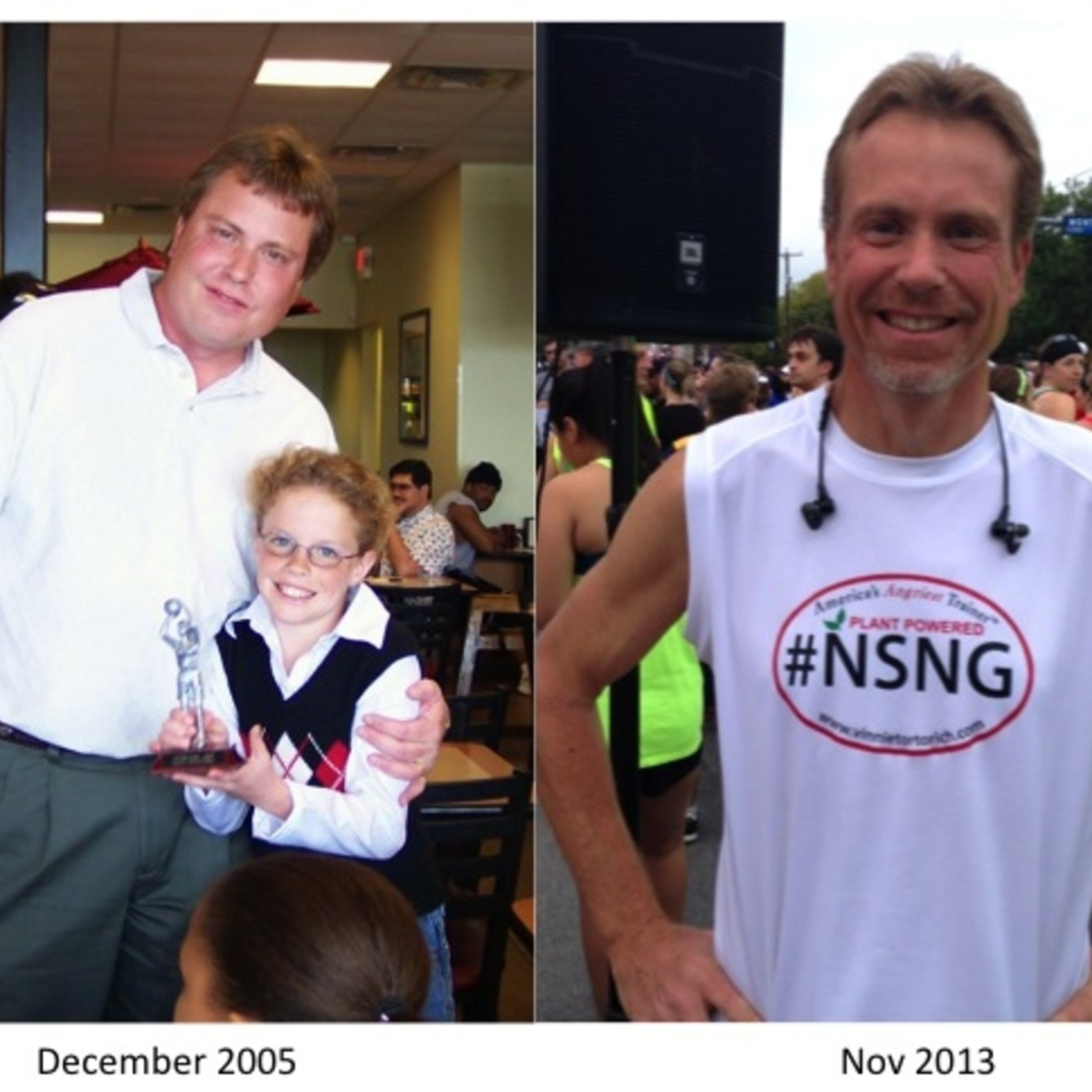
Podcast INSIDER: How To Lose 75 Pounds by Eating Plants - Premium Podcast!
BJ Tucker is a long distance runner, health advocate, father of 5 and has been married for 28 years.
His journey started 2 1/2 years ago when he was tired of being overweight, tired and not able to walk up a flight of stairs without losing his breath.
So he started eating plants. And running. And eliminating alcohol and grains. Since then he has lost 75 pounds, and become a successful long distance runner with achievements like back-to-back marathons. BJ recently featured my "10 Steps To Mastering A Plant Based Diet" post on his website. Why was BJ so interested in that? Because BJ is a self-described "plant-powered athlete". He eats no meat. So in today's audio podcast, I ask BJ: Questions:
-How did you lose 75 pounds over the past 2 years?
-Where did alcohol fit into the picture for you?
-How do you manage to eat a plant-based diet and yet go, as Vinnie Tortorich says, "NSNG"? Aren't grains very common on a plant-based diet?
-It's no secret that plant-based diets often contradict what I personally recommend here at BenGreenfieldFitness - namely a high-fat diet combined with avoidance of long, slow cardio. But you eat a plant-based diet and run long distances. Are you concerned about your blood work, hormones or gut, or do you pay attention to that?
-What's your running protocol look like? Do you have any special strategies you want to share, such as run-walk protocols, pacing methods, etc?
-Do you strength train, and if so, what do you do?
-How do you manage 5 kids, a successful marriage and long distance running? Any tips for our audience?
-Does your family also eat a plant-based diet? If so, do your kids ever ask about eating meat?
Do you have questions, comments or feedback about how to lose 75 pounds by eating plants? Leave your questions, comments and feedback at BenGreenfieldFitness.com and BJ or I will reply!
See omnystudio.com/listener for privacy information.
Available Results
Generated results are saved to your library for reuse and search.
Choose Template
Pick the result you want. You can review provider and model before generating.
A concise first-pass summary for understanding the episode quickly.
A comprehensive, source-grounded extraction of the reusable knowledge in an episode.
A comprehensive extraction focused on health practices, protocols, claims, and safety caveats.
A dedicated analysis of warnings, limitations, trade-offs, weak evidence, and uncertainty.
Repeatable methods, frameworks, mental models, processes, and systems.
Technologies, AI models, technical methods, capabilities, limitations, and adoption implications.
A concise first-pass summary for understanding the episode quickly.
A detailed readable summary organized by chapter or topic.
A navigable map of subjects, topic flow, and suggested chapters.
A comprehensive, source-grounded extraction of the reusable knowledge in an episode.
Reusable atomic knowledge units extracted from the episode.
A comprehensive extraction focused on health practices, protocols, claims, and safety caveats.
A comprehensive extraction focused on opportunities, strategy, markets, and company building.
Explicit actions, next steps, habits, recommendations, and things to avoid.
A dedicated inventory of concrete resources named in the episode.
A dedicated analysis of warnings, limitations, trade-offs, weak evidence, and uncertainty.
A concise first-pass summary for understanding the episode quickly.
A detailed readable summary organized by chapter or topic.
A navigable map of subjects, topic flow, and suggested chapters.
A comprehensive, source-grounded extraction of the reusable knowledge in an episode.
Reusable atomic knowledge units extracted from the episode.
A comprehensive extraction focused on health practices, protocols, claims, and safety caveats.
A comprehensive extraction focused on opportunities, strategy, markets, and company building.
Scientific findings, mechanisms, studies, hypotheses, and the limits of the evidence discussed.
Technologies, AI models, technical methods, capabilities, limitations, and adoption implications.
Investment theses, assets, catalysts, valuation reasoning, time horizons, and risks.
Chronologies, actors, causes, consequences, turning points, and competing historical interpretations.
Policies, proposals, stakeholders, arguments, implementation constraints, and predicted effects.
Career paths, skills, hiring signals, workplace decisions, transitions, and limitations of the advice.
Behavioral mechanisms, biases, motivation, habits, emotions, interventions, and evidence limitations.
Economic mechanisms, incentives, indicators, market structure, forecasts, and uncertainty.
Leadership principles, team systems, organizational design, culture, feedback, and failure modes.
Audience, positioning, messaging, acquisition, retention, experiments, metrics, and failed approaches.
Teaching methods, learning strategies, practice, feedback, assessment, and effectiveness evidence.
Theses, premises, arguments, objections, values, thought experiments, and unresolved questions.
Communication patterns, conflict, boundaries, expectations, repair methods, and contextual limitations.
Books, papers, authors, courses, and other learning resources mentioned in the episode.
Repeatable methods, frameworks, mental models, processes, and systems.
Explicit actions, next steps, habits, recommendations, and things to avoid.
Memorable statements and important claims with attribution and source context.
A dedicated inventory of concrete resources named in the episode.
A dedicated analysis of warnings, limitations, trade-offs, weak evidence, and uncertainty.