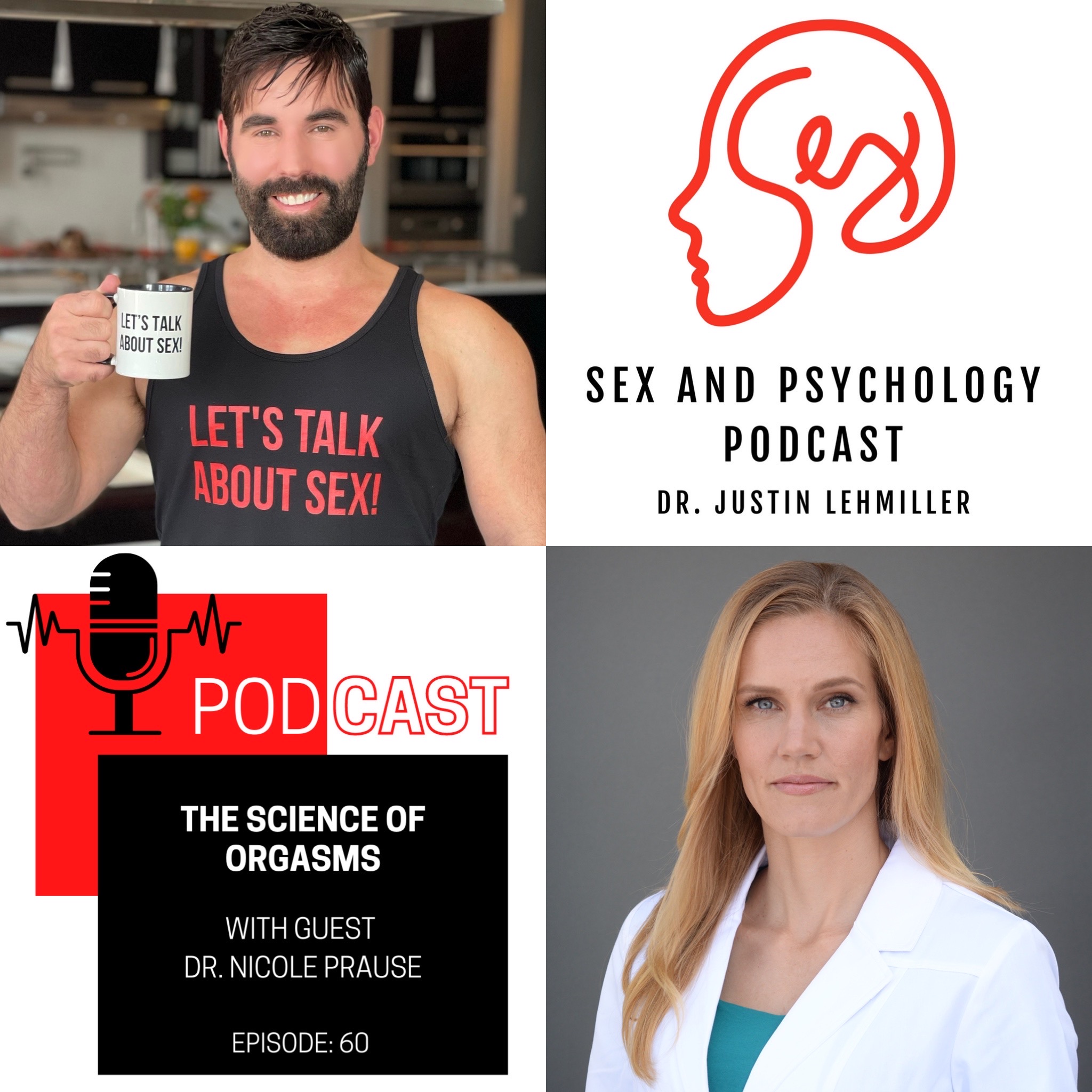
Episode 60: The Science of Orgasms
What does it really mean to have an orgasm? Different people—and even different scientists—define “orgasm” in different ways, which makes this a surprisingly difficult subject to study scientifically. So how do you measure when someone has an orgasm in a research lab? For this episode, I spoke to an orgasm researcher who has figured out how to do it. Her methods and findings are absolutely fascinating and will change everything you think you know about orgasms!
My guest today is Dr. Nicole Prause, a licensed psychologist and sex researcher who founded the sexual biotechnology company Liberos. She is a former Kinsey Institute trainee and has published an extensive body of research on the neuroscience and psychophysiology of sex.
Some of the topics we explore in this episode include:
- What technology do you need to study orgasms scientifically?
- Orgasms have both a physiological and a psychological component—but they don’t always line up in the same way for everyone. So what does it mean when someone experiences one but not the other?
- What does it actually mean to have multiple orgasms? Are we talking back-to-back orgasms with continued sexual stimulation? Can you take breaks? How much time can pass between each orgasm for it to count as “multiple?”
- Is there really a gender difference in the ability to have multiple orgasms? (The answer may surprise you!)
- Some people get sick every time they orgasm. What causes this post-orgasmic illness syndrome?
- Are there really different “types” of orgasms, or are all orgasms technically the same process?
- What happens inside the brain during an orgasm?
- For people who have trouble orgasming, what can they do about it?
This podcast was made on Zencastr. Join Zencastr today and receive 40% off of their professional plan for 3 months with my exclusive discount code: sexandpsych
***
Want to learn more about Sex and Psychology? Click here for previous articles or follow the blog on Facebook, Twitter, or Reddit to receive updates. You can also follow Dr. Lehmiller on YouTube and Instagram.
Listen and stream all episodes on Apple, Spotify, Google, or Amazon. Subscribe to automatically receive new episodes and please rate and review the podcast!
Credits: LEGIT Audio (Podcast editing) and Shutterstock/Florian (Music). Image created with Canva; photos used with permission of guest.
Available Results
Generated results are saved to your library for reuse and search.
Choose Template
Pick the result you want. You can review provider and model before generating.
A concise first-pass summary for understanding the episode quickly.
A comprehensive, source-grounded extraction of the reusable knowledge in an episode.
A comprehensive extraction focused on opportunities, strategy, markets, and company building.
Explicit actions, next steps, habits, recommendations, and things to avoid.
Repeatable methods, frameworks, mental models, processes, and systems.
A dedicated inventory of concrete resources named in the episode.
A concise first-pass summary for understanding the episode quickly.
A detailed readable summary organized by chapter or topic.
A navigable map of subjects, topic flow, and suggested chapters.
A comprehensive, source-grounded extraction of the reusable knowledge in an episode.
Reusable atomic knowledge units extracted from the episode.
A comprehensive extraction focused on health practices, protocols, claims, and safety caveats.
A comprehensive extraction focused on opportunities, strategy, markets, and company building.
Explicit actions, next steps, habits, recommendations, and things to avoid.
A dedicated inventory of concrete resources named in the episode.
A dedicated analysis of warnings, limitations, trade-offs, weak evidence, and uncertainty.
A concise first-pass summary for understanding the episode quickly.
A detailed readable summary organized by chapter or topic.
A navigable map of subjects, topic flow, and suggested chapters.
A comprehensive, source-grounded extraction of the reusable knowledge in an episode.
Reusable atomic knowledge units extracted from the episode.
A comprehensive extraction focused on health practices, protocols, claims, and safety caveats.
A comprehensive extraction focused on opportunities, strategy, markets, and company building.
Scientific findings, mechanisms, studies, hypotheses, and the limits of the evidence discussed.
Technologies, AI models, technical methods, capabilities, limitations, and adoption implications.
Investment theses, assets, catalysts, valuation reasoning, time horizons, and risks.
Chronologies, actors, causes, consequences, turning points, and competing historical interpretations.
Policies, proposals, stakeholders, arguments, implementation constraints, and predicted effects.
Career paths, skills, hiring signals, workplace decisions, transitions, and limitations of the advice.
Behavioral mechanisms, biases, motivation, habits, emotions, interventions, and evidence limitations.
Economic mechanisms, incentives, indicators, market structure, forecasts, and uncertainty.
Leadership principles, team systems, organizational design, culture, feedback, and failure modes.
Audience, positioning, messaging, acquisition, retention, experiments, metrics, and failed approaches.
Teaching methods, learning strategies, practice, feedback, assessment, and effectiveness evidence.
Theses, premises, arguments, objections, values, thought experiments, and unresolved questions.
Communication patterns, conflict, boundaries, expectations, repair methods, and contextual limitations.
Books, papers, authors, courses, and other learning resources mentioned in the episode.
Repeatable methods, frameworks, mental models, processes, and systems.
Explicit actions, next steps, habits, recommendations, and things to avoid.
Memorable statements and important claims with attribution and source context.
A dedicated inventory of concrete resources named in the episode.
A dedicated analysis of warnings, limitations, trade-offs, weak evidence, and uncertainty.