Trouble is My Travel Agent
"Yeah, danger is my assignment. I get sent to a lot of places I can't even pronounce. They all spell the same thing, though - trouble."
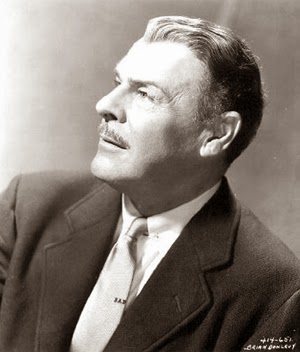
In the years during and after World War II, radio's gumshoes and beat cops were joined by international secret agents; these globe-trotting detectives worked at home and abroad to keep America and her interests safe from the enemy agents, saboteurs, and black marketers who threatened the stability of the post-war world. Previously, we heard the exploits of Ken Thurston, better known as The Man Called X, a debonair and urbane agent. Another member of the fraternity was Steve Mitchell, more two-fisted than Thurston but just as capable. As played by big screen star Brian Donlevy, Mitchell was dispatched all around the world from 1949 to 1953 in Dangerous Assignment. It was a terrific espionage adventure program anchored by Donlevy's lead performance.
Though it was never clearly explained which agency employed Steve Mitchell, it was clear he was operating on behalf of the U.S. Government. At the beginning of each episode, Mitchell received his assignment from "The Commissioner" (played by Herb Butterfield, who also doled out cases as Anthony J. Lyon on Jeff Regan, Investigator). Usually undercover as a foreign correspondent, Mitchell would catch a plane to a far-off locale to investigate a threat to America. But where the Man Called X was sophisticated and suave, Mitchell was a hard-boiled spy. Steve Mitchell was more likely to end up in the jungle or hiding in the sand dunes than he was to move in and out of high society parties. It's almost impossible to listen to Herbert Marshall as Ken Thurston and not imagine him in an immaculately tailored suit. It's equally difficult to hear Steve Mitchell and imagine him outside of dungarees and fatigues. The actor who gave voice to the man of action was one who had his own share of derring-do in real life, Brian Donlevy.
At age 14, Donlevy lied about his age to join the Army. In 1916, he served under General John J. Pershing in the Army's pursuit of Pancho Villa, and he served as a pilot with the French Air Force during World War I. Ultimately, he abandoned his military career for acting and broke into Hollywood in silent pictures in the 1920s. Donlevy earned an Oscar nomination for his role in Beau Geste in 1939, and the following year found some of his greatest success in the title role of Preston Sturges' The Great McGinty - a bum who ends up in the governor's mansion. Donlevy could play tough guys with the best of them, but he also managed to find the likable aspects of a character. His brutes were never wholly brutish, a quality that served him well in a number of 1940s film noir performances, including Kiss of Death in 1947.
Dangerous Assignment went on the air in the summer of 1949. NBC had recently lost The Man Called X, and the network was eager for another adventure series to fill the void. Brian Donlevy was heavily involved in the production of the series, and he approached NBC about getting the program on the air. After the summer run ended, NBC brough Dangerous Assignment back in February 1950. In late 1950, The Man Called X returned to NBC, and the programs aired back to back from 1950 to 1951. In 1952, Steve Mitchell's adventures came to television for 39 episodes. Donlevy not only reprised his role, but he produced the TV version as well. Also along for the TV series was Herb Butterfield as "The Commissioner."
The series was well produced, offering a variety of locations and adventures rounded out by the great Hollywood radio acting pool. In his tenure on the air, Steve Mitchell investigated deaths of fellow agents, pursued saboteurs, and tried to maintain America's sphere of influence. In one episode, the enemy spreads rumors that the United States is backing a coup in a South American country; Mitchell is dispatched to set the record straight and to stop the rumors. In the show we'll hear on the podcast this week, the theft of several barrels of oil jeopardizes the export of oil to the States. Scripts by Robert Ryf (a frequent contributor to Yours Truly, Johnny Dollar) and the driving score by Bruce Ashley helped to create a sense of atmosphere and foreign intrigue.
Available Results
Generated results are saved to your library for reuse and search.
Choose Template
Pick the result you want. You can review provider and model before generating.
A concise first-pass summary for understanding the episode quickly.
A comprehensive, source-grounded extraction of the reusable knowledge in an episode.
Technologies, AI models, technical methods, capabilities, limitations, and adoption implications.
Repeatable methods, frameworks, mental models, processes, and systems.
A dedicated analysis of warnings, limitations, trade-offs, weak evidence, and uncertainty.
A dedicated inventory of concrete resources named in the episode.
A concise first-pass summary for understanding the episode quickly.
A detailed readable summary organized by chapter or topic.
A navigable map of subjects, topic flow, and suggested chapters.
A comprehensive, source-grounded extraction of the reusable knowledge in an episode.
Reusable atomic knowledge units extracted from the episode.
A comprehensive extraction focused on health practices, protocols, claims, and safety caveats.
A comprehensive extraction focused on opportunities, strategy, markets, and company building.
Explicit actions, next steps, habits, recommendations, and things to avoid.
A dedicated inventory of concrete resources named in the episode.
A dedicated analysis of warnings, limitations, trade-offs, weak evidence, and uncertainty.
A concise first-pass summary for understanding the episode quickly.
A detailed readable summary organized by chapter or topic.
A navigable map of subjects, topic flow, and suggested chapters.
A comprehensive, source-grounded extraction of the reusable knowledge in an episode.
Reusable atomic knowledge units extracted from the episode.
A comprehensive extraction focused on health practices, protocols, claims, and safety caveats.
A comprehensive extraction focused on opportunities, strategy, markets, and company building.
Scientific findings, mechanisms, studies, hypotheses, and the limits of the evidence discussed.
Technologies, AI models, technical methods, capabilities, limitations, and adoption implications.
Investment theses, assets, catalysts, valuation reasoning, time horizons, and risks.
Chronologies, actors, causes, consequences, turning points, and competing historical interpretations.
Policies, proposals, stakeholders, arguments, implementation constraints, and predicted effects.
Career paths, skills, hiring signals, workplace decisions, transitions, and limitations of the advice.
Behavioral mechanisms, biases, motivation, habits, emotions, interventions, and evidence limitations.
Economic mechanisms, incentives, indicators, market structure, forecasts, and uncertainty.
Leadership principles, team systems, organizational design, culture, feedback, and failure modes.
Audience, positioning, messaging, acquisition, retention, experiments, metrics, and failed approaches.
Teaching methods, learning strategies, practice, feedback, assessment, and effectiveness evidence.
Theses, premises, arguments, objections, values, thought experiments, and unresolved questions.
Communication patterns, conflict, boundaries, expectations, repair methods, and contextual limitations.
Books, papers, authors, courses, and other learning resources mentioned in the episode.
Repeatable methods, frameworks, mental models, processes, and systems.
Explicit actions, next steps, habits, recommendations, and things to avoid.
Memorable statements and important claims with attribution and source context.
A dedicated inventory of concrete resources named in the episode.
A dedicated analysis of warnings, limitations, trade-offs, weak evidence, and uncertainty.