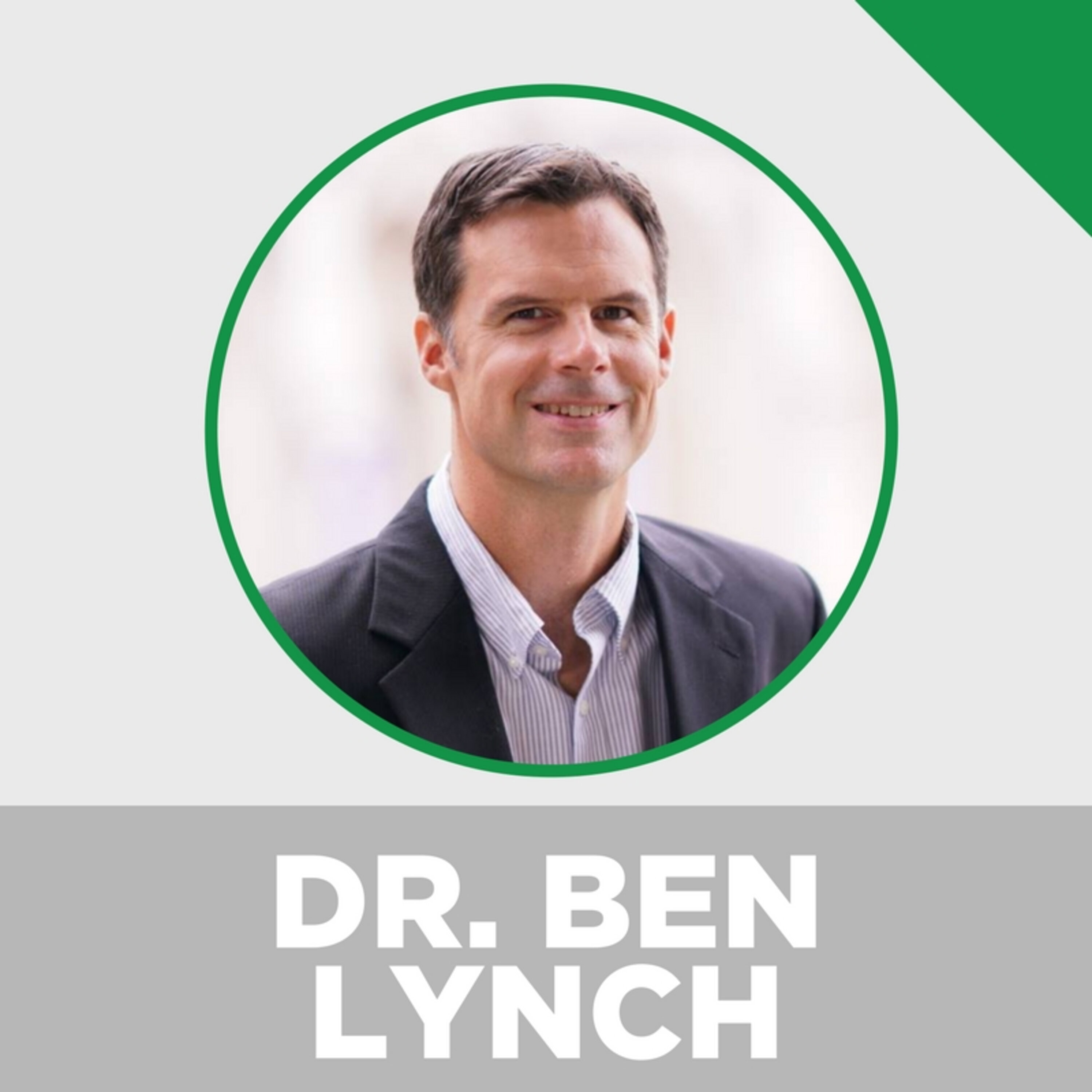
How To Fix Dirty Genes, Interpret Your Genetic Testing Results, Go Beyond 23AndMe Genetic Testing & More With Dr. Ben Lynch.
https://bengreenfieldfitness.com/benlynch
If you've ever tested your genes (or wanted to) and had a completely head-scratching experience when it comes to interpreting your results or translating your genetic testing results into actionable information, then today's podcast is right up your alley, as I interview Dr. Ben Lynch, one of the world's leading authorities in interpreting and "fixing" your genes.
Dr. Lynch, ND received his Cell and Molecular Biology, BS from the University of Washington and his doctorate in Naturopathic Medicine (ND) from Bastyr University. His passion for identifying the cause of disease directed him towards nutrigenomics and methylation dysfunction. Currently, he researches, writes and presents worldwide on the topic of MTHFR, methylation defects and genetic control. Dr. Lynch is the President of www.SeekingHealth.com, a supplement company oriented towards disease prevention and health promotion. He also founded and directs www.SeekingHealth.org, an educational institute providing specialized training for both health professionals and consumers. He lives in Seattle, WA with his wife, Nadia, and three boys, Tasman, Mathew and Theodor. He first discovered the power of epigenetics in 2008. At the time, he was a Doctor of Naturopathic Medicine, graduate of Bastyr University, with a special interest in environmental medicine—helping people recover from the assaults of industrial chemicals, heavy metals, and other environmental toxins. When he discovered what a big role genes played in this whole process, he began eagerly reading every scientific paper he could get is hands on.
Dr. Lynch quickly realized that there was a huge gap between what the geneticists published in their research papers and what the medical providers practiced in their offices. The scientists were ridiculously far ahead of doctors and nurses, who often had no idea how to help their patients respond to genetic abnormalities or even to follow the basics of good gene health. Nor did practitioners have any idea how to create a targeted program geared to specific genetic issues. So he made it his mission to bring that cutting-edge science right into the doctor’s office. He threw himself into genetic research, chasing down any article or paper that could shed any light on what we regular folks could do to improve health. He began working with individuals whose health-care providers just weren’t giving them the help they needed. And he started to give seminars, webinars, workshops, and talks so that practitioners could learn how to help their patients. In a remarkably short time, he had established himself as the go-to guy on treating genetic abnormalities through diet, supplements, and lifestyle. In 2011, he founded Seeking Health, a research-based company producing high-quality supplements targeted to particular health issues. In 2015, he was named Number 37 in Inc.’s list of 500 Entrepreneur Superstars from America’s fastest-growing private companies and Number 1 in Washington state. In 2016, he made the list again. He also established Seeking Health Educational Institute (SHEI), a website for both health professionals and lay people who want to learn more about nutrigenomics and methylation. SHEI quickly became one of the most trusted resources on genetics for health professionals and laypersons worldwide. In 2015, he developed StrateGene, a unique approach to helping people develop natural strategies for overcoming genetic abnormalities. People who were getting their genetic challenges from websites like 23andMe or Genos Research were receiving massively confusing documents with wildly contradictory information. His system zeroes in on the genetic abnormalities that pose the greatest challenges in people’s health and then provides comprehensive plans for overcoming those challenges through diet, environment and lifestyle.
During our discussion, you'll discover:
-How Dr. Lynch first become interested in genetic and genes, despite this being uncommon in naturopathic medicine...[8:30]
-Why most genetic analysis programs give you a ton of clinically irrelevant info, when most of it is not what you actually need...[11:30 & 26:00]
-How to upload your raw 23andme data into a website like Stratagene to get very relevant information about your genes...[29:30 & 31:20]
-How the "warrior" vs. "worrier" gene works, and what you can do if you are a worrier...[34:50]
-Examples of very common SNP "issues", and what the impact of those is, along with potential associated symptoms and conditions and what you can do about it...[44:15]
-Why you should consume bifidobacter probiotics, SAM-e and molybdenum, when you drink wine or other alcohol...[60:55]
-How to know what your own "dirty genes" are...[65:30]
-And much more...
Resources from this episode:-Ben Lynch's website, and Stratagene -My own personal Stratagene results -23andMe genetic testing -23andyou.com -The LowHistamineChef.com
Show Sponsors:
-eHarmony - Come see how eHarmony can change your life. Go to eHarmony.com and get started. Enter my code GREEN at checkout to get a FREE month with every 3-month subscription.
-Organifi - Go to BenGreenfieldFitness.com/Organifi and use discount code BEN for 20% your order.
-Human Charger - Go to HumanCharger.com/Ben and use the code BEN20 for 20% off.
-Bob's Red Mill - Head to BobsRedMill.com to get 25% off with promo code GREENFIELD.
Do you have questions, thoughts or feedback for Dr. Lynch or me? Leave your comments at BenGreenfieldFitness.com and one of us will reply!
See omnystudio.com/listener for privacy information.
Available Results
Generated results are saved to your library for reuse and search.
Choose Template
Pick the result you want. You can review provider and model before generating.
A concise first-pass summary for understanding the episode quickly.
A comprehensive, source-grounded extraction of the reusable knowledge in an episode.
A comprehensive extraction focused on health practices, protocols, claims, and safety caveats.
A dedicated analysis of warnings, limitations, trade-offs, weak evidence, and uncertainty.
Repeatable methods, frameworks, mental models, processes, and systems.
A comprehensive extraction focused on opportunities, strategy, markets, and company building.
A concise first-pass summary for understanding the episode quickly.
A detailed readable summary organized by chapter or topic.
A navigable map of subjects, topic flow, and suggested chapters.
A comprehensive, source-grounded extraction of the reusable knowledge in an episode.
Reusable atomic knowledge units extracted from the episode.
A comprehensive extraction focused on health practices, protocols, claims, and safety caveats.
A comprehensive extraction focused on opportunities, strategy, markets, and company building.
Explicit actions, next steps, habits, recommendations, and things to avoid.
A dedicated inventory of concrete resources named in the episode.
A dedicated analysis of warnings, limitations, trade-offs, weak evidence, and uncertainty.
A concise first-pass summary for understanding the episode quickly.
A detailed readable summary organized by chapter or topic.
A navigable map of subjects, topic flow, and suggested chapters.
A comprehensive, source-grounded extraction of the reusable knowledge in an episode.
Reusable atomic knowledge units extracted from the episode.
A comprehensive extraction focused on health practices, protocols, claims, and safety caveats.
A comprehensive extraction focused on opportunities, strategy, markets, and company building.
Scientific findings, mechanisms, studies, hypotheses, and the limits of the evidence discussed.
Technologies, AI models, technical methods, capabilities, limitations, and adoption implications.
Investment theses, assets, catalysts, valuation reasoning, time horizons, and risks.
Chronologies, actors, causes, consequences, turning points, and competing historical interpretations.
Policies, proposals, stakeholders, arguments, implementation constraints, and predicted effects.
Career paths, skills, hiring signals, workplace decisions, transitions, and limitations of the advice.
Behavioral mechanisms, biases, motivation, habits, emotions, interventions, and evidence limitations.
Economic mechanisms, incentives, indicators, market structure, forecasts, and uncertainty.
Leadership principles, team systems, organizational design, culture, feedback, and failure modes.
Audience, positioning, messaging, acquisition, retention, experiments, metrics, and failed approaches.
Teaching methods, learning strategies, practice, feedback, assessment, and effectiveness evidence.
Theses, premises, arguments, objections, values, thought experiments, and unresolved questions.
Communication patterns, conflict, boundaries, expectations, repair methods, and contextual limitations.
Books, papers, authors, courses, and other learning resources mentioned in the episode.
Repeatable methods, frameworks, mental models, processes, and systems.
Explicit actions, next steps, habits, recommendations, and things to avoid.
Memorable statements and important claims with attribution and source context.
A dedicated inventory of concrete resources named in the episode.
A dedicated analysis of warnings, limitations, trade-offs, weak evidence, and uncertainty.